The Pakistan Super League has adopted a home-and-away kit system in recent years, mirroring global sports trends. Yet, the league has never had a fully functional home venue structure for all its franchises.
This inconsistency is best reflected in the case of Quetta Gladiators, who have effectively maintained a single kit as their primary identity rather than a clearly defined home-and-away distinction.
In a system where not every team regularly plays at home, the idea of separate kits has always lacked a firm structural foundation. This year, with the tournament largely restricted to Lahore and Karachi, that structural gap has become more visible than ever.
Where the Structural Disconnect Lies
The issue is not simply about aesthetics—it is about coherence. This year, PSL is being held only in Lahore and Karachi. Therefore, home and away kits for a team like Peshawar Zalmi or Multan Sultans make no sense.
Even when PSL’s schedule is normal, PSL franchises do not operate in a true home-and-away model: some teams, such as Quetta Gladiators and Hyderabad Kingsmen, lack consistent access to their home cities, while Faisalabad city hosts matches without representing any franchise.
This weakens the fundamental logic behind differentiated kits. In traditional sports ecosystems, home and away kits reflect geography and rivalry; in PSL, they risk becoming interchangeable visuals without a grounded narrative.
PSL’s Rationale: Commercial Logic and Global Influence
In leagues with a proper home-and-away format, the “home kit” represents a team’s core identity—its city, colours, and culture—while the “away kit” is a secondary strip used when playing in an opponent’s territory. This reinforces the idea of territorial competition, where each team has a defined base and a home ground.
Multiple kits create additional revenue streams. Fans often buy both home and away jerseys, and sponsors gain more inventory for visibility. Many clubs also release third kits or special editions for the same reason.
The system is deeply rooted in sports like football, where leagues operate strictly on home-and-away structures. Cricket leagues that follow a similar geographic model have partially adopted it to align with global branding practices.
Why IPL and BBL Stick to One Core Identity
Cricket Leagues such as the Indian Premier League and Big Bash League offer a contrasting model as they rely on a single primary kit per team because the leagues are built around strong franchise branding, sponsor visibility, and instant audience recognition. A consistent jersey helps fans immediately identify teams, strengthens brand recall, and maximizes merchandise sales.
Sponsors also benefit from one stable visual platform rather than rotating between kits, ensuring clear and continuous exposure. In a league driven heavily by commercial value and mass viewership, maintaining one dominant identity proves more effective than dividing attention across multiple designs.
Structurally, the format of these leagues further reduces the need for separate home and away kits. Matches are played across multiple venues, often including neutral or shared grounds, which weakens the concept of a fixed “home” identity. If leagues with stronger venue structures still prioritise a single identity, PSL’s case for multiple kits becomes even harder to justify.
Operationally, a single kit simplifies logistics, reduces production and inventory costs, and ensures broadcast clarity. Instead of maintaining two permanent kits, the league uses occasional alternates or special-edition jerseys only when required—such as for colour clashes or marketing campaigns. The overall result is a system that prioritizes clarity, efficiency, and brand strength over visual variation.
What Experts and Fans Are Saying
Cricket fans generally don’t consider it necessary to follow football league protocols in cricket leagues. Expressing his opinion as a fan, Pradeep Tom wrote on Quora:
“The roles of each team are well defined. Just two batsmen from one side, and all the opposition players at a time. There is no room for confusion either for refs or for spectators, so the idea of an away jersey isn’t necessary like in football or basketball.”
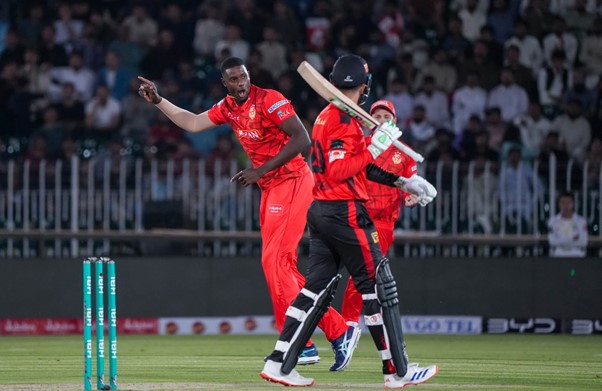
Islamabad United (in home kit) vs Lahore Qalandars (in away kit) playing at Rawalpindi in PSL 2025
Uzair Zafar wrote on Facebook: “Just because you’ve designed home & away kits doesn’t mean you must wear them every single time! If two teams look too similar on the field, switch it up for clarity. It’s not about rules—it’s about visual appeal, contrast, and respecting the fans’ experience.”
Talha Nawaz, a Journalist, wrote on X: “PSL teams are changing their colours so frequently that fans are genuinely struggling to understand which colour actually belongs to which franchise. Today (when United were playing its away game), Islamabad United’s jersey, helmet, and cap combination honestly looked more like Afghanistan’s national team than a PSL franchise.”
Branding specialists widely agree that consistency is central to building long-term equity. Event Marketing Guide writes, “Sports marketing’s consistency may be affected by frequent design changes. Companies should develop clear brand guidelines.”
The underlying sentiment is simple—fans want to recognize their team instantly. When kits change too frequently or lack context, that connection weakens.
Why PSL Should Reconsider Its Approach
For a league still consolidating its identity, clarity may be more valuable than variety. Sports branding is not just about visual appeal—it is about repetition, memory, and emotional attachment.
Richard Branson said, “Branding is about creating something recognizable, memorable, and resonating with your target audience.”
PSL’s two-kit system is not inherently flawed, but it currently operates without the structural backbone that gives it meaning in other leagues. Until a fully functional home-and-away model exists, a stronger focus on one primary, consistent kit per team could enhance recognition and deepen fan connection.