KARACHI: Sindh Chief Minister Syed Murad Ali Shah on Wednesday reaffirmed the provincial government’s commitment to promoting peace, religious harmony, interfaith dialogue, and national unity.
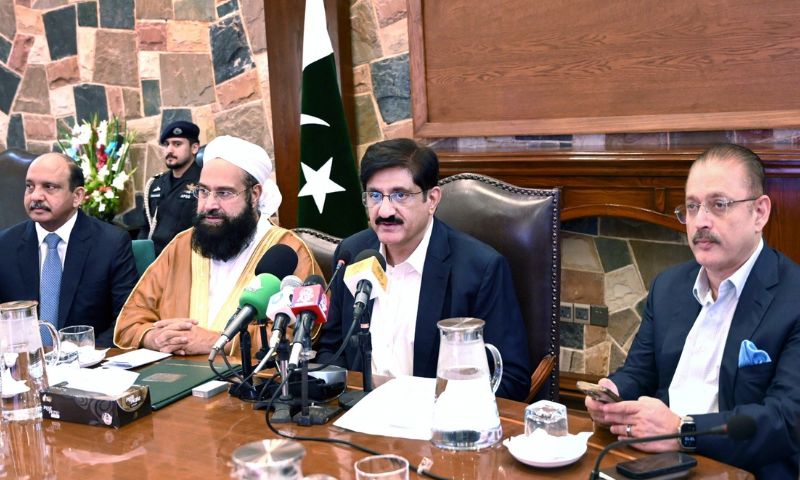
The commitment was expressed during a high-level meeting and joint press conference held at the CM House, where the chief minister met a delegation of the National Paigham-e-Aman Committee (NPAC) and the Provincial Paigham-e-Aman Committee (PPAC) Sindh, led by NPAC Coordinator Maulana Tahir Mehmood Ashrafi.
Maulana Tahir Mehmood Ashrafi praised the Pakistan Armed Forces, police, Rangers, Frontier Corps (FC) and other security institutions for their services and sacrifices in safeguarding the country’s security.
He said the entire nation honours the paramilitary personnel who continue to sacrifice their lives in the line of duty, describing the country’s martyrs as “the pride of the nation.”
Sindh CM Syed Murad Ali Shah met a delegation of the National Paigham-e-Aman Committee led by Maulana Tahir Mahmood Ashrafi and reaffirmed Sindh’s commitment to peace, religious harmony, tolerance and interfaith coexistence.#PaighamEAman #Sindh #ReligiousHarmony pic.twitter.com/3WEKovwMD5
— Sindh Chief Minister House (@SindhCMHouse) July 15, 2026
Chief Minister Murad Ali Shah assured the National and Provincial Paigham-e-Aman Committees of the Sindh government’s full cooperation and support.
He said Sindh, being the land of Sufi saints, carries a legacy of peace, love and religious harmony. The chief minister expressed hope that collective efforts for promoting peace would bring positive results and said Pakistan had gained greater international recognition following the success of Marka-e-Haq.
Role of Paigham-e-Aman Committees in promoting peace and tolerance
Maulana Tahir Mehmood Ashrafi said the federal and provincial governments established the National and Provincial Paigham-e-Aman Committees to counter violent tendencies and promote peace, tolerance and harmony across the country.
He said the committees were formed under the vision of Prime Minister Muhammad Shehbaz Sharif, President Asif Ali Zardari and Field Marshal Syed Asim Munir, with representation from all schools of thought as well as minority communities.
Ashrafi said the committees follow the principle of respecting one’s own beliefs while avoiding interference in the beliefs of others. He added that representatives from the Sikh, Christian and Hindu communities are also part of the committees, reflecting their commitment to strengthening interfaith and inter-sect harmony.
Speaking about Pakistan’s security situation, Ashrafi praised the armed forces for their role in combating terrorism and said the country had strengthened its position internationally through its contributions to regional and global peace.
He also paid tribute to security personnel engaged in operations against terrorists, particularly in Khyber Pakhtunkhwa and Balochistan.
Expressing concern over statements that undermine the sacrifices of security personnel, Ashrafi said soldiers do not lay down their lives for financial benefits but for the defence and security of the nation.
He criticised attempts to politicise the sacrifices of martyrs, saying such actions were unacceptable. He expressed solidarity with the families of martyrs and offered an apology for any remarks that may have caused them pain.
Unity and respect for national institutions and rejection of extremism
Maulana Tahir Mehmood Ashrafi thanked the Sindh government for its efforts to promote religious harmony and appreciated the province’s role in encouraging peaceful coexistence among followers of different faiths and sects.
He said the National Paigham-e-Aman Committee (NPAC) and Provincial Paigham-e-Aman Committees (PPACs) were working nationwide to promote peace, tolerance, unity and national solidarity.
Emphasising the importance of protecting national institutions, Ashrafi urged political forces to resolve differences through democratic and constitutional channels and avoid statements that could weaken state institutions.
“Our soldiers are our brothers and sons. We are proud of our armed forces and the sacrifices made by our martyrs and ghazis for the defence of the country,” he said.
Paying tribute to the armed forces, law enforcement agencies and the families of martyrs, Ashrafi said the nation remained indebted to those who sacrificed their lives for Pakistan’s security and sovereignty.
“No one should be allowed to disrespect the sacrifices of our martyrs. They have given everything for the protection of the country,” he added.
Ashrafi called on all sections of society to reject extremism, violence and divisive narratives, urging unity against elements seeking to create instability in the country.
Chairman Council of Islamic Ideology (CII) Allama Dr Raghib Hussain Naeemi, stressed the need for dialogue, unity, and greater engagement among all schools of thought and religious communities.
He also paid tribute to Rangers personnel who were martyred while defending the Rangers compound in Karachi from suicide attacks by terrorists belonging to Fitnatul Khwarij.
The state uses the term Fitnatul Khwarij for the banned Tehreek-i-Taliban Pakistan (TTP) terrorist group.
Naeemi praised the Sindh government, led by Chief Minister Syed Murad Ali Shah, for implementing effective security measures during Muharram-ul-Haram, saying terrorists failed to achieve their objectives of creating unrest in the city.
Sindh Senior Minister for Information, Transport and Mass Transit Sharjeel Inam Memon said the central message of Paigham-e-Aman was to promote peace, harmony, tolerance and mutual respect across society.
He said Pakistan’s defence was in capable hands and paid tribute to the country’s martyrs, describing their sacrifices as a source of pride for the entire nation.
“The sacrifices of our shuhada will always be remembered with gratitude and respect and will continue to inspire future generations,” Memon said.