
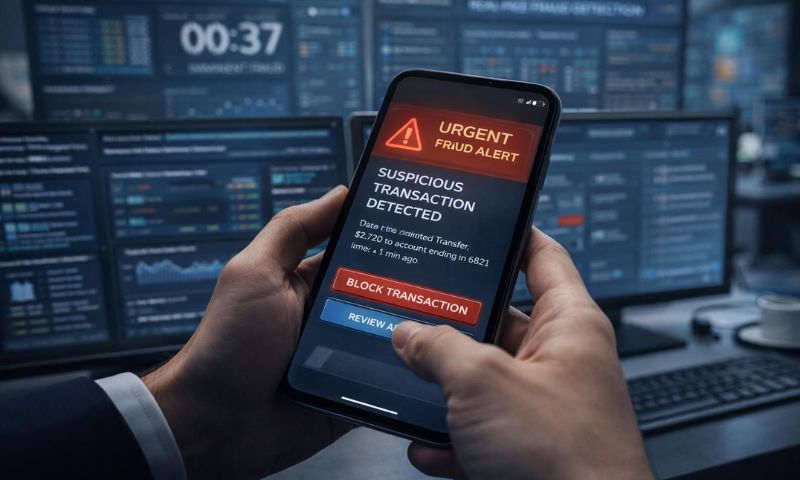
LONDON: Imagine receiving a telephone call from someone claiming to work for your bank. The caller knows your name, speaks professionally and warns that suspicious transactions have been detected on your account.
Everything sounds genuine. Yet the voice could be artificially generated, the warning fabricated, and the conversation designed to persuade you to authorise a fraudulent payment.
As artificial intelligence becomes more sophisticated, cybersecurity experts are warning that criminals can exploit the technology to deceive banking customers without necessarily stealing their passwords.
But can AI actually break into a bank account without knowing its password?
The answer depends on how the account is protected and whether criminals can manipulate other security procedures.
How Can AI Help Criminals Target Bank Accounts?
Traditional cyberattacks often involve stolen passwords, malicious software or fraudulent websites designed to capture login information.
AI introduces another dimension by making impersonation easier, faster and potentially more convincing.
Criminals can use generative AI to produce realistic messages, imitate familiar voices and create fake identities that appear trustworthy.
The US Federal Bureau of Investigation (FBI) warned in December 2024 that criminals were using AI-generated audio to impersonate individuals, including in attempts to obtain access to bank accounts.
ALSO READ: Australia Warns of Unprecedented AI-Powered Cyber Threats
Unlike conventional hacking, these schemes frequently target human judgement rather than exploiting weaknesses in banking software.
Can Voice Cloning Bypass Banking Security?
Some financial institutions have used voice recognition to verify customers during telephone banking.
However, advances in AI-generated speech have raised concerns about systems that rely heavily on voice authentication.
In July 2025, OpenAI chief executive Sam Altman warned at a US Federal Reserve conference that AI-generated voices posed serious risks to financial institutions using voiceprints to identify customers.
A convincing voice imitation may help criminals deceive a person or challenge a vulnerable authentication process.
Nevertheless, a cloned voice alone does not guarantee access to a bank account. Financial institutions may require additional verification, and their security procedures vary.
How Do Scammers Take Control Without Knowing Your Password?
One common approach is to convince customers to complete transactions themselves.
A fraudster posing as a bank employee may claim that an account is compromised and instruct the customer to transfer money into a supposedly secure account.
In reality, the destination belongs to the criminal.
Another method involves manipulating account recovery procedures or persuading customers to disclose one-time verification codes.
The FBI warned in November 2025 that criminals impersonating financial institutions used calls, messages, and fraudulent websites to take control of financial accounts.
The agency said it had received more than 5,100 complaints involving account takeover fraud since January 2025, with reported losses exceeding $262 million at the time of its warning.
These figures cover account takeover fraud generally and should not be interpreted as losses caused exclusively by AI.
Why Are AI-Powered Scams Difficult to Detect?
Many people associate online fraud with poorly written messages, suspicious links or obvious requests for money.
AI can reduce some of these warning signs.
Fraudulent emails can appear professionally written, while generated voices may resemble those of genuine employees or trusted contacts.
Scammers can also combine publicly available personal information with fabricated emergencies to make their approaches more persuasive.
However, convincing communication does not establish that the sender is genuine.
Even an apparently familiar voice or official-looking message should not replace independent verification.
How Can You Protect Your Bank Account?
Cybersecurity agencies recommend several precautions that can significantly reduce exposure to financial fraud.
Customers should never disclose passwords, banking PINs or one-time verification codes to unsolicited callers.
Anyone receiving an unexpected warning about suspicious transactions should end the conversation and contact their bank through its official application, website or a verified telephone number.
Using unique passwords, enabling multifactor authentication and regularly reviewing account activity can provide additional protection.
Where supported, phishing-resistant authentication methods, including passkeys, can offer stronger safeguards against certain account takeover techniques.
Customers should also be suspicious of requests to transfer money urgently to protect their savings.
The US Federal Trade Commission warns that legitimate financial institutions do not require customers to move money into another account simply to keep it safe.
If fraud is suspected, contacting the bank immediately may improve the chances of stopping or recovering a payment, although recovery is not guaranteed.
Are Banks Prepared for AI-Driven Fraud?
Financial institutions increasingly face the challenge of distinguishing legitimate customers from sophisticated impersonators.
Stronger identity verification, transaction monitoring and fraud detection systems can help reduce the risks.
However, security measures must also remain accessible to customers who depend on telephone and digital banking services.
AI itself can assist banks in detecting unusual transactions and identifying suspicious behaviour.
The challenge is therefore not simply to prevent criminals from using artificial intelligence, but to ensure financial safeguards evolve alongside the technology.
Ultimately, AI does not need to defeat every layer of banking security to facilitate financial fraud. Sometimes, persuading a customer to trust the wrong person is enough.
As digital banking becomes more widespread, protecting personal savings will increasingly depend on both technological safeguards and the ability to recognise manipulation.