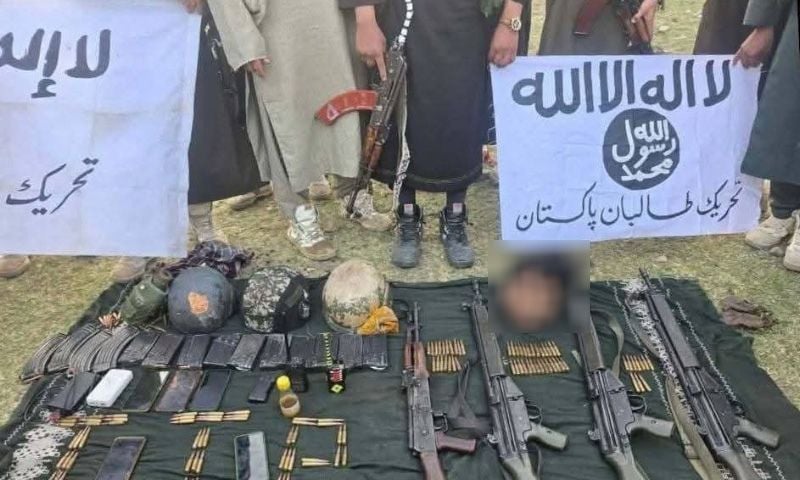



ISLAMABAD: In an act of unspeakable brutality that has sent shockwaves across Pakistan, terrorists affiliated with the banned Tehreek-e-Taliban Pakistan (TTP) have released gruesome images showing the beheaded body of Pakistani soldier Waqas Bangash, along with military equipment seized from the site of a deadly ambush in Dosali.
The release of this image has drawn widespread condemnation from religious scholars, civil society, and political circles, who have unanimously declared the act a flagrant violation of Islamic principles and a stark reminder of the group’s savage ideology.
The horrifying photograph and a video clip, circulated on social media platforms, depict the soldier’s severed head and display captured weapons and gear. This macabre propaganda stunt is the latest in a series of brutal tactics employed by the banned TTP and its allied factions in their ongoing campaign of terror against Pakistan.
Fitna al-Khawarij (TTP) released an image showing the beheaded body of Sepoy Waqas Bangash, who was martyred in the Doshali Ghat incident. According to the stated claim, this act of brutality is being presented as an attempt to divert attention from its own alleged desecration of… pic.twitter.com/MjQiRI6K18
— Balochistan Pulse (@BalochPulse) July 9, 2026
Flagrant violation of Islamic law and Deoband fiqh
The terrorist group’s decision to desecrate and mutilate the body of a fallen soldier has been condemned as a clear breach of Islamic law and traditional Deoband jurisprudence. Both the Quran and the teachings of Deoband scholars explicitly prohibit the mutilation of corpses, even in the heat of battle.
“There is absolutely no room in Islam for such heinous acts. The sanctity of the deceased must be preserved at all costs,” remarked a senior religious scholar from Peshawar.
Urooj Tahir, a social media user, expressed her outrage, stating: “This is horrifying, inhuman, and brutal beyond words. These so-called Fitna Al-Khawarij are pure evil. They claim to respect human dignity and forbid the desecration of bodies, yet their actions prove otherwise. Where are the human rights organisations now? Are these acts permitted in Islam? Are they allowed under Deoband fiqh? “These Fitna are savages who have no connection to Islam whatsoever. They are worse than animals, and calling them animals is an insult to animals, for even beasts have their own code. They are agents of Satan, and I condemn them all,” she said.
Another user Afshan Awan said, “They (Taliban) have nothing to do with humanity. They are cursed beasts of hell.”
Social Outrage: “Worse than animals”
Public and social circles have reacted with revulsion, terming the TTP’s narrative “built on lies” and its actions “utterly un-Islamic.” The sentiment on social media has been particularly scathing, with many users stating that the perpetrators are “worse than beasts” and that “calling them animals is an insult to animals.”
The act has reinforced the belief that those who claim to uphold Islam through violence are, in reality, ideological descendants of the Kharijites (khawarij), a faction historically condemned for its terrorism and deviation from mainstream Islamic thought.
Pakistani religious scholars have consistently condemned the terrorist activities and insurgency of the banned TTP and Taliban. The Pakistan Ulema Council (PUC), a broad coalition of clerics, in the past, has urged the Taliban interim government to implement resolutions passed by Afghan clerics against terrorism and ensure that Afghan soil is not used for attacks against Pakistan.
A representative of the Council stated, “The actions of these terrorists do not represent Islam or the values we hold dear. They are a stain on humanity and must be dealt with decisively.”
Scholars from various schools of thought have united in denouncing the act, terming it contrary to fundamental Islamic principles that forbid the desecration of the deceased and prohibit unlawful killing.
The history of such brutality is not new. In 2009, TTP terrorists in Swat exhumed the body of Pir Samiullah from his grave and strung it up as a warning to others. Such acts have been widely condemned as savage and contrary to Islamic norms.
While clerics acknowledge that religious edicts alone cannot defeat terrorism, they stress that influential religious voices speaking with one voice against terrorism are crucial. Experts, however, note that more concerted efforts, including kinetic action, deradicalisation programmes, and oversight of seminaries, are required to truly counter the terrorist threat.