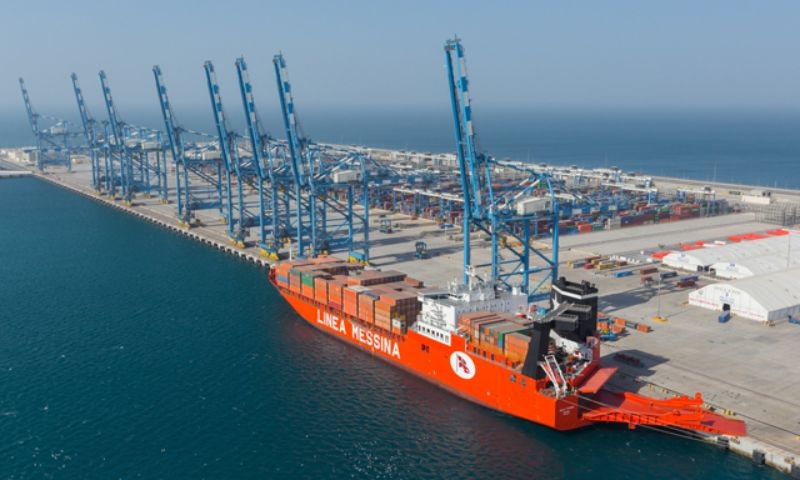



ISLAMABAD: Pakistan’s Gwadar port has emerged as a key regional shipping hub amid the ongoing Strait of Hormuz crisis, having handled around 11,000 containers so far in April alone.
The current surge in activity is unprecedented as it processed roughly 8,300 containers throughout 2025, reports The Diplomat.
On April 16, two cargo vessels docked at Gwadar Port, delivering 368.7 tons of machinery and general goods along with 5,000 metric tons of fertiliser. Earlier in the month, another vessel had already arrived carrying more than 14,000 metric tons of transshipment cargo.
Gwadar Port has a capacity of around 16,000 standard shipping containers and provides more than 90,000 square metres of storage space for general cargo.
Analysts say this surge is a long-term opportunity for Gwadar to improve its visibility in regional shipping networks and attract constant commercial interest.
Gwadar’s proximity to the Strait of Hormuz, a waterway through which nearly 20 percent of the world’s oil and liquefied natural gas (LNG) supplies pass, gives it considerable strategic significance.
Coupled with the deep waters of its eastern bay, which can accommodate large cargo vessels, this advantage has long attracted Chinese investment.
The recent surge in cargo traffic is being driven by shifting regional dynamics and heightened geopolitical tensions, particularly surrounding the Strait of Hormuz.
In recent months, the waterway has dominated global headlines due to the Israel-US conflict with Iran and repeated disruptions, including closures and blockades. As a critical global energy route, these developments have shaken markets, triggering supply concerns and pushing up oil prices.
At the same time, vessels operating in the strait face growing security risks, leading to higher insurance costs, delays, and uncertainty over safe passage.
As a result, many shipping operators are avoiding the route altogether.
However, cargo already in transit cannot be easily diverted, prompting vessels to seek temporary anchorage in safer, less congested locations along the Arabian Sea—bringing ports like Gwadar into greater prominence.
The report noted that goods bound for West Asian markets—particularly shipments from China that depend on the Strait of Hormuz—have limited scope for rerouting.
With vessels unable to remain at sea indefinitely, shipping operators are increasingly seeking alternative docking points or short-term storage facilities at nearby ports.
In this context, Pakistan’s Gwadar Port has emerged as a key logistical hub.
Its proximity to the Strait of Hormuz, combined with its relative distance from the immediate conflict zone, has positioned it as both a transshipment point and a safe anchorage where vessels can wait for greater clarity in regional conditions.
This perception of relative safety in an otherwise volatile environment is also linked to Pakistan’s evolving diplomatic role, including efforts to mediate between Iran and the United States. While
Pakistan’s diplomatic efforts to end the US-Iran conflict have strengthened Islamabad’s image as a credible and constructive player on the global stage.
The report added that Islamabad relies on energy imports that transit through the Strait of Hormuz, disruption of which has already affected the economy with rising costs and supply pressures.
Any war in Iran, which shares a roughly 900-kilometre-long border with Pakistan, can severely impact Islamabad’s energy, food, and other essential goods.
However, for Gwadar, the current surge in activity largely reflects transshipment rather than local demand, with incoming cargo being temporarily handled and stored at the port before being forwarded to other destinations.