


BRUSSELS: The European Union faced mounting criticism on Tuesday after hosting Taliban officials in Brussels for talks on migration and the return of failed Afghan asylum-seekers, with rights advocates, lawmakers and Nobel Peace Prize laureate Malala Yousafzai warning that the move risks legitimising a government widely condemned for its treatment of women and girls.
The unprecedented visit saw a five-member Taliban delegation meet EU officials and representatives of 15 member states to discuss cooperation on migration, deportations and consular issues.
The talks marked the first known meeting between Taliban officials and EU representatives in Brussels since the group’s return to power in Afghanistan in 2021.
The discussions immediately triggered a wave of criticism from human rights organisations and politicians who argued that engaging with the Taliban undermines the European Union’s long-standing commitment to human rights and women’s rights.
“This is a shameful chapter for Europe,” said Cecilia Strada, a member of the European Parliament from the centre-left Socialists and Democrats group.
Rochelle Garcia Hermida, EU Parliment member, strongly criticized the invitation of the Taliban to Brussels during an open session of the parliament. She said that this action grants the Taliban international legitimacy and intensifies the suppression of women in Afghanistan. pic.twitter.com/We5JloU9AW
— Jahanzib Wesa (@jahanzibwesa) June 23, 2026
“The commission is legitimising a regime that tramples on the rights of women and girls.”
Human Rights Concerns
Campaigners said the talks sent a troubling signal at a time when the Taliban remain under international criticism for imposing sweeping restrictions on Afghan women and girls.
Women in Afghanistan are barred from secondary and higher education, face severe restrictions on employment and public participation, and are subject to strict rules governing movement and dress.
“The Taliban have erased women and girls from public life,” Malala Yousafzai said in a strongly worded statement issued ahead of the meeting.
The EU has invited Taliban officials to Brussels to discuss a migration deal — and today I am shaken and deeply disturbed by this.
This is the same Taliban that banned girls from secondary schools and forced them into marriage. The same Taliban that, earlier this month,… pic.twitter.com/1X3tmlTxjh
— Malala Yousafzai (@Malala) June 22, 2026
“The EU has invited Taliban officials to Brussels to discuss a migration deal — and today I am shaken and deeply disturbed by this,” she said.
“Inviting the Taliban to Brussels for discussions on migration sends a dangerous message: that a regime can oppress women and girls while still being accepted as a diplomatic partner.”
Yousafzai described Taliban policies as a system of “gender apartheid” and urged European governments not to separate migration discussions from concerns about fundamental rights.
“Europe must not legitimise a regime responsible for one of the worst human rights crises in the world,” she said.
She also pointed to reports that Taliban authorities recently detained dozens of women and girls in Afghanistan’s western city of Herat over alleged dress-code violations.
“This is the same regime that last week detained at least 30 women and girls in Herat over their clothing, opened fire on people protesting the arrests, killed a child, and injured others,” she said.
“Any engagement with the Taliban must begin and end with the rights of Afghan women and girls.”
‘A Slap in the Face’
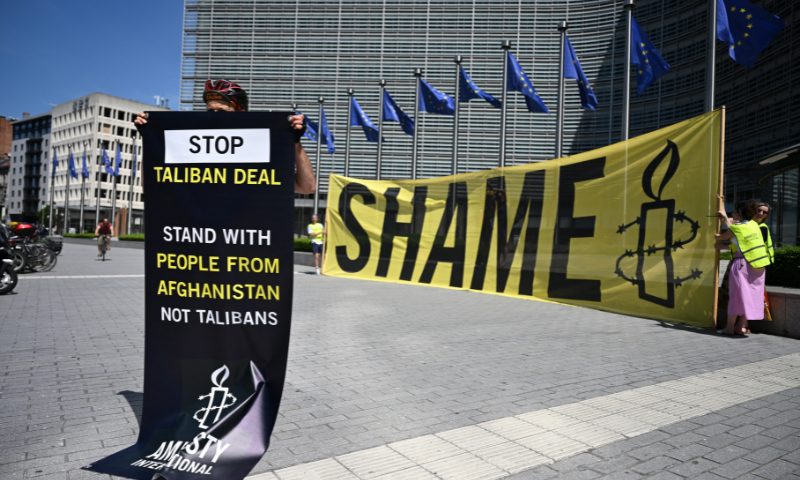
Outside the European Commission headquarters, Amnesty International activists staged a protest against the visit.
“It is truly a slap in the face to the values supposedly upheld by the European Union and Belgium,” said Ludovic Laus of Amnesty International.
Critics questioned whether the EU’s desire to increase deportations was taking precedence over its human rights principles.
The @EU_Commission invited Taliban authorities to Brussels to discuss accelerated deportations to #Afghanistan even though the EU is well aware of the dire human rights situation in the country.
Any engagement with the Taliban needs to prioritize protecting human rights and… pic.twitter.com/VouPJrcAAy
— Human Rights Watch (@hrw) June 23, 2026
They also raised concerns about what concessions Brussels might ultimately offer in exchange for Taliban cooperation on migration issues.
The European Commission insisted that hosting the delegation did not amount to recognising the Taliban government and described the gathering as a technical-level meeting focused on practical issues related to migration management.
#Taliban shouldn’t be invited to #Brussels. This gives into blackmailing & normalisation.
Together with fellow parliamentarians & former Afghan parliamentarians, I sent an open letter to @Bart_DeWever & @vonderleyen#EU shouldn’t trade its principles for deportation deals.
1/3 pic.twitter.com/T7j6hclDdE— Hannah Neumann (@HNeumannMEP) June 23, 2026
Officials said discussions centred on identifying Afghan nationals ordered to leave Europe, issuing travel documents and facilitating the return of individuals deemed security threats or convicted of serious crimes.
EU Defends Engagement
European governments have increasingly sought tougher migration policies amid growing political pressure and rising support for anti-immigration parties across the continent.
EU officials argue that cooperation with authorities in Afghanistan is necessary if member states are to enforce deportation orders.
“The ability to return individuals who do not have a legal right to remain in the country is a cornerstone of a credible and well-functioning asylum and migration system,” Swedish Migration Minister Johan Forssell said after the talks.
EU Migration Commissioner Magnus Brunner has similarly argued that engagement with Taliban authorities is unavoidable if Europe wishes to return irregular migrants to Afghanistan.
Growing Debate
The controversy highlights the increasingly difficult balance facing European governments as they seek to tighten migration policies while maintaining pressure on the Taliban over human rights.
European embassies were closed after the Taliban seized power in August 2021, and the EU has repeatedly condemned restrictions imposed on Afghan women and girls.
Yet with around 20 EU member states reportedly interested in returning some Afghan migrants without legal status, pressure is growing for practical engagement with Taliban authorities despite continuing concerns over human rights and governance in Afghanistan.
“Lost generation”
The Taliban’s restrictions on women and girls have been widely described by the United Nations and human rights organisations as the most severe rollback of women’s rights in the world.
Since returning to power in 2021, the group has barred girls from secondary and higher education, restricted women’s employment, limited their freedom of movement and excluded them from much of public life.
The United Nations has warned that the education ban is creating a “lost generation” of Afghan girls and could have devastating long-term consequences for the country’s economy, social development and human capital.
According to UN estimates, if the ban remains in place until 2030, more than four million girls could be deprived of secondary education, further entrenching poverty, inequality and isolation in Afghanistan.