Key Points
- Traditional crafts face mounting pressure from industrially manufactured products.
- Peshawar’s historic brassware industry has suffered a dramatic decline.
- Wax painting survives through a handful of dedicated artisans.
- Charsadda’s traditional handwoven khaddar faces rising production costs.
- Basket weaving is disappearing as consumer preferences change.
PESHAWAR, Pakistan: The rhythmic pounding of hammers against brass, the gentle movement of wooden looms and the intricate weaving of baskets once formed an integral part of everyday life in Pakistan’s northwestern Khyber Pakhtunkhwa province, where generations of artisans transformed locally available materials into objects of beauty, utility and cultural significance.
From the engraved brass utensils of Peshawar’s historic Misgaran Bazaar to the handwoven khaddar of Charsadda, intricate woodcarving in Swat, traditional basketry and centuries-old wax painting, these crafts represent a cultural inheritance passed down through generations. However, changing consumer preferences, industrial production, cheap imported alternatives, rising raw-material costs and inadequate institutional support are increasingly threatening their survival.
What was once a source of livelihood for thousands of skilled craftsmen and women is gradually becoming an endangered occupation, with ageing artisans struggling to find successors willing to devote years to mastering techniques that offer increasingly uncertain financial returns. The decline is particularly visible in Peshawar, where several historic markets that once specialised in particular crafts have gradually lost their traditional character.
A Directorate of Culture report — Culture Policy For the people of Khyber Pakhtunkhwa — acknowledges that Khyber Pakhtunkhwa possesses a diverse handicraft tradition encompassing woodwork, metalwork, cane and straw work, leatherwork, textiles, pottery, glasswork, karakul making, stonework, embroidery, traditional jewellery and gemstone cutting. These crafts are spread across different regions of the province, with particular concentrations of leatherwork in Charsadda and Peshawar and textile production in Charsadda and Swat.
The report identifies industrialisation, urbanisation and the availability of cheaper alternatives among the factors contributing to the erosion of traditional handicrafts.
A fading metalworking legacy
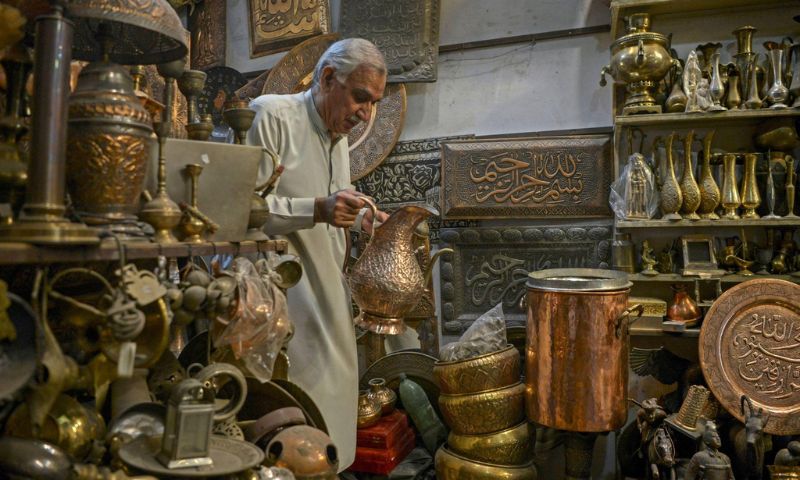
One of the most visible examples of this decline is the centuries-old brassware industry of Peshawar, particularly in Misgaran Bazaar near the historic Qissa Khwani area. The market was once renowned for its craftsmen, who produced engraved brass utensils, decorative trays, samovars, lanterns and other household items. Their products attracted customers from across the region and beyond.
Today, however, the number of working craftsmen has dwindled considerably.
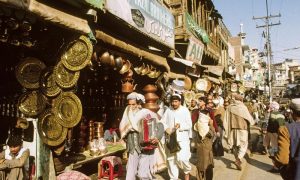
According to an Associated Press of Pakistan report published in July 2025, 75-year-old brass craftsman Haji Muhammad Rafiq recalled that Misgaran and Qissa Khwani bazaars once had at least 200 brassware shops. He estimated that barely 10 remained. The decline reflects a fundamental change in household consumption. Plastic, stainless steel and factory-manufactured products have increasingly replaced handmade brass utensils, while the rising cost of metal has made traditional products less affordable.
For craftsmen who spend hours engraving and polishing individual products, competing with mass-produced alternatives has become increasingly difficult.
Wax painting faces extinction
Another endangered tradition is wax painting, an intricate art form associated with Peshawar and believed to have evolved from the Mughal-era Roghan tradition.
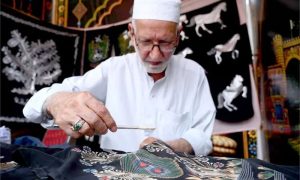
The craft involves applying specially prepared wax-based materials and natural pigments to fabrics and other surfaces to create elaborate designs.
Charsadda’s struggling weavers
Charsadda’s handwoven khaddar, locally known as khamta, represents another important part of the province’s traditional craftsmanship.
The coarse cotton fabric, particularly popular during winter, has long been associated with local identity and has traditionally been used for shawls and clothing. However, the craft has faced growing competition from machine-produced fabrics and cheaper synthetic alternatives.
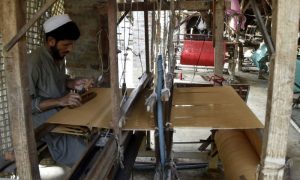
The growing shift towards machine-made fabrics has not only affected the demand for traditional khaddar but has also disrupted the livelihoods of generations of local weavers. As production costs rise and handmade products struggle to compete on price, many artisans find it increasingly difficult to sustain their traditional looms, raising concerns about whether the craft can survive without greater market access and support for its practitioners.
Despite these challenges, Charsadda khaddar retains a market among consumers who appreciate its warmth, durability and distinctive texture. Some traders have also embraced online selling to reach customers outside the district.
Basket weaving disappears
Basket weaving, once a widespread rural occupation in Khyber Pakhtunkhwa, is another craft gradually disappearing from local markets.
Traditionally practised in Peshawar, Nowshera, Charsadda, Mardan, Dera Ismail Khan and parts of Hazara and the former Federally Administered Tribal Areas, the craft involves weaving flexible willow stems, reeds and other natural materials into baskets of different shapes and sizes.
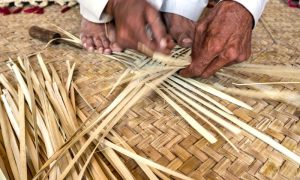
These products were historically used for household storage, agricultural activities, beekeeping and other everyday purposes. However, the growing availability of steel, glass, plastic and wooden alternatives has reduced demand. Deforestation and declining access to suitable willow material are additional challenges confronting the craft.
Markets in Peshawar that were once associated with basketry, including Qissa Khwani, Firdous, Dabgari Gardens and Meena Bazaar, have increasingly shifted towards general retail businesses.
Some remaining craftsmen have diversified into cane furniture repairs and decorative basket-making to sustain their livelihoods.
The decline is not simply a loss of an old occupation. It also represents the disappearance of practical knowledge about natural materials, harvesting seasons and traditional weaving techniques.
Swat’s woodcarving tradition
Unlike some other crafts, woodcarving in Swat continues to attract customers from across Pakistan, but its long-term preservation also depends on the availability of skilled artisans and the transfer of traditional techniques. The craft is practised in different parts of the valley, particularly Manglawar, Khwazakhela, Madyan and Bahrain.
Swati artisans are known for intricate designs used in doors, windows, furniture, decorative panels, jewellery boxes and household accessories. The craft has also developed into a source of income for families, with artisans producing furniture and smaller decorative items for buyers from Swat, Islamabad and Punjab.
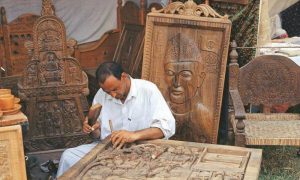
However, the growing preference for commercially manufactured furniture and changing consumer tastes present challenges to traditional craftsmanship.
Preserving the craft requires more than maintaining furniture workshops. It also involves documenting distinctive regional patterns and ensuring that younger artisans learn the techniques behind them.
Women artisans overlooked
Women have historically played an important role in preserving traditional crafts across Khyber Pakhtunkhwa, particularly through embroidery, textile production, decorative stitching and other home-based activities.
In remote districts, these skills have provided women with opportunities to contribute to household incomes while preserving distinctive regional designs and cultural identities.
Traditional embroidery and textile work from Swat, Chitral, Waziristan, Kurram and other areas reflect considerable regional diversity. However, many women artisans work from their homes and remain disconnected from organised markets, commercial buyers and formal business networks.
Connecting women artisans directly with customers through exhibitions, online platforms and organised retail networks could help improve their incomes while encouraging younger women to continue inherited skills.
A generational disconnect
The declining interest of younger generations is emerging as one of the most serious challenges to the survival of traditional craftsmanship.
For many young people, learning a craft requires years of practice, patience and physical labour, while the financial returns are often uncertain. Unlike previous generations, who inherited workshops and skills through family arrangements, many young people now aspire to employment in government departments, private companies or other professions offering comparatively stable incomes.
This transition is understandable from an economic perspective, particularly when traditional artisans struggle to compete with industrial manufacturers. The problem, however, is that when an experienced craftsman retires or dies without training a successor, the loss can be permanent.
Traditional craftsmanship involves more than the ability to manufacture an object. It includes knowledge of materials, preparation techniques, regional patterns, tools and the cultural meanings associated with different designs.
Government support needed
The preservation of traditional crafts requires a coordinated approach involving the provincial Culture Department, the Khyber Pakhtunkhwa Culture and Tourism Authority, educational institutions, local governments and private businesses.
The provincial government’s cultural heritage report recognises traditional handicrafts as potential contributors to economic development, particularly through small and medium-sized enterprises. It also identifies infrastructure development, skills training, knowledge transfer and an understanding of changing consumer behaviour as important measures for strengthening the sector.
Heritage at risk
For Khyber Pakhtunkhwa, the disappearance of traditional crafts would mean more than the closure of old workshops or the loss of familiar products from local markets. It would represent the erosion of knowledge, skills and artistic traditions that have helped shape the province’s cultural identity over generations.
From the brass engravings of Peshawar to the handwoven fabrics of Charsadda and the intricate woodwork of Swat, these crafts tell stories of communities, migration, local resources and changing cultural influences. Their preservation does not necessarily require resisting modernisation or rejecting factory-made products. Rather, it requires creating an economic environment in which handmade craftsmanship can coexist with modern manufacturing and consumer preferences.
Unless artisans receive meaningful support, younger generations are encouraged to learn traditional skills and locally made products find sustainable markets, many of these crafts could survive only in museum collections and historical photographs. The remaining master craftsmen are still willing to pass on their knowledge, but the window of opportunity is narrowing.
The question facing Khyber Pakhtunkhwa is whether it can turn its rich artisanal heritage into a sustainable source of livelihoods and cultural pride before the last generation of traditional craftsmen takes their skills with them.