


ISLAMABAD: Pakistan’s Information Minister Attaullah Tarar said on Monday that the Indus Waters Treaty (IWT) remains legally binding and cannot be unilaterally revoked or amended by India, stressing that the Pakistani people have a guaranteed right to the waters of the Indus basin under the treaty.
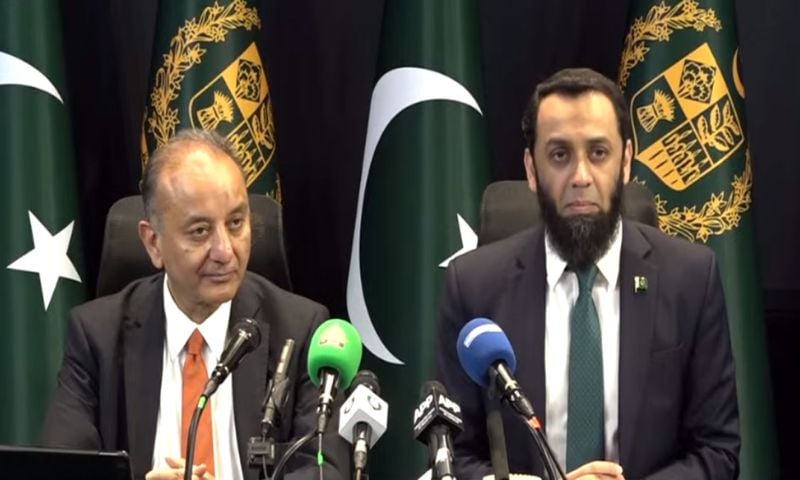
Speaking at a press conference in Islamabad alongside Climate Change Minister Musadik Malik, Information Minister Tarar said the agreement continues to be in force and is legally enforceable.
His remarks came after Indian Water Minister C.R. Patil said New Delhi was working to ensure that “not a single drop of water” flows into Pakistan.
Act of war
Islamabad has repeatedly maintained that any attempt to alter the natural flow of Transboundary Rivers or impede Pakistan’s share of water under the treaty would be regarded as an “act of war.”
“Legally, Pakistan’s stance has garnered support internationally, as the IWT cannot be unilaterally revoked, abolished, or amended,” Tarar added.
He said a seminar would be held in Islamabad on Tuesday, during which awareness would be raised about Pakistan’s rights under the treaty. “Water and legal experts from around the world will be attending the seminar,” he said.
Tarar said the Indus Waters Treaty provides a clear and well-defined framework that remains fully operational and continues to be implemented.
He added that Prime Minister Shehbaz Sharif and Chief of Defence Staff and Chief of Army Staff Field Marshal Syed Asim Munir have repeatedly emphasised that water is Pakistan’s lifeline and a red line that cannot be crossed.
“Our people have a right to water through a legally enforceable treaty that was accepted by both countries, that remains implemented today, and regarding which India has been disgraced on various forums. Their stance was not accepted at any forum,” he added.
Tarar reiterated that Pakistan’s rights under the Indus Waters Treaty had been recognised by international experts, describing it as a diplomatic success for the country.
Pakistan’s position and narrative on IWT acknowledged globally
“The world is increasingly acknowledging Pakistan’s position and narrative on the Indus Waters Treaty,” he said.
Speaking alongside him, Climate Change Minister Musadik Malik said the treaty had been discussed at several international forums over the past two months. He added that Pakistan’s position had also been upheld by the Court of Arbitration.
Referring to fluctuations in water flows, Malik said climate change was one of the contributing factors but noted that it was not the only reason, suggesting that other elements were also affecting water availability.
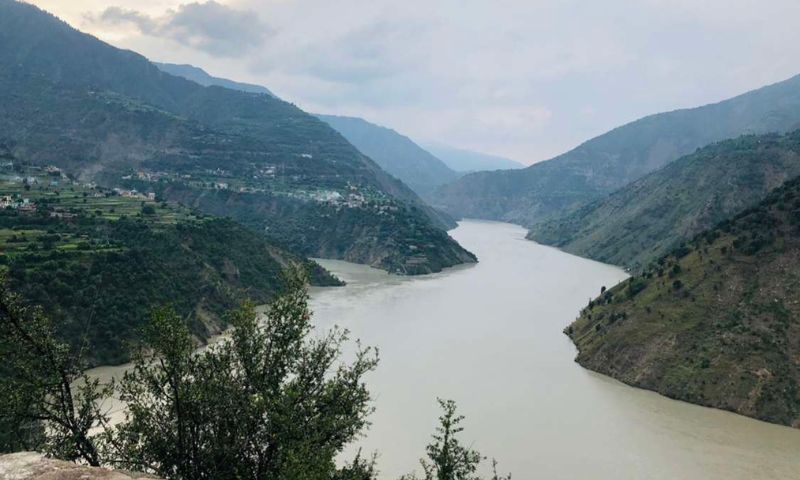
“There is a tap being controlled by the prime minister of a neighbouring country. He says he will not let even a drop of water flow into Pakistan,” Malik added.
He added that Pakistan had already declared that anyone trying to deprive it of its water would face severe consequences. “And we have shown this as well,” he said.
India puts treaty under strain
The Indus Waters Treaty, signed in 1960 with World Bank support, regulates the distribution of waters from the Indus River system between the two countries.
The treaty assigns the eastern rivers primarily for use by India and the western rivers largely for Pakistan, and includes provisions for technical cooperation, data sharing, and dispute resolution.
Pakistan has in recent months stated that India’s unilateral and illegal holding “in abeyance ” of the treaty in 2025 has threatened the livelihood of millions dependent on the Indus waters.
In June 2025, the Permanent Court of Arbitration (PCA) — an organisation that provides a framework for international disputes — had issued a Supplemental Award of Competence, stating that India could not unilaterally hold the treaty in abeyance.

Earlier this month, Pakistan called on the United Nations Security Council to take urgent notice of India’s violations of the Indus Waters Treaty (IWT), warning that unilateral actions affecting transboundary water resources undermine the international agreement and threaten regional stability.
Pakistan’s Deputy Prime Minister and Foreign Minister Ishaq Dar, in a letter to the President of the Security Council, Leonor Zalabata Torres, said that at least 17 projects by India on waterways part of the Indus River System would give New Delhi the “tools for hydro-hegemony”.
“Such an inter-basin diversion of water of the Chenab into the Beas system constitutes a grave violation of not just the IWT but also of the laws of treaty, particularly the Vienna Convention on the Law of Treaties, as well as the broader framework of international water law, including the principles reflected in the 1977 UN convention on watercourses,” he said.