
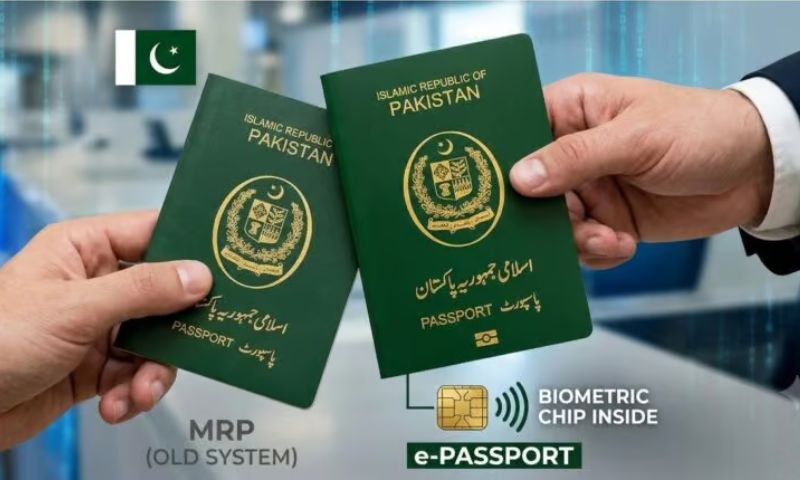
ISLAMABAD: Pakistan is set to introduce electronic passports (e-passports) nationwide from October 15, 2026, replacing the issuance of traditional machine-readable passports (MRPs) for all new applicants, according to a public notice issued by the Directorate General of Immigration and Passports (DGIP).
The announcement states that from October 15, all passport offices across Pakistan and Pakistani diplomatic missions abroad will begin issuing only e-passports as part of the country’s transition to a fully electronic passport system.
New applicants to receive only e-passports
Under the new policy, anyone applying for a new passport on or after October 15, 2026 will be issued an e-passport instead of a machine-readable passport. The system will be implemented simultaneously across domestic passport offices and overseas Pakistani missions, including consulates and embassies.
Existing passports remain valid
The DGIP clarified that machine-readable passports issued before October 15, 2026, will remain valid until their printed expiry dates. They will not be cancelled or invalidated before expiration.
However, once those passports expire, holders will no longer be able to renew them as machine-readable passports and will instead be required to obtain a new e-passport.
Nationwide implementation
According to the notice, implementation instructions have already been issued to all passport offices throughout Pakistan as well as to Pakistani diplomatic missions abroad to ensure a smooth nationwide rollout of the electronic passport system.
Read Also: Govt Starts Issuing e-Passports Across Pakistan
Faster and more secure travel
The DGIP said the transition is expected to make immigration procedures faster, more efficient, and more secure by introducing biometric e-passports equipped with an embedded electronic chip that enhances identity verification at international borders.
The move forms part of Pakistan’s broader efforts to modernise passport services and facilitate international travel for its citizens.
Earlier, in June 2026, the Pakistani government decided in principle to phase out Machine Readable Passports (MRPs) and shift completely to e-Passports, Interior Minister Mohsin Naqvi announced, saying the move would strengthen security, ensure global compatibility, and provide a more seamless travel experience at airports. Chairing a special meeting at the Passport and Immigration Headquarters, Naqvi said the transition would help eliminate passport-related fraud and forgery.
Director General Passports and Immigration Muhammad Ali Randhawa briefed the minister on the planned reforms, with the meeting approving the shift to e-Passports, although no specific deadline for ending MRP issuance was announced at the time.
An e-Passport is a secure travel document with a contactless electronic chip embedded in the booklet, which stores the holder’s biometric, facial and biographical information, along with a unique identification number and digital signature.
The chip enables border-control systems and compatible devices to read the information wirelessly. Pakistan’s e-Passports comply with International Civil Aviation Organisation (ICAO) standards, allowing Pakistani travellers to use compatible e-Gates at airports around the world and potentially reduce immigration waiting times.
The Pak ID platform will also be made available to online passport applicants to simplify applications and reduce processing times. Naqvi additionally directed officials to finalise the policy for business passports at the earliest in consultation with the Federal Board of Revenue.
Difference Between E-Passport and MRP
- Both: Are physical passport booklets used for international travel.
- E-Passport: Contains an electronic chip; MRP does not.
- E-Passport: Chip securely stores biometric, facial and personal data, plus a digital signature.
- MRP: Personal details are printed on the passport and read through the machine-readable zone (MRZ).
- Security: E-Passport offers additional electronic security against fraud and forgery.
- Immigration: E-Passports can be read by compatible e-Gates and automated border systems; MRPs rely on conventional scanning.
- Visas: Both have physical pages for visa stickers, stamps and immigration endorsements.
Pakistan’s e-Passport uses the same basic technology as e-Passports used around the world and follows International Civil Aviation Organization (ICAO) standards.
Read Also: What’s Changing in Pakistan’s Passport? A Look at the New Design
Like other internationally recognized e-Passports, it contains a contactless electronic chip that securely stores the holder’s personal and biometric information and uses electronic security features, including digital signatures, to help prevent forgery and tampering.
It can be used with compatible e-Gates and automated immigration systems. Like other e-Passports, it remains a physical passport booklet rather than a completely digital document, with pages for visa stickers and immigration stamps. There is no major difference in the basic concept or technology; differences mainly relate to each country’s passport design, fees, specific security implementation and immigration systems.
Pakistan’s e-Passport is essentially the same type of internationally used e-Passport, based on global ICAO standards. The main differences are country-specific features and implementation, rather than the basic e-Passport technology.