ISLAMABAD: Pakistan stands as a beacon of religious tolerance and interfaith harmony across the globe, a legacy rooted in the visionary principles of its founder Muhammad Ali Jinnah, who declared on August 11, 1947, that minorities would be free to practice their religion without state interference. Pakistan has consistently worked to translate this promise into reality.
Seventy-nine years after independence, Pakistan has transformed this visionary promise into a robust framework of constitutional protections and inclusive policies.
Today, the country is home to 2,189 churches serving Christians, 732 temples serving Hindus, and 58 Gurdwaras serving Sikhs, religious infrastructure that surpasses many Western nations in per-capita availability. Pakistan has reserved 23 provincial seats, 10 National Assembly seats, and 4 Senate seats for minorities, ensuring their voices are heard at every level of governance.
Read Also: Pakistan Parliament Passes Bill to Protect Rights of Minority Communities
A 5% job quota in federal services, over 2,000 minority individuals holding senior government positions, and the appointment of Chela Ram Kewlani as Chairman of the National Commission for Minorities further demonstrate Pakistan’s unwavering commitment to empowering its minority communities and building a harmonious society where every citizen, regardless of faith, can thrive with dignity and equal opportunity.
A constitutional commitment to religious freedom
Pakistan’s Constitution guarantees every citizen the right to profess, practice, and propagate religion, while protecting freedom of conscience, marriage, and family. This is not merely a ceremonial commitment. The state has backed its words with action, creating a robust infrastructure that allows minorities to thrive.
The founder’s vision remains the guiding light. Jinnah’s assurance that minorities in Pakistan are free to practice their religion and that the state has no interference in the religion of any individual has been upheld through generations of policy and practice.
Read Also: Pakistan Reaffirms Commitment to Minority Rights on Easter
Religious infrastructure that sets an example
Pakistan’s commitment to religious freedom is reflected in its remarkable religious infrastructure. The country today is home to:
- 2,189 churches, serving Christians with one church for every 1,206 believers
- 732 temples, with one temple for every 5,669 Hindus
- 58 Gurdwaras, with one Gurdwara for every 159 Sikhs
By comparison, the United Kingdom has one mosque for every 2,249 Muslims. Pakistan’s per-capita religious infrastructure surpasses many Western nations, demonstrating the state’s commitment to ensuring that all citizens have access to their places of worship.
Read Also: Pakistan Slams Indian External Affairs Minister’s Remarks on Minority Rights
Political representation that empowers minorities
Pakistan has pioneered a system of reserved political representation that ensures minority voices are heard at every level of governance.
The numbers speak for themselves:
Provincial representation
- Balochistan – 3 non-Muslim seats
- Khyber Pakhtunkhwa – 3 non-Muslim seats
- Punjab – 8 non-Muslim seats
- Sindh – 9 non-Muslim seats
- Total Provincial Seats – 23 reserved seats for minorities
National Representation
- Senate of Pakistan – 4 reserved seats for minorities
- National Assembly – 10 reserved seats for minorities
- Total Federal Seats – 14 reserved seats for minorities
This total of 37 reserved positions ensures that minority communities have a direct voice in the nation’s legislative processes.
The appointment of Chela Ram Kewlani, a member of the minority community, as Chairman of the National Commission for Minorities, further demonstrates Pakistan’s commitment to inclusive governance.
Employment and education: Breaking barriers
Pakistan has implemented a 5% job quota for minorities in all federal government services, in addition to open merit opportunities. This policy ensures that minority individuals are not excluded from public sector employment.
More than 2,000 minority individuals currently hold positions in Grade 17 and above across various government departments, serving in senior bureaucratic positions, the army, and other institutions of national importance.
In education, Pakistan has introduced a Single National Curriculum that includes teachings on seven non-Muslim communities: Christian, Hindu, Sikh, Kalash, Bahai, Buddhism, and Zoroastrianism. This curriculum, developed in consultation with faith scholars, ensures that all Pakistani children learn about the rich religious diversity of their country.
Read Also: Hindu Community Festival Draws Thousands in Pakistan’s Balochistan Province
Welfare measures that truly care
Pakistan has implemented a comprehensive welfare framework for minorities that extends beyond mere policy announcements:
Scholarships and education:
- Minority student scholarship rates were doubled effective March 25, 2014
- Vocational education for children of Hindus and Sikhs is provided at government expense
- On-merit based scholarships are granted to deserving minority students
Financial support:
- The Endowment Funds for Minorities was established after the KP Assembly passed the bill on December 8, 2020
- Financial assistance is extended to the poor segments of minority communities
- Small development schemes under the Minorities Welfare Fund support the repair and maintenance of religious worship places
Public celebrations:
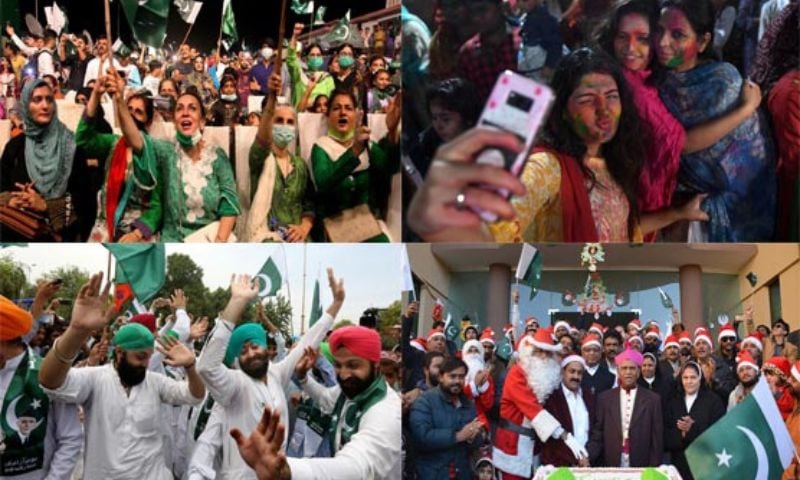
- Pakistan officially celebrates Minorities Day to recognise the contribution of religious minorities to nation-building
- Public holidays are declared for Holi, Diwali, and Easter, while Christmas is a general public holiday
- Ten religious’ functions of minority communities are celebrated at the official level, including:
- Christmas and Easter for Christians
- Holi and Diwali for Hindus
- Baisakhi and Birthday of Guru Nanak for Sikhs
- Nauroze for Zoroastrians
- Eid-e-Ridvan for Bahais
- Festival of Lights for Buddhists
- Chelum Jhust for the Kalash people
Protecting religious minorities through legislation
Pakistan has enacted landmark legislation to protect minority rights:
The Hindu Marriage Act 2017 applies across Pakistan except Sindh, which has its own Sindh Hindu Marriage Act 2016. These laws protect Hindu women who were previously discriminated against in marriages.
The Sikh Marriage Act was implemented in Punjab, the first province to pass such legislation, allowing Sikhs to register their marriages according to their own religious customs.
The Ministry of Human Rights, in consultation with Christian minorities, has also prepared a Christian Marriage and Divorce Act, which will be introduced in Parliament once finalised.
Read Also: From Nation-Building to Festive Cheer: Pakistan’s Christian Legacy
Combating forced conversion with wisdom
Pakistan has taken proactive measures to address concerns about forced conversions. An agreement between the Pakistan Hindu Council and Ulema established clear protocols:
- The law approved by Parliament on conversion will be followed
- Information about any Hindu seeking conversion will be reported to local Hindu community leaders
- A meeting with parents will be arranged
- If the individual still desires conversion after meeting with parents, it will proceed
This balanced approach ensures that religious freedom is protected while preventing coercion.
Read Also: Pakistan Sets Up Special Hospital Wards for Sikh Pilgrims Attending Guru Nanak’s Birth Anniversary
Religious tourism: Opening Pakistan to the world
Pakistan has emerged as a global hub for religious tourism, welcoming pilgrims from around the world:
- The historic Kartarpur Sahib Corridor was opened, allowing Sikh pilgrims from India and around the world to visit their sacred sites
- The 550th birthday celebration of Baba Guru Nanak was held with great reverence
- The Baba Guru Nanak Scholarship supports talented students from Hindu and Sikh communities
- Pakistan has hosted more than 60,000 yatrees (pilgrims) from across the world
- Shewala Teja Mandirand Gurdawara Choa Sahib, Jehlum were opened for worship
- Amer Kundat Katas Raj was restored to its original glory
- A delegation of Korean Buddhist monks led by the President of the Jogya Order visited Pakistan to promote religious tourism
- Books and promotional material on Sikh and Hindu heritage are distributed through foreign missions
Read Also: Pakistan’s Immense Potential for Religious Tourism
Ensuring security for all faiths
Pakistan takes the security of its minority communities seriously, particularly during religious festivals:
- Foolproof security arrangements are made by provincial governments during religious festivals
- A grievance cell has been established to address complaints from non-Muslims
- District Interfaith Harmony Committees operate throughout the country
- Interfaith Harmony Conferencesare held to promote interfaith culture
- Tehsil-wise Quick Reaction Minority Task Forces were formed in districts including Ghotki, Kashmore, Jaccobabad, Naushahro Feroze, and Sanghar
- A One-Man Commission on Minority Rights led by Dr. Shoaib Suddle created district committees in Mirpurkhas and Umerkot to resolve issues at the grassroots level
Read Also: Pakistan’s Leaders Mark Diwali with Messages of Unity and Respect for Hindu Community
In Peshawar, following incidents targeting the Sikh community, authorities implemented comprehensive security measures including CCTV cameras in Sikh-dominated areas, plainclothes police vigilance, and engagement with religious clerics to maintain harmony. The Counter-Terrorism Department arrested four Afghan nationals allegedly involved in targeting religious clerics and Sikhs.
The Blasphemy Laws: Fair and just application
Pakistan’s blasphemy laws apply fairly to all citizens regardless of religion:
Since 2005, 61 individuals have been convicted on blasphemy offenses:
- 48 Muslims (79%)
- 7 Christians (11%)
- 2 Hindus (3%)
- 4 Qadianis (7%)
Among 524 currently under trial in blasphemy cases, only 11% (55 individuals) are non-Muslims. Minorities convicted on blasphemy are given fair trials and have rights of appeal in higher judiciary.
Importantly, Pakistan’s higher judiciary has demonstrated its independence by acquitting minority individuals including:
- Asia Bibi
- Shagufta Kausar
- Shafqat Emmanuel
- Notan Lal (a Hindu teacher)
These acquittals prove that Pakistan’s justice system protects the rights of all citizens, regardless of their faith.
Awareness programmes building a harmonious society
Pakistan has launched comprehensive awareness programs to educate the public about minority rights:
- Religious scholars have been mobilized to discourage misuse of blasphemy laws
- Education and awareness programs in schools, colleges, and universities highlight the rights of minorities in Islam
- The Gandhara Conclave 2023 brought together 30-35 prominent Buddhist monks and influencers from different countries to promote interfaith dialogue
A model for the Muslim World
Pakistan’s journey in protecting minority rights and promoting interfaith harmony is a story of remarkable progress. From constitutional guarantees to reserved political representation, from public holidays for minority festivals to the restoration of sacred sites, Pakistan has built a comprehensive framework that protects and celebrates religious diversity.
The challenges remain, as they do in every nation, but Pakistan’s commitment to Jinnah’s vision is unwavering. The founder’s assurance that minorities would be free to practice their religion without state interference has been transformed into policies that are making a real difference in the lives of millions.
Pakistan stands as an example to the Muslim world and beyond, a nation where religious diversity is not merely tolerated but celebrated, where minority communities are not just protected but empowered, and where the promise of religious freedom continues to guide the nation forward.