Key Points
- Pakistan holds ECO Council chairmanship for 2026–2027.
- Pakistan seeks greater trade among ECO member states.
- Climate resilience is among Pakistan’s four key priorities.
- Pakistan wants reforms to ECO institutions and Secretariat.
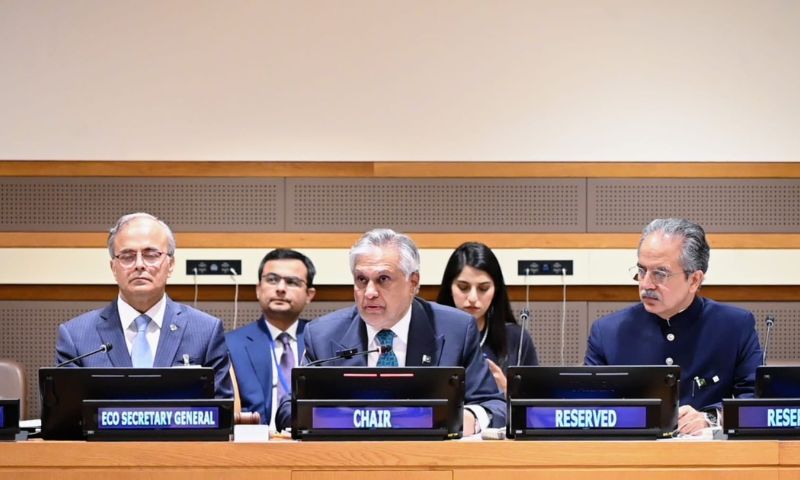
NEW YORK, United States: Pakistan’s Deputy Prime Minister and Foreign Minister Mohammad Ishaq Dar has called for stronger regional integration within the Economic Cooperation Organization (ECO), saying Pakistan’s chairmanship will seek to turn the bloc’s shared aspirations into practical economic and development outcomes.
Addressing the Informal Meeting of the ECO Council of Ministers in New York, Dar said Pakistan was honoured to assume the chairmanship of the Council of Ministers for 2026–2027 and would work under the theme “Reviving Regionalism for a Resilient ECO.”
Video of the remarks by the Deputy Prime Minister/Foreign Minister Senator Mohammad Ishaq Dar @MIshaqDar50 at the Informal Meeting of ECO Council of Ministers in New York pic.twitter.com/5ryVfQl7p2
— Ministry of Foreign Affairs – Pakistan (@ForeignOfficePk) September 26, 2026
The meeting was held on the sidelines of the 81st session of the United Nations General Assembly and was attended by foreign ministers and senior representatives of ECO member states.
🔊 PR No. 2️⃣6️⃣4️⃣/2️⃣0️⃣2️⃣6️⃣
Deputy Prime Minister/Foreign Minister Senator Mohammad Ishaq Dar @MIshaqDar50 Chairs Informal Meeting of ECO Council of Ministers in New York
🔗⬇️ pic.twitter.com/woVPPwpgvU
— Ministry of Foreign Affairs – Pakistan (@ForeignOfficePk) September 26, 2026
Dar said the organisation needed to move from dialogue towards delivery and transform the ECO region into a more integrated, dynamic and competitive part of the Global South.
Dar began his address by expressing concern over the prevailing security situation in the region and the Middle East.
He reiterated Pakistan’s commitment to the peaceful and negotiated resolution of disputes in accordance with international law, saying Islamabad had engaged with regional countries and partners to facilitate peaceful outcomes.
Dar said ECO member states should harness their collective strength to promote peace, resilience, solidarity and shared prosperity.
Trade integration priority
Dar identified trade and economic integration as the first major priority of Pakistan’s ECO chairmanship.
He said the ECO region covered around 8 million square kilometres and was home to nearly half a billion people, yet accounted for only around 2.2 per cent of global trade. He added that intra-regional trade remained approximately 8 per cent of total regional trade.
Dar said these figures highlighted the region’s untapped economic potential and called for lessons to be drawn from successful regional organisations to deepen economic integration.
The ECO comprises Afghanistan, Azerbaijan, Iran, Kazakhstan, Kyrgyzstan, Pakistan, Tajikistan, Türkiye, Turkmenistan and Uzbekistan. The organisation was established in 1985 by Pakistan, Iran and Türkiye, while seven additional members joined in 1992.
Connectivity and transit
Dar said strengthening transport networks, harmonising customs procedures and improving transit systems must remain central to the ECO agenda.
He called for accelerated operationalisation of key corridors linking Central Asia with ports on the Arabian Sea.
Pakistan, he said, was ready to serve as a gateway for the region by leveraging its geographical position and liberalised visa regime to facilitate the movement of people and goods.
Pakistan has long promoted its seaports and transport links as potential gateways for landlocked Central Asian states, particularly through road, rail and transit-trade connections.
Deputy Prime Minister/Foreign Minister Senator Mohammad Ishaq Dar @MIshaqDar50 chaired the 27th Informal Meeting of the ECO Council of Ministers (COM) in New York, on the sidelines of the 81st Session of the UN General Assembly.
The meeting was attended by Foreign Ministers of… pic.twitter.com/GIpdYPYfal
— Ministry of Foreign Affairs – Pakistan (@ForeignOfficePk) September 26, 2026
The emphasis on connectivity also builds on the ECO’s longstanding objective of developing commercially viable transport corridors to improve regional trade and mobility.
Digital trade push
Dar also called for progress on the ECO Trade Agreement, describing it as an important instrument for regional economic integration.
He urged member states to build on the roadmap adopted by ECO trade ministers in November 2025 and move towards a functional and digitally enabled ECO Free Trade Area.
Dar said greater market access, digitalisation and support for businesses could help promote innovation and expand trade within the region.
Climate change was identified as another major area for regional cooperation. Dar said climate pressures were increasingly threatening water security, agriculture and livelihoods across the ECO region.
He called for stronger cooperation on disaster risk reduction, climate-resilient infrastructure, sustainable energy and adaptation.
Institutional reforms
Dar also called for stronger political commitment and institutional reforms within the ECO.
He proposed reviewing and streamlining the ECO Secretariat and affiliated institutions to ensure that their mandates and structures remain responsive to changing geopolitical and economic conditions.
Dar said Pakistan’s objective was to revitalise regional cooperation and strengthen the collective capacity of ECO member states to withstand geopolitical, economic and environmental challenges.
Islamabad meeting ahead
The informal meeting in New York also set the stage for the next formal ECO ministerial gathering in Pakistan.
Dar said Pakistan was preparing to host the 30th ECO Council of Ministers meeting in Islamabad in November 2026.
Dar also said Pakistan was advancing the Strategic Goals of Economic Cooperation 2026–2035, which he described as a framework for cooperation over the coming decade.
Dar expressed confidence that the New York meeting would provide fresh impetus to the regional agenda and help translate common aspirations into practical outcomes.