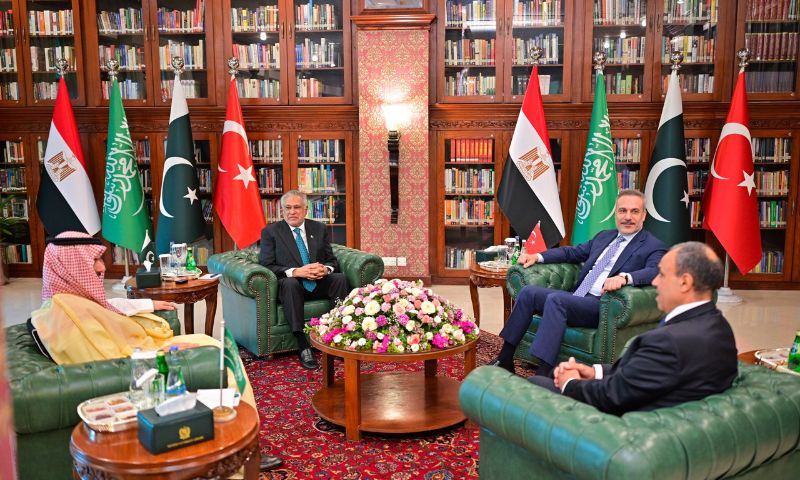
ISLAMABAD: The key talks commenced on Sunday in Islamabad as Pakistan hosted the Quadrilateral Consultations, bringing together the Foreign Ministers of Pakistan, Saudi Arabia, Turkiye, and Egypt to discuss the evolving situation in the Middle East as Islamabad is acting as a lead mediator between the United States and Iran.
“Convened at the invitation of Deputy Prime Minister / Foreign Minister Senator Mohammad Ishaq Dar, the Foreign Ministers during the consultations will review the evolving regional situation and discuss issues of mutual interest,” a Foreign Office statement said on Sunday.
The Consultations among the Foreign Ministers of Pakistan, Saudi Arabia, Türkiye, and Egypt have commenced in Islamabad on 29 March 2026.
Convened at the invitation of Deputy Prime Minister / Foreign Minister Senator Mohammad Ishaq Dar @MIshaqDar50, the Foreign Ministers during… pic.twitter.com/5capTCXUNO
— Ministry of Foreign Affairs – Pakistan (@ForeignOfficePk) March 29, 2026
Egypt’s Badr Abdelatty and Hakan Fidan from Turkey arrived in Islamabad on Saturday night while their Saudi counterpart Faisal bin Farhan touched down on Sunday afternoon.
Before the meeting, Pakistan’s Foreign Minister Ishaq Dar held separate bilateral talks with his visiting counterparts.
Pakistan emerges as diplomatic bridge
Islamabad has increasingly positioned itself as a key intermediary between Tehran and Washington, relaying messages and facilitating indirect engagement between the two adversaries.
At the opening of the Quadrilateral Consultations in Islamabad on 29 March 2026, the Foreign Ministers of Pakistan, Saudi Arabia, Türkiye, and Egypt pose for a family photo. pic.twitter.com/JLEOlVTuyS
— Ministry of Foreign Affairs – Pakistan (@ForeignOfficePk) March 29, 2026
Prime Minister Shehbaz Sharif has intensified outreach to global leaders, offering Pakistan as a neutral venue for peace talks and urging a “comprehensive settlement” to the conflict.
Saudi Foreign Minister meets PM Sharif
After attending the quadrilateral moot on the Middle East conflict at the Ministry of Foreign Affairs, the foreign ministers of Saudi Arabia, Turkiye and Egypt called on Prime Minister Shehbaz Sharif this evening.
According to a statement issued by the Prime Minister’s Office, the premier warmly welcomed the Saudi Foreign Minister and conveyed his respectful regards for the Custodian of the Two Holy Mosques King Salman bin Abdulaziz Al Saud and warm greetings for Crown Prince Mohammed bin Salman bin Abdulaziz Al Saud.
While reaffirming Pakistan’s full and unwavering solidarity and support with Saudi Arabia, PM Shehbaz appreciated the remarkable restraint exercised by Riyadh amid the current crisis.
PM Shehbaz assured the Saudi FM that Pakistan would always stand shoulder to shoulder with Saudi Arabia.
While emphasising Saudi Arabia’s leadership role in the Muslim Ummah, PM Sharif stressed the need to forge unity within the Islamic countries at this critical time.
Foreign Minister of Kingdom of Saudi Arabia Prince Faisal bin Farhan Al-Saud calls on Prime Minister Muhammad Shehbaz Sharif in Islamabad. 29 March 2026.#PakistanforPeace pic.twitter.com/gGPJMfCpDd
— Prime Minister's Office (@PakPMO) March 29, 2026
Turkiye, Egypt FMs meet PM Sharif
Later, foreign ministers from Turkiye and Egypt met PM Sharif for talks focused on promoting peace in the Middle East.
The Turkish top diplomat Hakan Fidan and Egyptian Foreign Minister Dr. Badr Abdelatty were received at the Prime Minister’s House by Special Assistant Tariq Fatemi, before holding a meeting with the premier.
Prime Minister Sharif warmly welcomed the distinguished Foreign Ministers in his office.
The discussions were attended by Pakistan’s Deputy Prime Minister and Foreign Minister Ishaq Dar and National Security Adviser Muhammad Asim Malik, and focused on regional developments and collective efforts to advance peace and stability.
Islamabad: 29 March 2026
Meeting of Foreign Ministers in Pakistan for Peace in the Middle East
Foreign Minister of Türkiye Hakan Fidan and Foreign Minister of Egypt Dr. Badr Abdelatty arrive at the Prime Minister’s House for a meeting with the Prime Minister.
The Special… pic.twitter.com/Ga2MWNMYon
— Prime Minister's Office (@PakPMO) March 29, 2026
Pakistan’s Pivotal Role in Peace Efforts
Recent developments further highlight Pakistan’s growing role as a peace facilitator and Islamabad as a neutral diplomatic venue. Iran has agreed to allow limited passage of Pakistani-flagged vessels through the Strait of Hormuz, which officials in Islamabad describe as a “constructive gesture” toward de-escalation.
Analysts note that Pakistan’s close ties across the region — including its cooperation with Saudi Arabia and its shared border with Iran — enhance its ability to facilitate dialogue and promote de-escalation.
While expectations remain cautious, diplomats say the Islamabad meeting could mark the beginning of a coordinated diplomatic effort led by regional powers.
“This is not yet a breakthrough,” a senior official said, “but it could become the foundation for sustained dialogue if momentum is maintained.”
With violence escalating and new actors entering the conflict, the coming days will be critical in determining whether diplomacy can outpace war.
Pakistan’s proactive diplomatic engagement is rooted in its long-standing commitment to regional peace and stability. Leveraging its balanced relations with Iran, Gulf states and global powers, Islamabad is uniquely positioned to play a constructive role in reducing tensions.
Analysts note that Pakistan’s close ties across the region — including its cooperation with Saudi Arabia and its shared border with Iran — enhance its ability to facilitate dialogue and promote de-escalation.
This strategic positioning underscores Pakistan’s responsible approach as a peace facilitator, prioritising stability, economic security and cooperative solutions over confrontation.
At the same time, Pakistan’s neutral positioning — maintaining ties with both Iran and the US — has enhanced its credibility as a potential peacemaker.