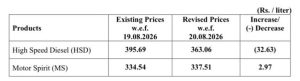
ISLAMABAD: Pakistan’s government on Wednesday announced a major reduction of Rs32.63 per litre in the price of high-speed diesel (HSD), while increased the petrol price by Rs2.97 per litre under new price mechanism.
Under the revised rates, petrol will be sold at Rs337.51 per litre, while HSD will cost Rs363.06 per litre.
According to a notification issued by the Petroleum Division, the revised prices will take effect from Thursday, August 20.
ڈیزل کی قیمت میں 32 روپے 63 پیسے کی کمی#DieselPriceCut #FuelPriceReduction #DieselUpdate #FuelRelief pic.twitter.com/Doi7WeEIdQ
— APP (@appcsocialmedia) August 19, 2026
Earlier, Petroleum Minister Ali Pervez Malik, addressing a press conference along with Information Minister Attaullah Tarar, said the price of diesel would be reduced by more than Rs30 to Rs32 per litre following discussions with the refineries.
The announcement came after the government held talks with petroleum refinery representatives to discuss the reduction in diesel prices and its impact on consumers.
“…I am thankful to the refineries,” the minister said, highlighting that they’ve helped the government during the war by reducing the price of petroleum products.
Minister for Petroleum Ali Pervaiz Malik has announced that oil refineries have agreed to reduce diesel price by around 32 rupees per liter to provide relief to the people @AliPervaiz450 @TararAttaullah @Official_PetDiv #RadioPakistan #News #OGRA https://t.co/6WLyp2iZwV
— Radio Pakistan (@RadioPakistan) August 19, 2026
The minister said that he would hold consultations with the refineries in Karachi on the upgradation of refineries — which has not been done “for more than seven decades”.
Tarar, while briefing journalists, said the prime minister had chaired the meeting and directed the petroleum minister and relevant officials to negotiate with oil refineries and ensure whatever relief was possible was provided to the public.
Also Read: Pakistan to Cut Diesel Price by Rs30-32 per Litre: Minister
He said providing maximum possible relief to the people had remained the government’s priority, adding that the public would receive “more good news” in the coming days.
Pakistan daily fuel price review mechanism
The Pakistan government shifted to a daily fuel price review mechanism amid heightened volatility in global oil markets triggered by renewed tensions in the Middle East. The move is aimed at ensuring that changes in international oil prices are reflected more quickly in domestic fuel rates.
The government had earlier replaced the fortnightly pricing system with weekly reviews following the outbreak of the Middle East conflict.
The latest escalation in regional tensions and concerns over disruptions to energy supplies through the Strait of Hormuz prompted authorities to adopt daily price revisions.
Petrol is mainly used in private transport, small vehicles, rickshaws and two-wheelers, and changes in its price affect the middle and lower-middle classes.
Similarly, changes in diesel prices also impact the public at large, as it is mainly used in the heavy transport sector, power plants and large generators.
Oil Tops $91
Oil prices rose for a fourth consecutive session on Wednesday as conflicting claims from the United States and Iran over shipping through the Strait of Hormuz kept markets focused on the risk of supply disruptions.
Brent crude futures gained 26 cents, or 0.29 per cent, to $91.28 a barrel in early trade. Likewise, US West Texas Intermediate crude rose 37 cents, or 0.44 per cent, to $85.31.
Both benchmarks had closed at their highest levels since July 24 in the previous session.
The latest gains came after US President Donald Trump said the Strait remained open, contradicting Iran’s position that the strategic waterway would stay closed until Washington met conditions set out in an earlier interim agreement.
The uncertainty is significant because the Strait of Hormuz normally carries about one-fifth of global oil and liquefied natural gas shipments.
Recent shipping data shows traffic has fallen dramatically: only six commodity vessels crossed on Monday, compared with a 10-day average of 11, and no very large crude carriers or LNG tankers were recorded.
The lack of clarity has made traders increasingly sensitive to developments around the waterway.
The temporary US-Iran ceasefire has expired without a broader agreement, and Washington and Tehran continue to issue conflicting statements about negotiations and the status of Hormuz.