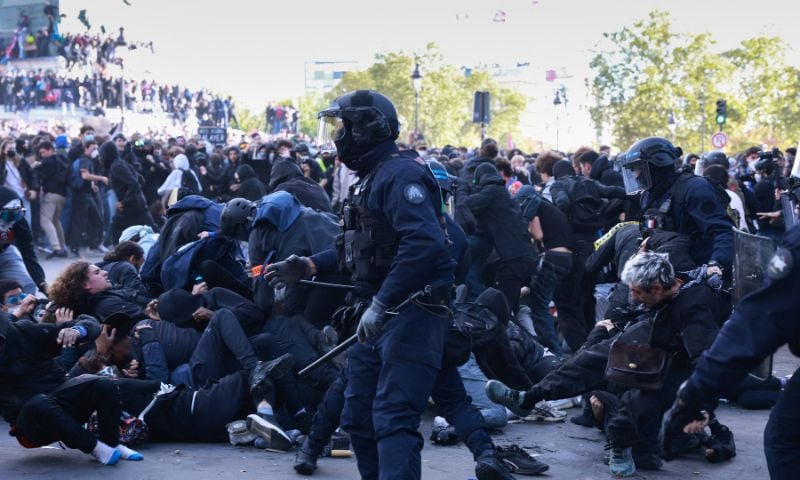
PARIS, France: Student protests in France have snowballed into a wider movement in their third week, drawing support from some of the country’s most prestigious universities and intensifying pressure on the government over staff shortages, education spending and the state of the public school system.
Student unions vowed on Friday to continue demonstrations after the government pledged to deploy 3,000 qualified teachers who have yet to take up their posts.
Despite the concession, 141 schools remained shut across the country, according to the education ministry.
The movement has grown beyond high-school blockades, with some university students joining the protests to express anger over what they describe as a dysfunctional education system, further strained by spending cuts linked to France’s budget pressures.
The unrest presents a challenge for the government, which must respond to demands for greater education funding while trying to rein in public debt.
It also risks reviving the kind of street protests that have historically forced French governments to retreat from austerity measures.
Student and teacher unions have called for another nationwide school strike next Tuesday.
Universities Join Protests
Police cleared a blockade at Assas University, one of France’s leading law schools, in central Paris on Friday morning, broadcaster BFM TV reported. Nearby, the prestigious Mines Paris engineering school was also disrupted by blockades.
The Institut Catholique, a private university known for its conservative reputation, announced on its website that it would switch to remote classes because of a blockade at its campus.
The growing involvement of universities has added momentum to a movement that began with school blockades and has increasingly focused attention on staffing shortages and the wider pressures facing public education.
Student unions described the government’s pledge to deploy additional teachers as their first significant achievement since the protests began.
Marius Mesnil, a representative of a high-school student union, told Franceinfo radio that the concession demonstrated the value of continuing the demonstrations.
“I find it crazy we need to block hundreds of high schools just to get a vacancy plan,” he said.
Education Minister Edouard Geffray told broadcaster TF1 that the measure would take effect immediately and cost “several dozen million euros”.
Pressure Over Spending
The protests come as France faces difficult choices over public spending, with investors closely monitoring the government’s response in a country carrying a heavy debt burden.
The government is under pressure to address shortcomings in education while limiting expenditure. France’s substantial pension commitments and efforts to reduce public spending have narrowed its room for manoeuvre.
Stephane Boujnah, head of Euronext, which operates the Paris stock market, said France urgently needed to make difficult decisions to bring down its debt, arguing that the issue was particularly important for younger generations.
“What sacrifice are we asking of our own children? Because we’re going to leave them with a complicated situation, and if we want them to be able to make their own choices — if we want to solve the problem for high school students — well, maybe we need to spend a little less on pensions so that we have a little more money for the children,” he told RMC radio.
The debate reflects a broader tension between demands for better-funded public services and the government’s efforts to bring public finances under control.
Staffing Shortages
Nearly 10% of teaching hours at French state high schools remain unstaffed, according to education ministry figures.
The shortage has contributed to growing dissatisfaction among parents and students. It has also prompted increasing numbers of wealthier families to leave the public education system in favour of private schools, adding to concerns about unequal access to education.
For protesters, the government’s promise to deploy 3,000 qualified teachers addresses one of their main grievances, but unions have indicated that the concession will not end the campaign.
The continuation of demonstrations and the call for another nationwide strike suggest that the dispute could persist as students and teachers press for further action.
Violence and Wider Unrest
France’s interior ministry said 71,500 people took to the streets in Paris and elsewhere on Thursday. While most demonstrations were peaceful, authorities reported increasing violence in some locations.
A fire broke out at a school in the western city of Poitiers, the ministry said. Officials also reported incidents of vandalism and attacks against education staff elsewhere in the country.
The unrest has also coincided with labour protests in neighbouring Belgium, where two major unions staged a nationwide strike on Friday against planned government budget cuts and the rising cost of living.
The strike disrupted public transport, schools and air traffic. Tens of thousands of protesters were expected to gather in Brussels later on Friday for a major demonstration.
The developments highlight mounting public discontent over spending decisions and the cost of living in parts of Europe, as governments face competing demands to protect public services and control their budgets.