
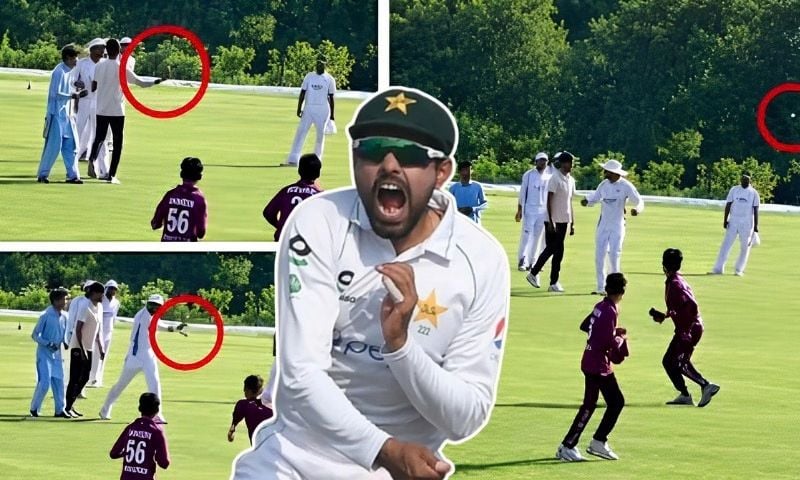
Babar Azam has once again found himself at the centre of a social media debate after a video showed him taking a fan’s mobile phone and throwing it away during a President’s Trophy match in Islamabad.
The incident happened on September 30 at Diamond Cricket Ground, where Babar was representing OGDC against State Bank of Pakistan. Videos circulating on social media show spectators entering the playing area and approaching Babar while he was fielding. One fan came towards him for a selfie, and Babar took the phone and threw it away.
There is no doubt that Babar’s reaction can be criticised. A fan’s phone is personal property, and taking it and throwing it was not the right way to deal with the situation.
But before turning the incident into another debate about Babar’s attitude, perhaps we should ask a different question: what was happening around him at that moment?
As someone who has worked as a journalist and follows sport closely, I understand that a player on the field can be in a completely different mental space.
When a player is in the middle of a match, his focus is on the game. He may be dealing with pressure, frustration, fatigue, competition and the need to perform. The situation becomes even more intense when the match is close or when a player is already under pressure because of his own performance.
In those moments, players can react emotionally. We have seen cricketers argue with opponents, exchange words with teammates and show frustration on the field. These things happen in competitive sport.
That does not mean every reaction should be excused. Players are public figures and they are expected to behave responsibly. But it also means we should be careful about judging a player’s entire personality from one moment without understanding the circumstances around it.
In Babar’s case, the situation was not simply a fan standing outside the boundary asking for a picture.
Reports from the match say spectators repeatedly entered the playing area to approach him. At one point, another fan approached him while he was fielding, and later, after Babar was dismissed for 21, several spectators again surrounded him while he was trying to return to the pavilion. Ground staff had to intervene.
That raises another important question: where does a fan’s right to meet a favourite player end, and where does a player’s personal space begin?
Fans naturally want pictures with their favourite cricketers. For someone like Babar, who attracts huge attention, that is part of being a star. But a cricket ground is still a workplace for the player during a match. Entering the playing area and repeatedly approaching a player can distract him and create a security concern.
We also cannot know exactly what was going through Babar’s mind at that moment.
Maybe he was frustrated with his own performance. Maybe he was completely focused on the match. Maybe he was tired of repeated interruptions. Or perhaps he was simply having a bad moment.
And that is exactly why criticism should come with some context.
Babar’s reaction can be questioned without turning it into a judgement about who he is as a person. At the same time, the behaviour of spectators who enter the playing area should also be questioned.
Players are human beings before they are celebrities.
They can lose their patience. They can have bad days. They can make mistakes. And sometimes, a few seconds on camera do not tell us the complete story.
Babar could have handled the situation differently. But before criticising him, we should also look at the environment in which that moment happened.
The question is not only, “Why did Babar throw the phone?” It is also, “Why was a fan able to walk onto the playing field and approach him in the first place?”
Both sides of the incident deserve to be looked at.