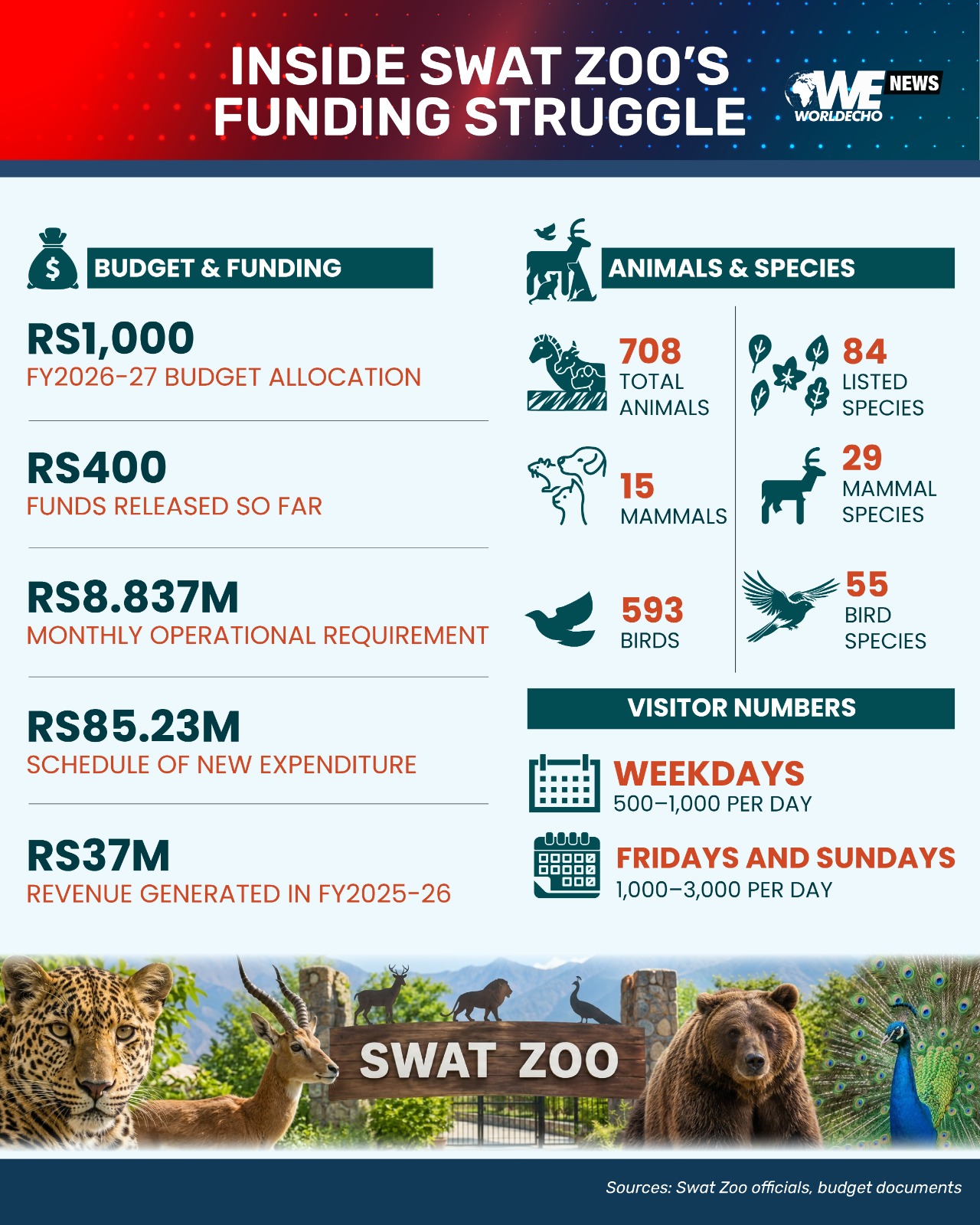
MINGORA, Pakistan: The cages are full, the visitors keep coming and the animals still need to be fed every day. Yet the sprawling Swat Zoo has been allotted just Rs1,000 ($3.6) for the fiscal year 2026-2027 to cover its operational expenses, leaving wildlife officials struggling to keep the facility afloat.
The paltry operational allocation for the Swat Zoo has triggered widespread criticism across Khyber Pakhtunkhwa, with conservationists, students, researchers and local residents describing the amount as grossly inadequate for a facility that houses hundreds of animals, employs around 100 workers, and attracts thousands of visitors every month.
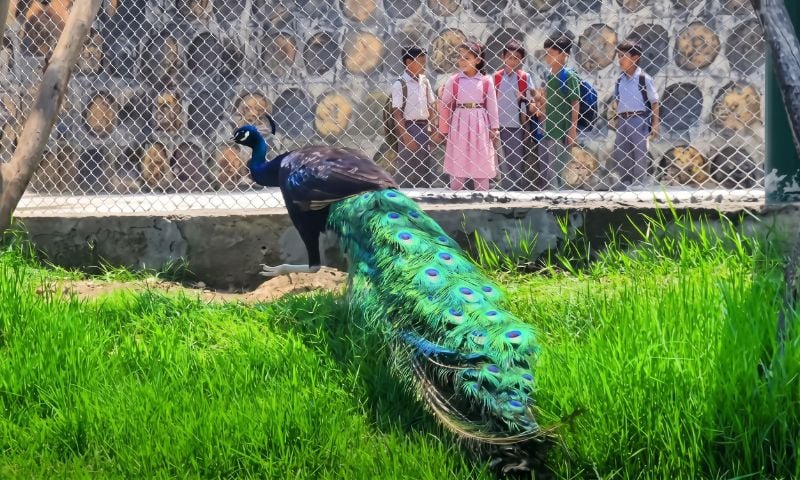
According to data provided by zoo officials, the facility houses 708 animals representing 84 listed species, including 115 mammals from 29 species and 593 birds from 55 species.
For a facility of this scale, however, the issue goes far beyond the size of a budget line. It is about keeping an institution that depends on daily supplies, regular staffing and continuous care functioning day after day.
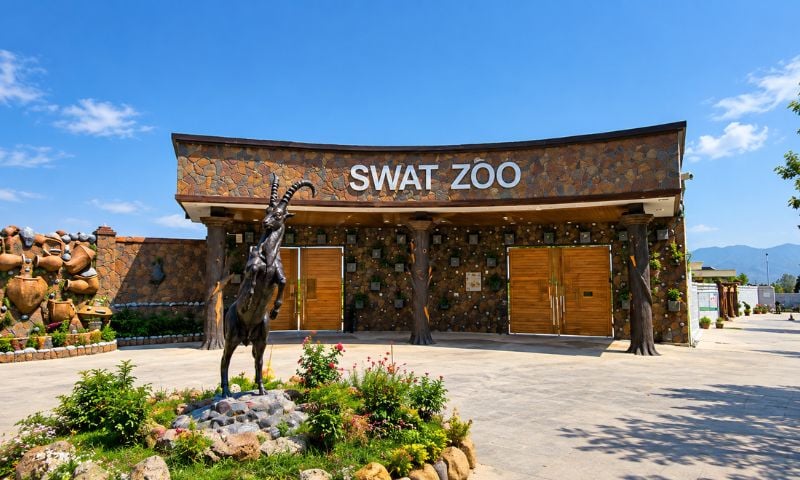
A zoo with such a sizeable collection and a steady stream of visitors, meanwhile, has become a key part of Swat’s educational, recreational and tourism landscape.
Located in Kanju Township, about 5 kilometres from Mingora city, the Swat Zoo is one of the largest public wildlife facilities in northern Pakistan. Established in the scenic Swat Valley — one of Pakistan’s most popular tourist destinations known for its lush green landscapes, pleasant climate and rich biodiversity — the zoo has become an important educational, recreational and conservation centre since it opened to the public.
A growing cash crunch
But behind the attraction for visitors lies a growing financial strain, with officials struggling to meet even the zoo’s most basic running costs.
“The funds allocated in the budget are meant to cover salaries, utility bills, animal feed and other expenses. However, this year, the government has released only Rs400 out of the Rs1,000 allocated in the budget.” Abdul Ghafoor, wildlife conservator
“The funds allocated in the budget are meant to cover salaries, utility bills, animal feed and other expenses. However, this year, the government has released only Rs400 out of the Rs1,000 allocated in the budget,” Abdul Ghafoor, the conservator of wildlife at Swat Zoo, tells WE News English.
He says that zoo staff have not received their salaries for four months.
“Moreover, all bills submitted by the feed contractor are pending, and we have also been unable to pay the utility bills,” he adds. The zoo owes Rs10.75 million in outstanding dues to the feed contractor.
The unpaid bills come as the zoo continues to shoulder the recurring costs of feeding and caring for hundreds of animals.
Running on a shoestring
Wildlife officials say the amount allocated in the budget is insufficient even to purchase a single day’s feed for the animals, let alone meet the full daily expenses of the zoo. In other words, the zoo is being expected to keep the show on the road without the means to pay for the fuel.
“The zoo incurs daily expenditure on animal feed, medicines, electricity, maintenance and staff salaries. A budget of Rs1,000 cannot support any of these essential requirements,” says Ghafoor.
The development work on the zoo began in 2021 and was completed on June 30, 2026, including the construction of enclosures and the procurement of animals.
With the development phase now complete, the zoo has moved from building infrastructure to the far more demanding task of keeping it operational.
“During the fiscal year ending June 30, 2026, the zoo generated approximately Rs37 million in revenue through entrance fees and other receipts, with the entire amount deposited into the government treasury,” Ghafoor says.
The visitor numbers continue to increase every year. On weekdays, around 500 to 1,000 visitors come to the zoo daily, while on Fridays and Sundays the number rises to 1,000 to 3,000 visitors.
The growing footfall also means greater pressure on the facility — and on the people responsible for keeping it clean, secure and functioning.
Staff left in limbo
Officials say the zoo currently has about 35 regular employees, while dozens of additional workers have been hired on daily-wage basis for animal care, cleaning, horticulture, maintenance and security, bringing the total workforce to nearly 100 people.
However, the completion of the development phase has created an urgent need to shift the zoo’s expenditures from the development budget to the regular operational budget.
That shift, Ghafoor says, is yet to be matched by a corresponding financial commitment from the government.
“We submitted a Schedule of New Expenditure (SNE) amounting to Rs85.23 million to the provincial government in June 2025. Two or three meetings have also been held regarding its approval, but it is still pending,” he complains.
Until the SNE is approved, he adds, the future of the staff remains uncertain.
“If these funds are not released immediately, contractors may stop supplying food and medicines for the animals, creating serious welfare concerns,” Ghafoor says.
When funding runs dry
The financial squeeze is not confined to unpaid bills or staff salaries. Wildlife experts say the consequences of prolonged underfunding could ultimately be felt by the animals themselves.
“Animals need food and medical treatment every single day,” says wildlife researcher Dr Hamidullah, who frequently visits the facility for conservation studies.
“A zoo is not a building project that ends once construction is completed. It is a living institution whose expenses continue throughout the year. Without proper funding, animal welfare can be seriously compromised.” – Dr Hamidullah, wildlife researcher
“A zoo is not a building project that ends once construction is completed. It is a living institution whose expenses continue throughout the year. Without proper funding, animal welfare can be seriously compromised.”
The figures provided by zoo officials put that funding gap in stark terms
According to figures supplied by zoo officials, the facility requires Rs8.837 million each month to meet its operational needs, including Rs2 million for animal feed, Rs50,000 for medicines, Rs5.787 million for salaries, including those of keepers and security, Rs400,000 for utilities, and Rs600,000 for transport and other operations.
Its confirmed outstanding liabilities total Rs24.825 million, comprising Rs10.725 million owed to the feed contractor, Rs7.2 million in daily-wage labour and security dues, and Rs6.9 million in pending salaries for project staff. Any unpaid bills for telephones, electricity, water, gas or petrol are additional to this amount.
Learning beyond classrooms
Yet the zoo’s significance extends beyond its balance sheet. For students and researchers across the Malakand Division, it also provides something that cannot be replicated in a classroom or laboratory — direct contact with wildlife.
Researchers say the Swat Zoo has become an important centre for academic learning in the Malakand Division. For students, the zoo is more than a collection of cages; it is a classroom without walls.
“It is difficult to understand animal behaviour only from books,” says Ayesha Khan, a zoology student at the Government Girls College Saidu Sharif, Swat.
“When we visit the zoo, we observe different species closely, learn about their habitats and understand conservation practices. It is like a living classroom for students.” – Ayesha Khan, a zoology student
“When we visit the zoo, we observe different species closely, learn about their habitats and understand conservation practices. It is like a living classroom for students.”
Similarly, Bilal Ahmed, a veterinary student at the University of Veterinary and Animal Sciences Matta, Swat, says practical exposure at the zoo complements university education.
“Our laboratory work becomes much more meaningful when we can observe real animals and understand their health management. Losing such a facility would affect the quality of wildlife education in the region.”
For researchers, however, the zoo’s value is not limited to education. They also point to its role in providing a refuge for wildlife and raising public awareness about conservation.
“The zoo serves as a shelter for rescued and injured wild animals rescued from illegal trafficking or conflict with humans,” says Dr Sana Farooq, a Swat-based conservation researcher.
It also helps educate the public about biodiversity and encourages respect for wildlife, she adds.
More than wildlife
The same combination of education and recreation has also made the zoo a destination for families and tourists visiting the valley.
The valley, famous for its mountains, rivers and forests, draws large number of domestic tourists every year. Visitors say the zoo has added another family attraction to Swat’s tourism offering.
“The weather in Swat is pleasant throughout much of the year, making the zoo an ideal place for families,” says Muhammad Irfan, a local resident who visits the zoo regularly with his children.
The zoo allows children, he adds, to see animals they would otherwise only know through television or books.
Tourist Sadia Bibi, visiting from Peshawar, says the zoo adds value to Swat’s tourism sector.
“People come to Swat for its natural beauty, rivers and mountains. Having a modern zoo gives families another reason to spend more time in the valley. It should be improved rather than neglected.” – Sadia Bibi, tourist
“People come to Swat for its natural beauty, rivers and mountains. Having a modern zoo gives families another reason to spend more time in the valley. It should be improved rather than neglected.”
The cost of neglect
Researchers likewise see the facility as an investment in the valley’s long-term biodiversity research and conservation.
Shah Faisal, a biodiversity researcher at the University of Swat, says: “Wildlife conservation depends on research, education and public awareness. The Swat Zoo provides opportunities for all three. Investing in such institutions benefits future generations.”
The budget allocation has also prompted calls from civil society organisations for the provincial government to clarify whether the Rs1,000 figure was entered in error.
“If this is merely a budgetary placeholder or clerical mistake, it should have been corrected immediately through a supplementary grant,” says Muhammad Abid, a local social activist.
“But if this reflects the government’s actual financial priority for the zoo, it raises serious questions about the future of wildlife conservation and tourism development in Swat.”
Observers note that the zoo contributes not only to conservation but also to the local economy through tourism, employment and educational activities.
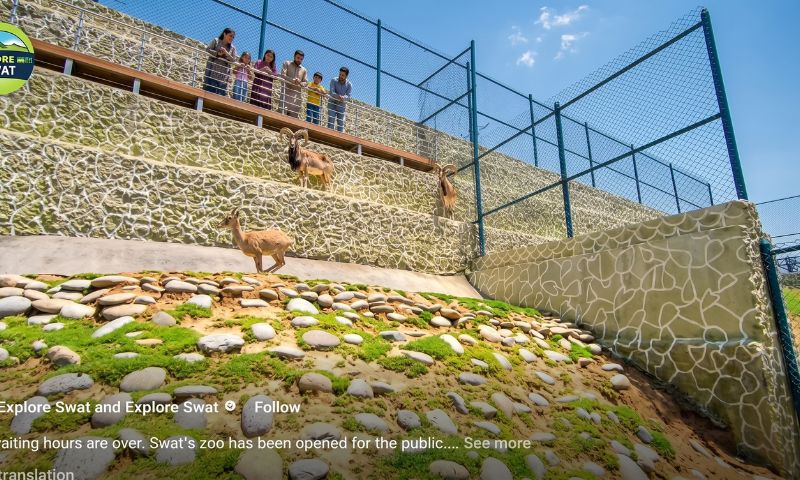
With visitor numbers steadily increasing and operational expenses mounting after the completion of its development phase, stakeholders believe that immediate financial support is essential to sustain the facility.
Until the operational budget and pending SNE are approved, officials warn that shortages of animal feed, veterinary medicines and staff could threaten both the welfare of the animals and the future of one of Swat Valley’s most significant public attractions.
Transition still unfinished
The government, however, says the financial impasse is being addressed and that the zoo’s transition from a development project to a regular government facility is already under way.
Junaid Khan, Secretary of Climate Change, Forestry, Environment and Wildlife, tells WE News English that the Swat Zoo project was initially included in the Annual Development Programme (ADP) and has now moved from the development phase to its current operational status.
He says the Finance Department would create regular posts for the project under the government department’s regular establishment.
“In the past, there have been instances where project staff were regularised, and similarly, the Finance Department has now created posts for the employees of Swat Zoo. We are trying to regularise the existing project staff, but the process will take some time.” – Junaid Khan, Secretary Wildlife
“In the past, there have been instances where project staff were regularised, and similarly, the Finance Department has now created posts for the employees of Swat Zoo. We are trying to regularise the existing project staff, but the process will take some time,” he says.
He adds that the department was not sitting idle and had already moved a summary to the Planning and Development (P&D) Department for further processing. “Soon, they will start receiving their salaries,” he says.
For now, the zoo remains caught between a completed development project and an unfinished financial transition — a facility that is open to the public, full of animals and drawing thousands of visitors, but still waiting for the funds needed to keep it running.