
Key Points
- Global trade reached a record $35 trillion in 2025.
- India is forecast to grow by 7.3 per cent in 2026, leading major Asian economies.
- Trade between China and the United States has fallen by more than 20 per cent since 2024.
ISLAMABAD: Global economic growth is expected to slow to 2.6 per cent in 2026 from 2.9 per cent last year as the energy shock from the Middle East crisis tests the resilience of the world economy, the United Nations trade and development agency said on Friday.
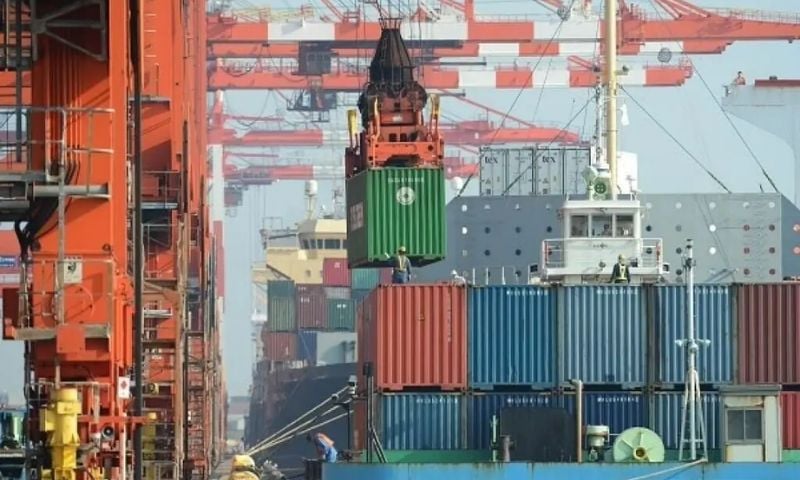
The United Nations Conference on Trade and Development (UNCTAD), in its latest Trade and Development Report, projected that global trade in goods and services would expand by 4 per cent in real terms this year, following a record $35 trillion in trade during 2025.
However, higher energy prices are contributing to the expected increase in trade value, while rising costs threaten to weigh on economic activity, businesses and consumers.
The outlook highlights the risks facing an interconnected global economy already under pressure from geopolitical tensions, trade restrictions and uncertainty over investment.
Asia remains the main growth engine
Asia is projected to account for 59 per cent of global economic growth in 2026, with India expected to expand by 7.3 per cent, Indonesia by 5.2 per cent and China by 4.5 per cent.
The forecasts underline the region’s importance to global production, investment and consumption. However, trade patterns are shifting as geopolitical tensions and restrictions reshape commercial relationships between major economies.
Trade between China and the United States has declined by more than 20 per cent since 2024, while East Asian economies have expanded trade with both China and North America.
UNCTAD warned that export controls, investment screening and supply-chain requirements were making it harder for new companies to enter strategically important industries.
Such barriers can limit competition and access to technology while encouraging businesses to reorganise production and sourcing across different markets.
AI trade raises financial risks
Artificial intelligence-related products, particularly semiconductors, are among the principal drivers of merchandise trade. UNCTAD cautioned, however, that rising trade in AI-related goods does not automatically translate into broad economic development.
The agency also warned that the AI boom could multiply risk factors to financial stability as markets become increasingly exposed to a small number of companies.
A sharp correction in technology valuations could undermine investor confidence and affect wider financial markets.
Global forecasts reflect uncertainty
Other international institutions have also warned that geopolitical conflict and trade disruption could weaken the global outlook, although their projections differ.
The World Bank cut its global growth forecast for 2026 to 2.5 per cent in June, citing the Middle East war, and warned that growth could fall to 1.3 per cent in its worst-case scenario.
The International Monetary Fund has projected growth of 3 per cent, but has also identified the Iran war, fragmentation of global trade and possible corrections in AI-related markets as significant risks.
The Organisation for Economic Co-operation and Development has forecast global growth of 2.9 per cent in 2026 despite the Middle East conflict, reflecting differences among international institutions in their assessments of the economic impact.
READ ALSO: OECD lifts 2026 global growth forecast to 2.9% despite Middle East war
The divergent projections highlight uncertainty in the world economy, with the prolonging conflict, energy prices, supply-chain resilience and the productivity gains from artificial intelligence likely to shape the outcome.
For energy-importing developing economies, higher oil and gas prices can increase transport and production costs, add to inflationary pressures and strain foreign exchange reserves. Governments may also face difficult choices between supporting households and businesses and maintaining spending on development.
The central concern is that expanding global trade may not translate into stronger economic growth if higher energy costs and geopolitical tensions continue to constrain production, investment and consumer demand.