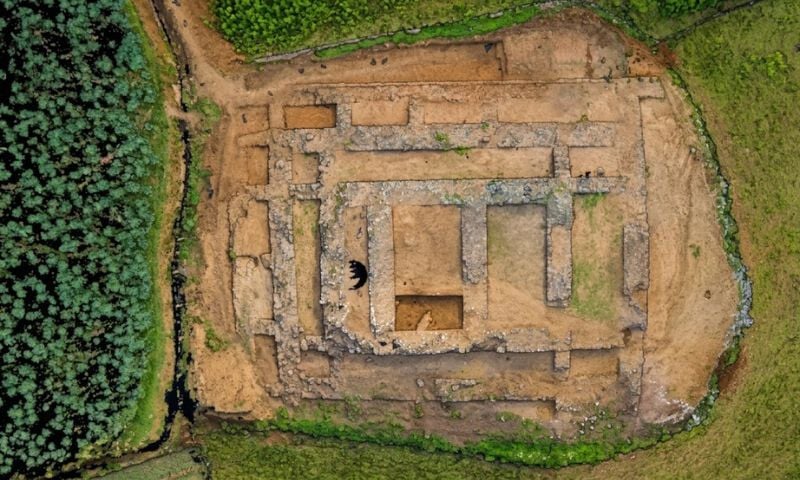
ISLAMABAD: A monumental ancient structure, measuring nearly 100 metres long and 50 metres wide, has been uncovered at Jandial in Pakistan’s historic Khanpur-Taxila region, offering fresh opportunities to explore the architecture, urban development and cultural history of the ancient Gandhara civilisation.
The discovery, announced by the Khyber Pakhtunkhwa (KP) Archaeology Department, has brought renewed attention to a site that remained largely unexplored for more than a century. Archaeologists are now investigating the structure’s original purpose and its place in the wider archaeological landscape of Gandhara.
Read Also: Pakistan Launches Conservation Plan to Protect 3,000-Year-Old Taxila Heritage
Monumental structure found near ancient Sirkap
Identified as Jandial D, the monument lies opposite the famous Ionic temple of Jandial, outside the fortified ancient city of Sirkap.
The structure was first noted by British archaeologist Alexander Cunningham in 1864, but it had remained largely unexplored until recent excavations began in mid-August 2026.
The latest archaeological work has revealed substantial walls, providing new evidence of the monument’s scale and construction. However, researchers have yet to determine whether it served a public, religious or another function.
The discovery is expected to contribute to a better understanding of the historical development and urban landscape of the Khanpur-Taxila region, one of Pakistan’s most significant archaeological areas.
International collaboration drives excavation
The discovery was made under the Khyber PATH Project, directed by Italian archaeologist Dr Luca M. Olivieri and funded by the Italian Agency for Development Cooperation (AICS).
The project is being implemented by the Italian Archaeological Mission of Ca’ Foscari University of Venice in collaboration with the KP Directorate General of Archaeology and Museums. KP Director General of Archaeology and Museums Dr Abdul Samad is supervising the initiative.
Italian non-governmental organisation ISCOS has also provided logistical and financial support.
Read Also: Pakistan’s Heritage And Diplomacy Intersect On World Heritage Day
Archaeologists highlight Gandhara’s untapped potential
Dr Abdul Samad said the discovery demonstrated the continuing archaeological potential of Khyber Pakhtunkhwa and highlighted the importance of scientific research and international cooperation.
“The discovery at Jandial demonstrates that the archaeological landscape of KP continues to hold important historical secrets,” he said.
“Our priority is to support scientific research, strengthen international partnerships and protect these irreplaceable heritage assets.”
He also stressed the need to safeguard archaeological remains threatened by expanding urbanisation, warning that development pressures make the protection of historic sites increasingly important.
Dr Olivieri said the discovery reflected the richness and unpredictability of the region’s archaeological landscape.
He added that the monument’s enormous scale and strategic location raised important questions about the ancient landscape of Sirkap and the wider Gandharan region.
Read Also: UNESCO to Include Two Heritage Sites of Pakistan in World Heritage List
Khyber PATH Project covers eight archaeological sites
The Khyber PATH Project has been operating for a year, conducting archaeological research and conservation work at eight sites across Khyber Pakhtunkhwa, from Swat to the Khanpur-Taxila region.
Its activities include the excavation and conservation of ancient fortifications at Sirsukh, as well as research at Bazira, also known as Barikot, in Swat. Barikot is included on UNESCO’s Tentative List of World Heritage Sites.
Read Also: Pakistan Opens 1,000-Year-Old Gakhar Heritage Sites for Tourists Near Islamabad
The discovery at Jandial adds another important dimension to these efforts, potentially helping researchers piece together how ancient settlements were organised and how monumental structures shaped the region’s historical landscape.
As excavations continue, archaeologists hope further findings will clarify the monument’s function and deepen understanding of Gandhara’s architectural and cultural heritage.