
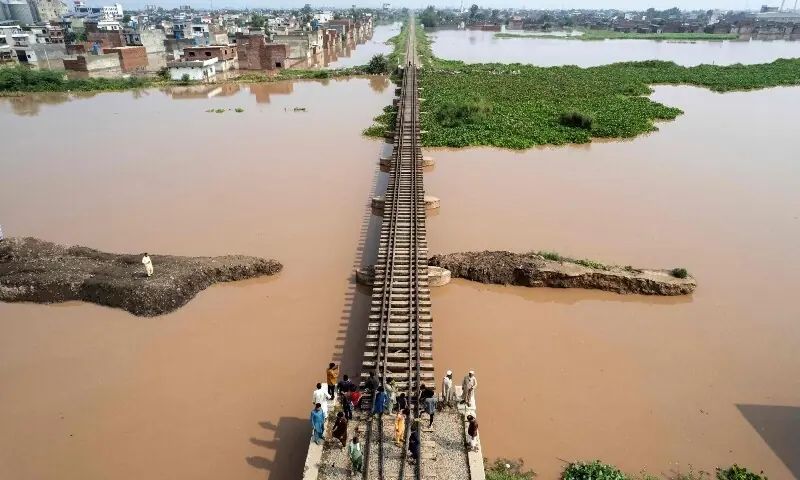
ISLAMABAD: Pakistan is bracing for a fresh and potentially devastating spell of monsoon rains starting tomorrow, as the Pakistan Meteorological Department (PMD) warned of widespread heavy to very heavy showers across the country from July 29 to August 5, threatening to unleash urban flooding, landslides, and flash floods in already waterlogged regions.
🌊 PMD Flood Bulletin | 28 JulGuddu may reach Medium Flood Level in 24 hrs. A fresh wet spell is expected from 29 Jul (night), with flash flood risk in Kabul River tributaries, DG Khan hill torrents & parts of Balochistan.#PMD #FloodUpdate #FloodForecast #PakistanWeather pic.twitter.com/Xu4WbLbbEZ
— Pak Met Department محکمہ موسمیات (@pmdgov) July 28, 2026
The forecast comes as several parts of the country continue to reel from a preceding monsoon spell that has already claimed 110 lives, injured 360 people, and damaged nearly 800 houses. With the new weather system expected to intensify from August 1, authorities are racing against time to shore up preparedness and minimise loss of life in vulnerable areas.
Widespread rainfall expected across all regions
According to the PMD’s advisory, monsoon currents from the Arabian Sea and Bay of Bengal are likely to penetrate upper and central parts of the country starting July 29. A westerly wave currently affecting northern areas is expected to strengthen from August 1, spreading the impact across most of the upper and central regions.
Punjab is expected to bear the brunt of the deluge, with scattered heavy to very heavy showers forecast in Islamabad, Rawalpindi, Murree, Galliyat, Attock, Chakwal, Jhelum, Gujrat, Gujranwala, Lahore, Faisalabad, and several other districts from July 29 to August 4. The Met Office warned of urban flooding in low-lying areas of major cities including Islamabad, Rawalpindi, Peshawar, Lahore, Multan, and Faisalabad between July 30 and August 4.
Thunderstorms accompanied by gusty winds, with rain at isolated locations, are expected during the next 3 to 5 hours across northeastern Punjab and adjoining areas.#PMD #PMD #WeatherAlert #WeatherUpdate #ThunderstormAlert #RainAlert #GustyWinds #StayAlert #StaySafe pic.twitter.com/cv7LmAOTgB
— Pak Met Department محکمہ موسمیات (@pmdgov) July 28, 2026
Khyber Pakhtunkhwa will experience rain-wind and thundershowers in districts including Dir, Chitral, Swat, Kohistan, Mansehra, Abbottabad, Peshawar, and Mardan from July 29 to August 5. The PMD issued a stark warning for landslides in mountainous areas, particularly in Dir, Chitral, Swat, Kohistan, Buner, Battagram, Mansehra, Haripur, and Abbottabad.
Glacier Lake Monitoring Update: Maximum Air Temperature Observed in Glaciated Valleys on July 27, 2026.#PMD #GLOFMonitoring #GlacierLakeMonitoring #PakistanWeather #AirTemperatureUpdate #GlaciatedValleys #GilgitBaltistan #KhyberPakhtunkhwa #NorthernPakistan #GlacierMelt pic.twitter.com/4442YPwJxR
— Pak Met Department محکمہ موسمیات (@pmdgov) July 28, 2026
Azad Kashmir and Gilgit-Baltistan are also in the firing line, with moderate to heavy falls expected from July 28 to August 6. The Met Office cautioned that flash floods could occur in local streams and nullahs of Kashmir, Murree, Galliyat, and northeastern Punjab during the forecast period.
Sindh and Balochistan, which have largely remained dry during the current monsoon season, will finally see rainfall from July 31 to August 2 and July 31 to August 3, respectively. Urban flooding is anticipated in Nawabshah, Sukkur, Hyderabad, Thatta, Badin, and other districts of Sindh.
NDMA briefs PM on monsoon preparedness
Earlier in the day, Prime Minister Shehbaz Sharif chaired a high-level review meeting on the ongoing monsoon situation, where the National Disaster Management Authority (NDMA) briefed him and federal ministers on the evolving weather pattern. The NDMA official confirmed that the “overall monsoon profile is still focused on the northern region of Pakistan,” with intensity expected to be more pronounced in the north compared to southern parts.
The meeting was informed that 110 lives have been lost during the ongoing monsoon spell, with 360 people injured, 796 houses damaged, and 376 livestock animals perished. The NDMA warned that the ongoing global El Niño phenomenon has accelerated glacier melting in Pakistan’s northern regions, increasing the risk of Glacial Lake Outburst Floods (GLOFs) and flash floods over the coming month.
Prime Minister Sharif directed all relevant authorities to remain on high alert and ensure emergency preparedness. He ordered the NDMA to coordinate with provincial disaster management authorities and ensure timely dissemination of information regarding the monsoon situation and rain forecast to all federal and provincial departments.
The premier further directed Planning Minister Ahsan Iqbal to chair the flood committee’s meetings on a daily basis and determine the appropriate course of action after reviewing the evolving situation. He emphasised that the early warning system for GLOFs and flash floods in the northern regions must remain fully operational.
Press Release : Monsoon New Spell | 28-07-2026 pic.twitter.com/CIRR7s3f4N
— Pak Met Department محکمہ موسمیات (@pmdgov) July 28, 2026
Government commits to climate resilience amid global warming challenges
Acknowledging Pakistan’s negligible contribution to global emissions, the prime minister noted that the country continues to suffer disproportionately from the adverse effects of climate change. He stated that the government was “rapidly implementing” short-, medium-, and long-term measures to address the impacts of climate change.
Planning Minister Ahsan Iqbal stressed the importance of a whole-of-government approach towards monsoon preparedness. “We cannot stop floods or high temperatures, but we can take measures to protect lives, and this is why we have been focusing on strengthening our preparedness,” he said. Recalling the 2025 floods, the minister noted that timely rescue and relief activities had prevented significant loss of life despite the scale of the disaster.
Iqbal added that the government was working with China on agricultural research aimed at producing weather-resistant varieties of crops to ensure food security in the face of changing climate patterns.
Finance Minister Muhammad Aurangzeb provided a crucial update on Pakistan’s financial commitment to climate resilience, revealing that the country had allocated $700 million annually to climate change initiatives for the next ten years under a country partnership framework (CPF) with the World Bank.
In 2025, the World Bank had pledged $20 billion to Pakistan under the ten-year framework to support inclusive and sustainable development. Aurangzeb outlined two key priorities within the programme, climate change and population management.
“It is a programme of $2 billion per year for the next ten years, which means for climate-related interventions, we have $700 million available every single year,” the finance minister explained, urging the need for “investable, bankable projects.” He emphasised: “We have the funds available; now let’s utilise them properly.”
🌧️ PMD Weather Advisory Another active monsoon spell is expected 29 Jul–05 Aug across much of Pakistan. Rain-wind/thundershowers with scattered heavy to very heavy falls may trigger urban flooding, flash floods & landslides in vulnerable areas. #PMD #WeatherAlert #Monsoon2026 pic.twitter.com/f0oaSaCUsM
— Pak Met Department محکمہ موسمیات (@pmdgov) July 28, 2026
Infrastructure and emergency response measures
The meeting was informed that immediate measures had been taken to control urban flooding in central Punjab, including Lahore. Drainage operations are underway in areas where agricultural land has been inundated due to flooding in seasonal streams, while flood conditions in Dera Ghazi Khan and adjoining areas are currently under control.
The National Highway Authority reported that roads at 106 affected locations have been reopened through timely action following landslides. Additionally, the Ministry of Information Technology has activated the National Emergency and Telecommunication Centre, enabling Rescue 1122 to respond immediately to emergency calls made from any mobile phone.
In a forward-looking initiative, 700 locations have been identified across the country to store rainwater during the monsoon season for agricultural purposes during the dry season.
Public advisory
The PMD has advised tourists to exercise caution during the forecast period, particularly in northern areas prone to landslides and flash floods. The Met Office’s Flood Forecasting Division reported that the Indus River at Kalabagh, Taunsa, and Guddu, as well as the Ravi River at Balloki and Sidhnai, were continuing to experience low-flood situations, with Indus at Guddu expected to attain medium-flood level in the next 24 hours.
Read Also: Pakistan on High Alert as Monsoon Floods Swell Rivers, Threaten Multiple Regions
As Pakistan faces yet another climate-induced crisis, the government’s message is clear: preparedness, coordination, and rapid response are the keys to protecting lives and livelihoods in the face of nature’s fury.