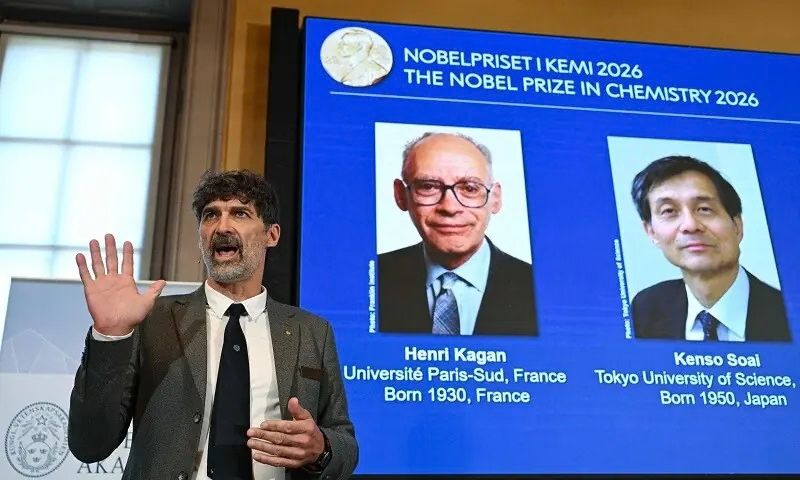
STOCKHOLM, Sweden: French scientist Henri B. Kagan and Japanese chemist Kenso Soai have won the 2026 Nobel Prize in Chemistry for discovering non-linear effects and autocatalysis in asymmetric organic synthesis, helping solve a century-old mystery about how molecules acquire a single “handedness”.
BREAKING NEWS
The Royal Swedish Academy of Sciences has decided to award the 2026 #NobelPrize in Chemistry to Henri B. Kagan and Kenso Soai “for the discovery of non-linear effects and autocatalysis in asymmetric organic synthesis.” https://t.co/nH090ql1Xc— The Nobel Prize (@NobelPrize) October 7, 2026
The Royal Swedish Academy of Sciences announced the award on Wednesday, praising the scientists for research that has transformed understanding of chirality, a property in which molecules exist in two forms that are mirror images of each other.
Read Also: Francis Halzen Wins 2026 Nobel Physics Prize for Antarctic ‘Ghost Particle’ Hunt
A century-old chemical mystery
The Nobel Committee said Kagan and Soai had provided an important solution to the long-standing question of how homochirality can emerge spontaneously — why living systems tend to use only one of two possible mirror-image forms of certain molecules.
“Henri Kagan and Kenso Soai have provided a solution to a chemical mystery that is over a century old: how homochirality can emerge spontaneously,” Heiner Linke, chair of the Nobel Committee for Chemistry, said.
“The chemical reactions they have developed are spectacular.”
Kagan is affiliated with Université Paris-Sud in Orsay, France, while Soai is associated with the Tokyo University of Science. Soai is 95 years old.
“In basic research, we want to learn more and more about how molecules behave and how they can interact – this year’s prize fits into that.”
Immediately after the announcement, Peter Somfai, Member of the Nobel Committee for Chemistry, was interviewed by freelance journalist Sharon Jåma regarding the 2026 Nobel Prize in Chemistry.
— The Nobel Prize (@NobelPrize) October 7, 2026
Research with major pharmaceutical implications
Their work has significant implications for chemistry and pharmaceutical research because mirror-image versions of the same molecule can behave very differently in the human body. The ability to control which molecular form is produced is therefore important in developing medicines and other biologically active compounds.
Kagan’s research in the 1980s showed how a small imbalance between mirror-image molecules could be amplified during chemical reactions. Soai later demonstrated how a molecule could act as a catalyst to produce more molecules with the same molecular “handedness”, leading to what became known as the Soai reaction.
The laureates will share the Nobel prize award of 12 million Swedish kronor, equivalent to about $1.2 million, along with the Nobel medal and diploma.
Félicitations à Henri Kagan of France and Kenso Soai of Japan for winning this year’s Nobel Prize in chemistry.
Their discoveries have opened new avenues for scientific research, including the manufacturing of pharmaceuticals.
Since this July, Japan is officially associated with Horizon Europe.
This means that Japanese researchers and organisations can now take part in the world’s largest public research and innovation programme.
Together, Europe and Japan will continue breaking new frontiers.
— Ursula von der Leyen (@vonderleyen) October 7, 2026
Other 2026 Nobel winners
The Chemistry announcement followed the 2026 Nobel Prize in Physiology or Medicine, awarded to Karl Deisseroth, Peter Hegemann and Georg Nagel, and the 2026 Nobel Prize in Physics, awarded to Francis Halzen.
Read Also: Nobel Medicine Prize Awarded to Three Scientists for Brain Activity Research
The remaining 2026 prizes, Literature, Peace and the Sveriges Riksbank Prize in Economic Sciences in Memory of Alfred Nobel, were scheduled for announcement later in the week.