
Key points
- Magnitude 5.9 quake struck eastern Japan early Sunday
- No tsunami warning was issued after the quake
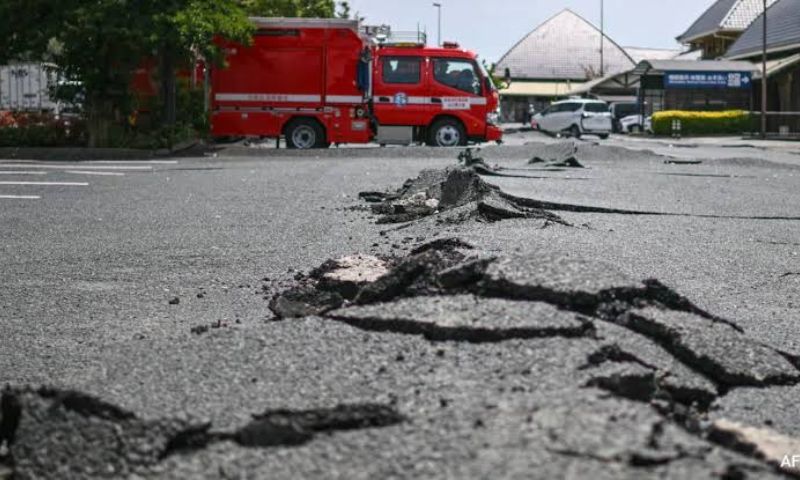
ISLAMABAD: A magnitude 5.9 earthquake struck eastern Japan early Sunday, injuring at least 37 people and disrupting rail services in the Tokyo region, officials said.
The Japan Meteorological Agency said the quake struck southern Ibaraki Prefecture in the early hours of the local day at a depth of 70 kilometres.
The US Geological Survey measured the earthquake at magnitude 5.8. No tsunami threat was reported.
The Fire and Disaster Management Agency said injuries were reported across five prefectures, including Tokyo, Saitama, Kanagawa, Chiba and Ibaraki.
Most were minor and occurred when people fell or collided with furniture and doors as they rushed out of bed after being awakened by the shaking.
An elderly woman in Yokohama suffered a serious hip injury after falling from her bed.
The earthquake strongly shook Tokyo and triggered emergency alerts on mobile phones.
Japan trains delayed
Some express trains serving Tokyo and Narita Airport, along with local services in northeastern Japan, were delayed, although Shinkansen bullet trains continued to operate normally.
Authorities also reported a ruptured underground water pipe in Tokyo and minor damage to a building in Saitama.
No abnormalities were reported at nuclear facilities. The weather agency warned residents to remain alert for possible moderate aftershocks for about a week.
ALSO READ: Japan Earthquake Death Toll Climbs to 34 as Search for Survivors Intensifies
Japan is among the world’s most earthquake-prone countries because it lies at the junction of several tectonic plates along the Pacific “Ring of Fire”.
The country experiences thousands of tremors each year, including many that are strong enough to be felt by residents.
The most devastating recent earthquake was the magnitude 9.0 Great East Japan earthquake on March 11, 2011. It struck off the northeastern coast and generated a massive tsunami. The disaster killed or left missing nearly 20,000 people and triggered the Fukushima nuclear accident.
Other major earthquakes include the magnitude 7.3 Kumamoto earthquake in 2016 and the magnitude 7.6 Noto Peninsula earthquake in January 2024, which caused extensive destruction and hundreds of deaths.
Japan has developed some of the world’s most advanced earthquake early-warning, building and disaster-response systems because of its exposure to frequent seismic activity.
The country’s warning system can issue alerts seconds before strong shaking reaches some areas, giving residents time to take protective action.