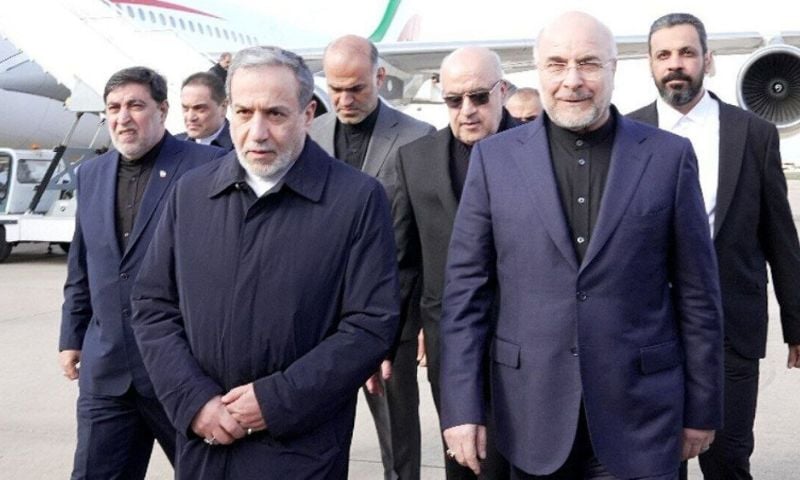



DOHA: Top Iranian negotiators and the central bank governor are in Qatar for discussions on the “most sensitive unresolved issues” in ongoing Pakistan-mediated talks with the United States, according to an official briefed on the visit and Iranian media reports.
Iran’s top negotiator Mohammad Bagher Ghalibaf and Foreign Minister Abbas Araghchi are holding talks with Qatar’s Prime Minister on a potential US-Iran deal to end the conflict, an official briefed on the visit told Reuters on Monday.
Iran’s Central Bank Governor is also part of the delegation, indicating that financial matters, including the possible release of frozen Iranian assets, are under discussion, according to the official, cited by Reuters.
According to the official, the talks are focusing primarily on the Strait of Hormuz and Iran’s stockpile of highly enriched uranium.
The discussions are part of broader efforts to reach a memorandum of understanding on outstanding issues in Iran-US negotiations, Iranian media reported.
Trump and US officials signal progress
US President Donald Trump said in a post on Truth Social that any deal with Iran would either be “great and meaningful” or there would be no agreement, reiterating that negotiations were still ongoing.
Trump said the emerging agreement would be the “exact opposite” of the 2015 nuclear deal reached under former president Barack Obama, which he again described as a “disaster”.
He said the previous accord had created “a direct and open path to a nuclear weapon” for Iran, adding that his administration would not accept a similar arrangement.
“The deal with Iran will either be a great and meaningful one, or there will be no deal,” Trump wrote, reiterating his position that Washington would not compromise on key conditions.
Meanwhile, US Secretary of State Marco Rubio said that an agreement aimed at ending the war with Iran could materialise “today”.
“We thought we might have some news last night, maybe today, I wouldn’t read too much into it,” Rubio said in New Delhi, referring to the potential agreement.
“We have what I think is a pretty solid thing on the table in terms of their ability to open up the straits, get the straits open,” he told reporters as he departed the Indian capital, where he has been on an official visit.
“It has a lot of support in the Gulf… every country that we’ve walked through it (with) understands it’s not just very reasonable, but it’s the right thing for the world to get done.”
The US and Iran have observed a ceasefire since April 8 while mediators push for a negotiated settlement. However, Iran has imposed controls on Gulf shipping, and the US has blockaded Iran’s ports.
The war erupted after the United States and Israel attacked the Islamic Republic on February 28, and Iran responded with missile and drone attacks across the region.
Deal ‘largely negotiated’
On Sunday, in a post to Truth Social, Trump said that the deal “has been largely negotiated, subject to finalization between the United States of America, the Islamic Republic of Iran and the various other Countries.”
Nuclear Issue
Rubio told The New York Times that an agreement with Iran had gained regional support but a nuclear deal couldn’t be achieved “in 72 hours on the back of a napkin.”
“Right now, we have seven or eight countries in the region that are endorsing this approach, and we’re prepared to move forward on this approach,” he said.
Earlier, Rubio had said a bargain could be struck to end the regional war as early as Sunday, but Trump again reined in expectations.
A post on Trump’s Truth Social read: “If I make a deal with Iran, it will be a good and proper one,” adding that “It isn’t even fully negotiated yet.”
‘Lasting peace’
Iranian officials confirmed the existence of a draft agreement but stressed that — despite the long-standing US demand for an end to its uranium enrichment — talks on the issue of Iran’s contested nuclear program have been deferred for 60 days after any deal.
Iranian President Masoud Pezeshkian told state television that Tehran was “still prepared to assure the world that we are not seeking nuclear weapons,” but it was unclear if this promise would be enshrined in the text of the deal.
Iran’s President Masoud Pezeshkian:
We are ready to reassure the world that we are not seeking nuclear weapons.
We are not seeking instability in the region. It is Israel that is the destabilizer in the region.
Our negotiating team will not compromise when it counts to our… pic.twitter.com/nB3f1tPr7U
— Ariel Oseran أريئل أوسيران (@ariel_oseran) May 24, 2026
According to Iran’s Fars news agency, “sanctions on oil, gas, petrochemicals and their derivatives would be temporarily lifted during the negotiation period so that Iran can freely sell its products.”
Leaders from Saudi Arabia, the United Arab Emirates, Qatar, Egypt, Jordan and Bahrain, as well as representatives from Turkey and Pakistan, joined a call with Trump to discuss the deal on Saturday.
Pakistan ready to host next round of US-Iran talks
Pakistan, which mediated historic face-to-face negotiations between US and Iranian delegations in April, hopes to host another round of talks “very soon,” Prime Minister Shehbaz Sharif said.
I congratulate President Donald Trump on his extraordinary efforts to pursue peace and for holding a very useful and productive telephone call earlier today, with the leaders of Saudi Arabia, Qatar, Turkiye, Egypt, the UAE, Jordan and Pakistan. Field Marshal Syed Asim Munir…
— Shehbaz Sharif (@CMShehbaz) May 24, 2026
In a statement shared on X, Prime Minister Sharif described the discussions as “very useful and productive”, saying they provided an important platform for consultations on the evolving regional situation and possible pathways towards long-term stability.
He said Pakistan’s army chief Asim Munir, who visited Tehran on Friday and Saturday, also joined the call, which “provided a useful opportunity… to move the ongoing peace efforts forward to bring lasting peace in the region.”