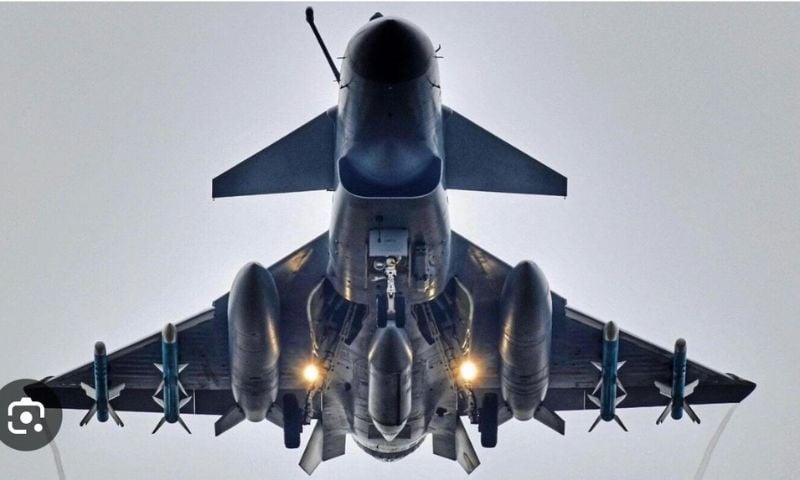
JAKARTA: Pakistan’s combat experience with China’s J-10CE fighter is emerging as a powerful catalyst for the aircraft’s international expansion, with Indonesia expected to become the third foreign operator after Pakistan and Uzbekistan.
Indonesia is expected to receive its first batch of Chinese-made J-10CE fighter jets in April 2027, according to an Indonesian media report.
Jakarta confirmed an order for 42 J-10CE fighter jets last October, with an approved budget of around US$9 billion, Indonesian news outlet Republika Online reported on Monday, citing sources familiar with the matter.
The first delivery is expected in April, although the number of aircraft to be handed over in the initial batch has not been disclosed.
The J-10CE, an export variant of China’s J-10C, is a 4.5-generation multirole fighter developed by Chengdu Aerospace Corporation. Also known as the Vigorous Dragon, the aircraft is equipped with modern avionics and an active electronically scanned array (AESA) radar.
Pakistan’s combat experience boosts J-10CE profile
Pakistan was the first international customer for the J-10CE and has provided the aircraft with its most significant combat experience to date.
Uzbekistan has officially shown its new Chinese-made J-10CE fighter jets for the first time, airing footage on state TV during Independence Day events.
The footage shows six J-10CEs operating from Karshi-Khanabad Air Base, confirming Uzbekistan as the second foreign operator of the type after Pakistan.
— Clash Report (@clashreport) August 30, 2026
During the four-day India-Pakistan conflict in May 2025, Pakistan deployed J-10CE fighters equipped with AESA radars and long-range PL-15 air-to-air missiles.
Pakistan said the aircraft played a key role in engagements with Indian aircraft.
The reported combat use has contributed to growing international interest in the Chinese fighter, giving prospective buyers an operational reference beyond manufacturers’ specifications and demonstrations.
Uzbekistan becomes second foreign operator
Uzbekistan has since emerged as the second international operator of the J-10CE.
The Central Asian country publicly displayed at least six Chinese-made J-10CE fighters during Independence Day celebrations, marking a notable shift for a country whose air force has traditionally relied on Soviet-designed aircraft such as the MiG-29 and Su-27.
The exact size and value of Uzbekistan’s acquisition have not been officially disclosed.
Bangladesh considering J-10CE
Bangladesh is another potential customer for the Chinese fighter. Zahed Ur Rahman, an information and broadcasting adviser to Bangladesh’s prime minister, previously said that a draft proposal to acquire J-10CE fighters had been submitted to the Ministry of Finance and the Armed Forces Division for approval.
Bangladesh has closely followed Pakistan’s use of the aircraft, including its deployment alongside PL-15 long-range air-to-air missiles during the 2025 conflict.
Growing appeal of Chinese fighter
The J-10CE’s growing overseas profile reflects China’s expanding presence in the international combat aircraft market.
The fighter combines modern avionics, AESA radar, beyond-visual-range combat capability and compatibility with advanced Chinese air-to-air missiles, making it an option for countries seeking to modernise their air forces.
🇺🇿🇨🇳✈️ Uzbekistan reportedly receives J-10CE fighter jets
Footage from Uzbekistan’s Independence Day celebrations reportedly shows six Chinese J-10CE multirole fighters arriving at Karshi-Khanabad Air Base.
The aircraft carry Uzbek flags, reportedly confirming their entry into the Uzbek Air Force.
The reported order totals 24 J-10CEs, which would make Uzbekistan the third operator after China and Pakistan#Uzbekistan #China #J10CE #AirForce #Military #Breaking
— The Political Inspector | TPI (@PnPPolitics) August 29, 2026
The aircraft also offers prospective buyers an alternative to more expensive Western fighters such as the Rafale and Eurofighter Typhoon.
Pakistan’s decision to become the J-10CE’s first foreign customer has therefore assumed wider significance. Its operational experience has provided China with a real-world reference point as other countries assess the fighter’s capabilities and export potential.
The expanding interest in the J-10CE illustrates a broader shift in the international fighter market.
Pakistan took the step of becoming the aircraft’s first foreign customer.
Following its employment during the 2025 conflict, other countries are now examining the platform through the lens of operational experience rather than relying solely on advertised specifications.
The development also highlights the wider significance of Pakistan’s acquisition.
Islamabad’s decision gave China an important international showcase for the J-10CE, while Pakistan’s combat experience has become part of the discussion surrounding subsequent foreign purchases.