Key Points
- Treaty cannot be changed unilaterally
- Legal diplomacy remains the best option
- Water resources are a global commons
- Pakistan pursuing diplomatic engagement
- UN framework remains the proper forum
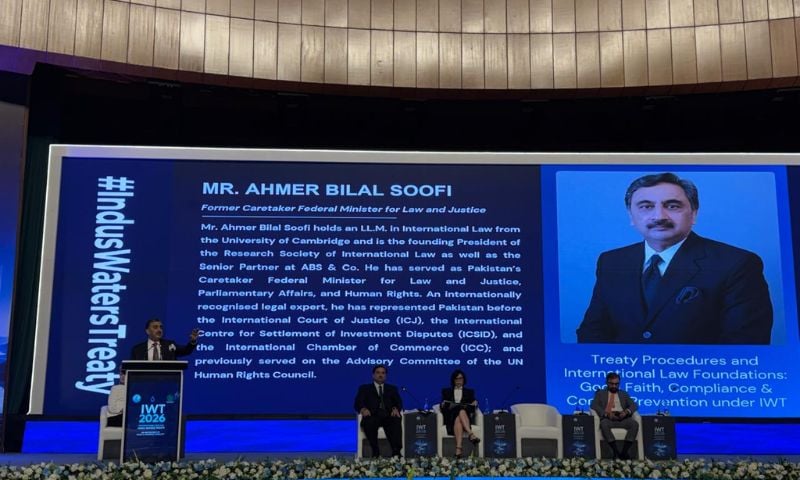
ISLAMABAD: Leading international law expert Ahmer Bilal Soofi has warned that any violation of the Indus Waters Treaty by India poses a threat to international peace and security.
Speaking at an international seminar on the Indus Waters Treaty in Islamabad on Tuesday, he said unilateral actions affecting the treaty would constitute a breach of international law and could escalate regional tensions into a broader peace and security concern under the United Nations framework.
Ahmer Bilal Soofi said that any unilateral suspension or deviation from treaty obligations could undermine regional stability and international peace, turning what is essentially a bilateral issue into a matter of global concern.
He emphasized that water resources constitute a “global commons” and cannot be subjected to absolute national ownership. He noted that the Indus Waters Treaty was designed to ensure guaranteed downstream flows while allowing limited and regulated use, particularly for hydropower development.
Soofi argued that India’s stance of placing the treaty in “abeyance” would amount to a breach of established principles of international treaty law.
He said such issues must be addressed strictly through legal dispute-resolution mechanisms under international law, rather than through unilateral suspension or politically driven interpretations.
He further stated that Article 12(4) of the Indus Waters Treaty (1960) clearly provides that the treaty can only be modified by mutual consent of both parties, not unilaterally, and therefore any attempt to suspend or place it in abeyance has no legal standing.
Soofi highlighted that disputes of this nature are not merely technical or bilateral, but must be viewed within broader legal and humanitarian frameworks, including international obligations and state responsibility principles.
He noted that Pakistan has consistently engaged with relevant mechanisms through legislation and institutional cooperation.
He said that bypassing established legal procedures and resorting to unilateral political or strategic responses risks further escalation of tensions. He described the issue as part of a wider geopolitical and security context affecting the region.
In his address, he stated that breaches of international treaties constitute “serious international wrongful acts” under the rules of state responsibility.
While acknowledging that affected states may consider countermeasures, he stressed that restraint and prioritization of legal and diplomatic channels remain essential.
He added that Pakistan has engaged relevant international institutions, including the United Nations framework, the UN Security Council, the UN Secretary-General, and permanent members of the Security Council through formal channels.
Warning against escalation, he also referred to protections under international humanitarian law concerning critical infrastructure, including dams and water installations. He suggested that structured legal diplomacy could serve as a viable mechanism for sustained dialogue between India and Pakistan on water-sharing disputes.
Concluding his remarks, Soofi cautioned that deviation from established global treaty frameworks could result in reputational and diplomatic consequences, including international isolation and a loss of credibility within the global legal order.