
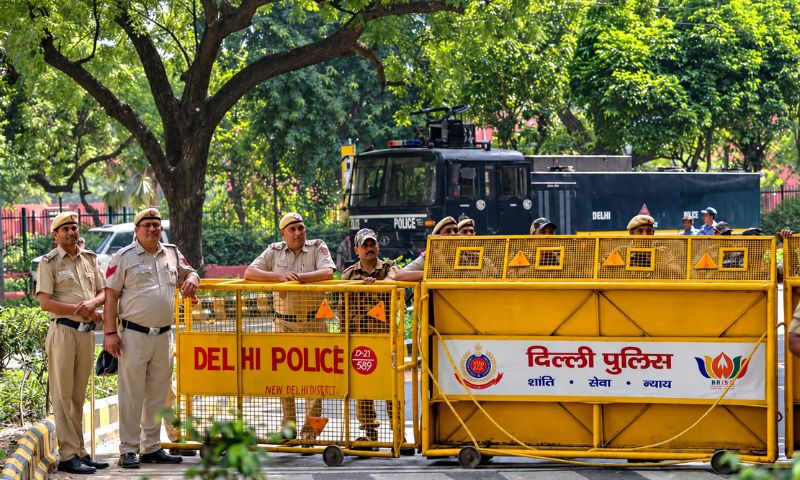
NEW DELHI: Indian authorities have withdrawn the official status of Jantar Mantar, one of the country’s most prominent protest venues, triggering concerns among activists that the Narendra Modi government is presiding over a shrinking space for democratic dissent.
Delhi Police announced in an order that Jantar Mantar was no longer a designated protest site, without giving a reason for the decision. The move has reignited debate over restrictions on public demonstrations and the accessibility of spaces where citizens can challenge those in power.
For more than three decades, the site in central New Delhi has served as a focal point for demonstrations by trade unions, retired military personnel, anti-corruption campaigners, women’s rights groups and student activists.
Located near Parliament, government offices and major media organisations, Jantar Mantar has long offered protesters a prominent platform to draw national attention to their demands.
“This is nothing but a move to curb dissent,” human rights activist Shabnam Hashmi told the media, criticising the decision to withdraw the site’s official status.
The development follows tensions between authorities and protesters associated with the youth-led Cockroach Janta Party (CJP) online movement, which has mobilised thousands against a revision of electoral rolls that critics fear could disenfranchise eligible voters.
The issue comes months after student demonstrations over irregularities in competitive examinations put further pressure on the government, with the protests eventually forcing the education minister to resign.
In July, thousands of students associated with the CJP movement gathered at Jantar Mantar before attempting to march towards Parliament. For nearly a month, the area became a prominent centre of youth-led dissent, with slogans, graffiti and messages challenging the government covering its walls.
Tensions resurfaced this month when police refused permission for a CJP demonstration demanding the resignation of the chief election commissioner over the disputed voter-roll revision.
On Tuesday, a day after the site was formally de-notified, police detained CJP leaders who climbed over barricades in an attempt to reclaim the protest venue.
“Jantar Mantar is not just a location but a spirit of resistance that nobody can ever take away,” the movement’s founder, Abhijeet Dipke, said.
Activists argue that shifting demonstrations away from central Delhi could weaken the effectiveness of protests by increasing travel costs, reducing public participation and limiting media coverage, particularly for campaigners travelling from distant states.
Hashmi said Jantar Mantar’s central location had made it uniquely effective, allowing demonstrators to reach Parliament, government ministries and media offices with relative ease.
“In a democracy, you require spaces where you can protest,” she said, describing the decision as “absolutely unacceptable”. Authorities have designated two alternative protest venues on the outskirts of Delhi, while Ramlila Maidan, closer to the city centre, remains available for larger gatherings.
READ ALSO: India Detains Top ‘Cockroach’ Leaders After Flash Protest
However, campaigners fear that the alternatives may not offer the same visibility or direct access to political decision-makers, raising questions about whether the relocation will undermine citizens’ ability to hold the government accountable.
Despite the restrictions, protesters have vowed to continue their demonstrations at Jantar Mantar.
A protester told media on Tuesday that campaigners would pursue civil disobedience and continue gathering at the site despite the police order. “We will sit here and protest,” she said before police removed her as she attempted to march towards the venue.
The closure of Jantar Mantar as an authorised protest site has intensified scrutiny of restrictions on public dissent in India, with critics warning that limiting access to prominent demonstration venues risks weakening democratic accountability in a country that claims to be the world’s largest democracy.