
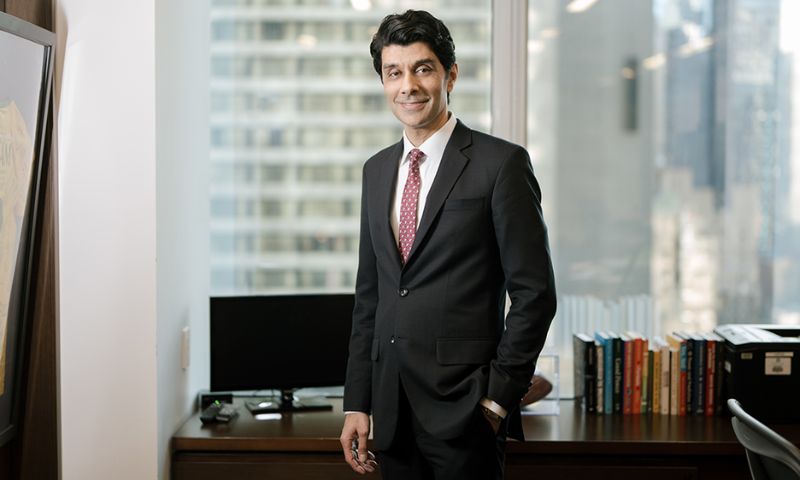
ISLAMABAD: For Raja Jawad Akram, the journey from Lahore, Pakistan, to one of Europe’s biggest financial institutions was never mapped out as a grand plan.
Like many young Pakistanis who leave home for education, he went abroad with an uncertain future. More than three decades later, that journey has taken him to the senior-most ranks of global banking.
Akram was appointed Chief Financial Officer of Deutsche Bank earlier this year, placing a Pakistan-born executive at the centre of the finances of one of Europe’s most important banks.
His appointment is notable not only because of the position itself, but because of the distance between where his journey began and where it has taken him.
A graduate of Aitchison College in Lahore, Akram left Pakistan to pursue higher education in the United States. His career began at KPMG before taking him through senior management positions at Citigroup and Morgan Stanley.
The progression was gradual rather than dramatic. Education led to a job, the job led to another opportunity, and years accumulated almost unnoticed.
“One year turns into two, and two turns into five. Ten years later, you realise that maybe the definition of home has shifted in some ways,” Akram said.
Pakistanis building careers abroad
That observation captures a broader experience shared by thousands of Pakistanis who have built careers overseas.
For Akram, life in the United States became a professional success story.
Yet the longer he remained abroad, the more complicated the idea of returning home became. The passage of time itself altered the meaning of home.
His story also offers a different perspective on the debate over Pakistan’s continuing outflow of educated and ambitious young people.
Every year, students leave the country for universities across North America, Europe and elsewhere.
Some leave primarily for education, others for better professional opportunities, and many see overseas study as a possible route towards a different life.
Not all return.
Akram’s career demonstrates what can happen when an ambitious Pakistani builds a professional life abroad.
His rise through some of the world’s most influential financial institutions ultimately brought him to Deutsche Bank, where he now occupies a position that carries enormous responsibility.
Yet his journey is not simply a story about reaching the top.
It is also about what happens in the years between departure and success.
The people who leave Pakistan often remain connected to it through family, friendships, memories and professional ties.
But distance changes relationships, and so does time. A temporary decision to study abroad can gradually become a permanent career, and a permanent career can eventually make returning feel less like going home and more like starting again.
Akram’s experience therefore sits at the intersection of two realities: Pakistan continues to produce young people capable of competing at the highest levels internationally, but the country also struggles to retain much of that talent.
His achievement is a source of pride for Pakistan, but it also raises a difficult question about what the country loses when its most ambitious young people build their futures elsewhere.
For Akram, the answer appears less straightforward than simply choosing between Pakistan and the world.
His story suggests that home is not always abandoned in a single decision.
Sometimes it changes quietly — one year, then another, until a place that was once unquestionably home becomes one of several places to which a person belongs.
That may be the less visible cost of success abroad: not losing home, but discovering that home itself has changed.