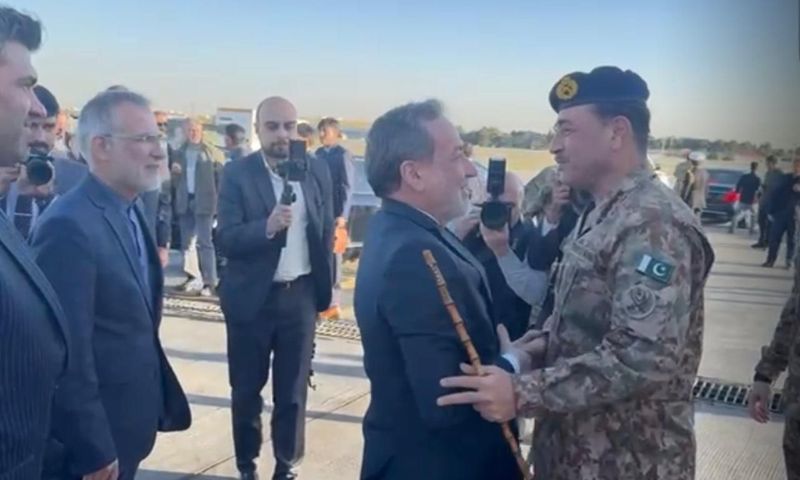
ISLAMABAD: Pakistan’s Chief of Defence Forces and Army Chief, Field Marshal Syed Asim Munir, along with Interior Minister Mohsin Naqvi, arrived in Tehran on Wednesday as part of a high-stakes diplomatic push to de-escalate rising tensions in the Middle East, the Inter-Services Public Relations (ISPR) confirmed.
Iranian Foreign Minister Abbas Araghchi received the Pakistani delegation. The visit comes against the backdrop of an intensifying confrontation involving the United States and Iran, which has heightened fears of a broader regional conflict with global implications.
With military posturing and retaliatory threats escalating, diplomatic channels have narrowed, increasing the urgency for neutral intermediaries.
The arrival of the high-level Pakistani delegation underscores Islamabad’s effort to position itself as a credible mediator, leveraging its longstanding ties with both Washington and Tehran.
Pakistan maintains a friendly relationship with the United States, while also sharing deep historical, cultural, and border-linked ties with Iran — placing it in a unique position to facilitate dialogue.
Field Marshal Syed Asim Munir’s presence signals the seriousness of the initiative, reflecting a coordinated civil-military approach to foreign policy at a time of acute regional instability.
Pakistan’s COAS, CDF Field Marshal General Asim Munir has arrived in Tehran, where he was received by Iranian Foreign Minister Abbas Araghchi upon his arrival. pic.twitter.com/smmPRTTDYc
— Red Marker – پیرِ ٹویٹر (@RedMarkar) April 15, 2026
Diplomatic sources indicate that Pakistan is quietly working to explore backchannel communications aimed at reducing misperceptions and preventing further escalation.
Pakistan has consistently advocated for restraint and dialogue, urging all parties to avoid actions that could spiral into open conflict. Experts have stressed that any prolonged confrontation could destabilise energy markets, disrupt global trade routes, and exacerbate economic pressures in already fragile regions, including South Asia.
During their stay, the delegation is expected to hold in-depth consultations with senior Iranian leadership, focusing on broader regional security dynamics.
Iran and Pakistan share a long border and mutual security concerns, making stability in the region a shared priority. The current crisis, however, has elevated the stakes considerably, prompting Islamabad to take a more proactive diplomatic role.