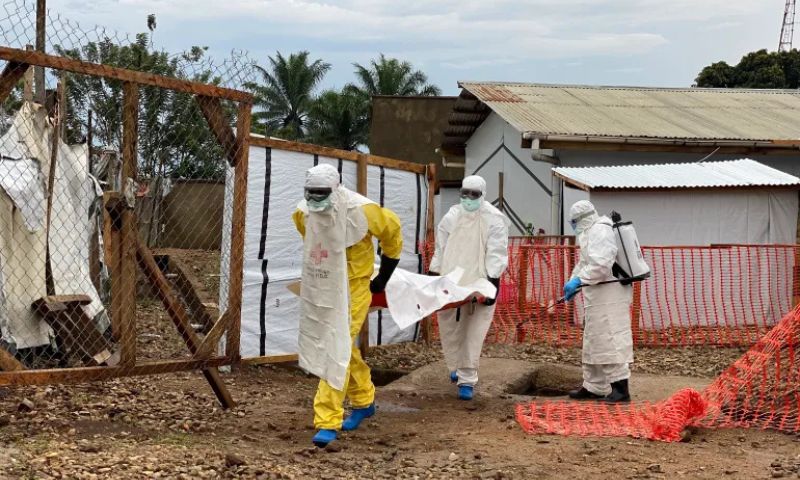



KINSHASA, Democratic Republic of Congo: A deadly Ebola outbreak in the Democratic Republic of Congo (DRC) has spread to a fourth province, health authorities said on Monday, prompting fresh containment measures as officials warned that the country’s entire north-eastern region is now affected.
The outbreak has so far infected 1,274 people and killed 360, according to the World Health Organization (WHO). Twenty additional cases, including two deaths, have also been reported in neighbouring Uganda.
DR Congo declared its 17th Ebola outbreak on May 15. The epidemic is caused by the Bundibugyo strain of the virus, for which there is currently no approved vaccine or specific treatment.
The WHO has issued an international alert over the outbreak, while clinical trials of experimental antiviral drugs are expected to begin in the coming days, according to the UN health agency.
The head of the Africa Centres for Disease Control and Prevention (Africa CDC) also told the BBC that trials could begin as early as this week.
Fourth province records first case
The province of Ituri remains the epicentre of the outbreak, accounting for 1,165 confirmed infections and 301 deaths, according to Congolese health authorities. Scientists and humanitarian workers say the actual figures are likely to be higher.
Until recently, confirmed infections had been limited to Ituri, North Kivu and South Kivu. Health authorities have now confirmed that Haut-Uele, which borders South Sudan and the Central African Republic, has also recorded a case.
Authorities are tracing contacts and investigating the chain of transmission.
Across the border, Uganda has reported 20 confirmed cases and two deaths, according to the WHO.
Authorities impose restrictions
Meanwhile, Interior Minister Jacquemain Shabani announced a ban on mass gatherings in the capital, Kinshasa, and in the provinces of Tshopo, Haut-Uele and Bas-Uele as a precautionary measure to prevent further spread of the virus.
Although no Ebola cases have been confirmed in Kinshasa, authorities fear the disease could reach the city of around 18 million people.
The move followed confirmation that a Congolese doctor who later tested positive for Ebola in France had travelled through Kinshasa after working at an Ebola treatment centre in one of the affected regions.
The government has also ordered a mandatory 21-day quarantine for travellers moving from Ebola-affected provinces to other parts of the country.
Mass gatherings had already been prohibited in Ituri, North Kivu and South Kivu, where the outbreak is concentrated.
The disease spreads through direct contact with infected bodily fluids, including blood and vomit.
According to the WHO and Africa CDC, the current outbreak has the potential to become one of the largest in the country’s history because the virus circulated for several weeks before it was identified as Ebola.