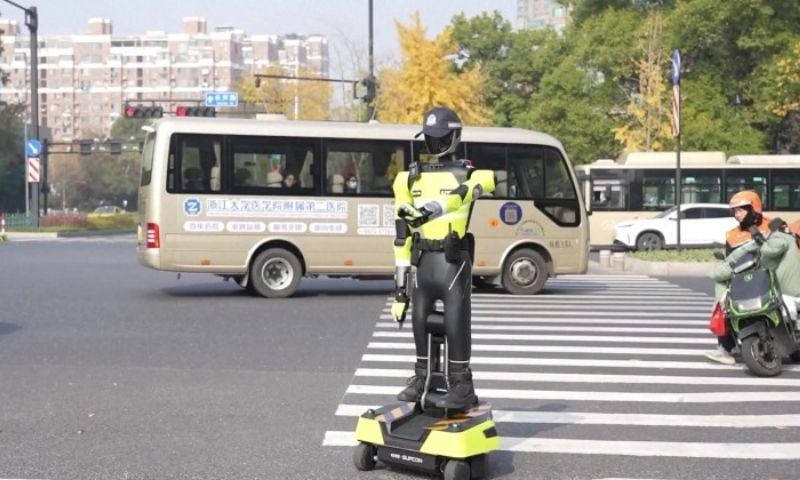
HANGZHOU, China: Move over RoboCop, China’s newest traffic enforcer doesn’t carry a gun, can’t make arrests, and rolls on wheels rather than mechanical legs. But at a bustling intersection in this eastern Chinese city, a 1.88-metre humanoid robot is doing something perhaps more remarkable: it is quietly reshaping how millions of commuters obey traffic laws, one polite warning at a time.
Traditional traffic police are being supplemented by robots in China.
The automation of street control is happening fast.
via @sz_mediagroup pic.twitter.com/0mWg9tWJhe— Andres Vilariño 🇪🇦 (@andresvilarino) August 19, 2026
The T2 robot, built by SUPCON Information, has been patrolling Hangzhou’s streets since May, using an array of cameras, radar and onboard computing to spot helmetless e-bike riders, vehicles crossing stop lines, and pedestrians ignoring signals, and in the process, delivering a glimpse into a future where machines increasingly manage the mundane but critical tasks of urban life.
170,000 warnings and counting
The 98-kilogram T2 has proven remarkably effective in its short deployment. Fifteen robots have operated in Hangzhou since May, issuing more than 170,000 warnings, and according to SUPCON, monthly helmetless riding and stop-line violations have dropped by over 40 per cent.
While the claimed reductions have not been independently verified (Hangzhou’s traffic police did not respond to requests for comment), the numbers have captured the attention of authorities across China.
Nearly 50 robots now operate across roughly eight cities in three Chinese provinces, with deployments expected to approach 200 by year end, a rapid expansion that signals Beijing’s growing confidence in machine-based enforcement.
🇨🇳 Seems like traffic officers will be the next ones to get replaced.
In China, they’re already out here standing in the rain, waving cars through with perfect form and zero overtime.
The robots don’t complain, don’t take breaks, and don’t care if it’s pouring.
Human traffic…
— Mario Nawfal (@MarioNawfal) August 15, 2026
How the T2 Works
The T2’s sensor package, cameras, radar, and onboard computing working in tandem, allows it to identify multiple violations simultaneously:
- Riders without helmets
- E-bikes carrying passengers
- Vehicles stopping across marked lines
- Pedestrians crossing against signals
The robot’s seven-jointed arms reproduce standard traffic-police gestures, synchronised perfectly with the signal cycle. Its 1.88-metre frame makes it highly visible, while its polite, pre-recorded warnings add a human touch to machine enforcement.
Beyond enforcement, the T2 answers questions about directions, parking, and traffic rules. An emergency function connects users directly to local police – a feature that could prove invaluable in crisis situations.
No breaks, no fatigue
According to Cao Hui, who heads SUPCON’s intelligent unmanned systems innovation centre, the T2 represents a fundamental shift in enforcement philosophy.
“The goal is to shift enforcement earlier, replacing punishment after a violation with a reminder before the behaviour becomes habitual,” Cao said.
The robots operate autonomously from 7am to 6pm, moving between pre-set positions without remote control. A central platform lets traffic-police teams monitor and dispatch them.
“It doesn’t get tired,” Cao added. “It can work steadily for long periods.”
SUPCON claims the robots have been tested for thousands of hours in tourist areas, school zones, business districts, rush-hour traffic, and poor weather. While strong sunlight, rain, and temperature extremes can still affect cameras and radar, the company puts violation-recognition accuracy above 95 per cent.
Read Also: Engineers Aim to Build Robot Messi and Defeat FIFA World Cup Champions by 2050
From exhibition floor to street corner
The traffic robots are one visible piece of a broader Chinese push to move machines out of demonstration halls and into jobs that actually need doing.
Hangzhou had already tested a single AI traffic robot in its Binjiang district in December before the squad deployment. On the first day of the May Day holiday, the city deployed a formally organised squad of 15 traffic management robots around the West Lake scenic area, working alongside human officers on crowd guidance and navigation help for tourists.
Similar units appeared in Kashgar and Ordos on the same day, a coordinated national rollout that underscores Beijing’s commitment to the technology.
Export ambitions and obstacles
Chery-backed robotics firm AiMOGA sees a significant market abroad, particularly where traffic officers work in punishing conditions. The company cites high temperatures in the Middle East and long rainy seasons in Southeast Asia as obvious openings.
However, selling one overseas is harder than selling a car, according to AiMOGA executive Zhang Guibing. Police robots would need to:
- Fit local law-enforcement IT systems
- Obtain certifications
- Comply with data-protection rules
“Data-protection rules are a particular constraint given that the machines carry cameras and other sensors,” Zhang said.
The future is already here! 🤖🚦
A smart robot traffic police officer has recently been deployed in Hanjiang, Putian. With precise and standardized traffic-control gestures, the robot helps guide vehicles and pedestrians in an orderly manner. Capable of working around the clock,… pic.twitter.com/PU7nkcaaZY— Hola Fujian (@HolaFujian) August 21, 2026
Privacy concerns and trade barriers
Those data-protection questions are not hypothetical. European and British debates over automated policing have already turned sharp, with civil liberties groups arguing that routine biometric monitoring normalises mass surveillance in ordinary public life.
A camera-equipped machine standing permanently at an intersection raises the same category of question regardless of whether it can make an arrest.
Trade policy adds a second wall. The U.S. Federal Communications Commission has banned future imports of foreign-made humanoid and quadruped robots on national security grounds, a rule drafted so broadly that it appears to capture robot vacuums as well.
For Chinese manufacturers, the American market is closing at exactly the point where domestic deployments are producing the operational data that would make an export pitch credible.
Read Also: China Opens World’s First Dedicated School for Robots in Hangzhou
A trillion-Yuan bet
The wider bet, backed by state projections putting the embodied intelligence market above one trillion yuan by 2035, is that scale at home eventually opens doors elsewhere.
For now, China’s traffic robots remain firmly on domestic streets, quietly enforcing rules, issuing warnings, and demonstrating that the future of urban governance may well be machine-shaped.