INCHEON, South Korea: Imagine a football match where players never get tired, never argue with the referee, and never ask for a pay raise. Now imagine they’re all robots.
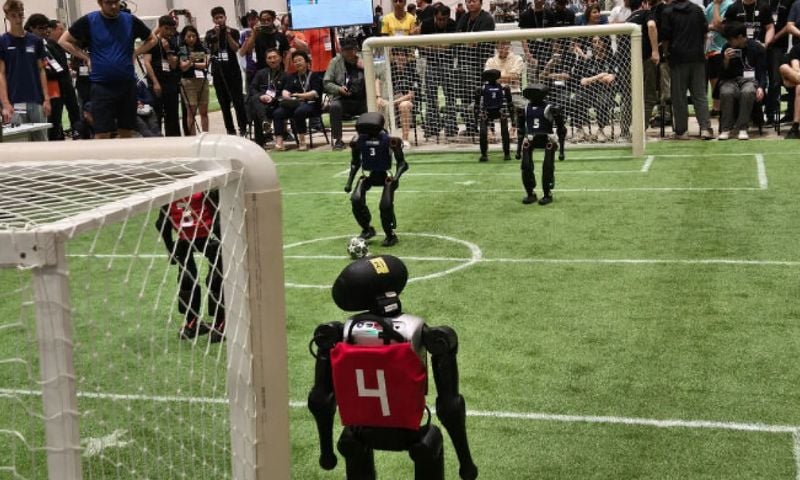
That’s exactly what’s happening at RoboCup, the world’s biggest robotics competition, taking place this week in the South Korean city of Incheon. Humanoid robots in red and blue jerseys are playing football on small pitches, and the crowd is loving every moment.
But this is more than just a fun show. Engineers are working toward a bold goal: building a team of robots that can beat the FIFA World Cup champions by the year 2050.
🎦 Robôs humanoides jogam a sua Copa do Mundo e criadores buscam a versão Messi; veja lances. Torneio na Coreia do Sul tem gols, trombadas e jogadores caindo sozinho 📲📰 Leia mais em https://t.co/d2Y7hDbxv7 pic.twitter.com/fyraDbhc0Y
— Folha de S.Paulo (@folha) July 3, 2026
How the robots play
Unlike remote-controlled toys, these robots think for themselves. Once the match starts, they make their own decisions using artificial intelligence. They decide when to pass, when to shoot, and how to defend.
On Friday, the action was fast and exciting. A robot shot the ball out of bounds, and the referee shouted “stop!”, instantly, every robot froze in place. A moment later, a robot named “number one” scored a goal, and the crowd cheered.
But things got rough too. One robot crashed into the goalkeeper, knocking it over. “You can’t do that!” a fan laughed.
Dozens of matches were happening at the same time inside a big convention centre. Small, medium, and large robots played on different pitches, and visitors walked around watching their favourites.
Güney Kore’de düzenlenen RoboCup’ta şut çekmek isteyen bir robot sakatlandı. 🥺pic.twitter.com/4Fzd1ZTw2N
— mühendisyen (@muhendisyenn) July 3, 2026
Fans are already picking teams
People who came to watch said it felt surprisingly like watching real football.
“I had never seen robots playing football before. It was fascinating and really fun,” said Cho Woo-cheol, a 45-year-old construction worker. “I found myself supporting the blue team because they looked a bit more human. They’re not moving exactly like people yet, but they were much closer than I expected.”
Another visitor, Kim Mi-hong, 60, said robot football could one day have its own fans. “People were already saying, ‘The red team is better,’ and recognising players by their numbers. As the technology improves, I think fandoms will naturally come,” she said.
The big dream: Beat humans by 2050
RoboCup started in Japan in 1997. Since then, it has grown into a huge event that also includes rescue robots, home robots, and industrial robots. But football remains the main attraction.
“We think robots can defeat humans by 2050,” said Thomas Rofer, a scientist from Germany’s B-Human team. “Recently there has been a big step forward in robot development. We have already seen a robot that can kick as hard as a human.”
Artificial intelligence is making all of this possible. Experts say robots are learning faster than ever before. One study even predicts that by 2050, there could be nearly 1 billion humanoid robots working in factories and homes around the world.
While the world’s eyes are on Lionel Messi at the FIFA World Cup, another soccer tournament unfolds in Incheon — with robot players.
RoboCup 2026 kicked off Thursday in Incheon’s Songdo Convensia, showcasing a wide range of artificial intelligence robots capable of… pic.twitter.com/Df3Y650ZBZ— The Korea Herald 코리아헤럴드 (@TheKoreaHerald) July 3, 2026
No prize money, just science
Unlike the FIFA World Cup, there is no prize money at RoboCup. University teams come from all over the world to compete, but their real goal is to push science forward.
Shim In-wook, a professor from Inha University, believes robot football will one day become a sport of its own.
“In the FIFA World Cup you might have one Lionel Messi,” he said. “But once you build one Messi robot, you can build thousands more.”
The tournament runs through Sunday, and visitors are leaving with big smiles and even bigger hopes for the future. If the engineers have their way, one day we’ll be cheering for robot Messi, and maybe even watching machines lift the World Cup trophy.