
Key Points
- Test simulates full-race operations, including navigation, timing, and emergency response systems
- Autonomous robots require real-time perception, balance control, and energy management
- New regulations tighten human intervention and strengthen scoring, resupply, and safety protocols
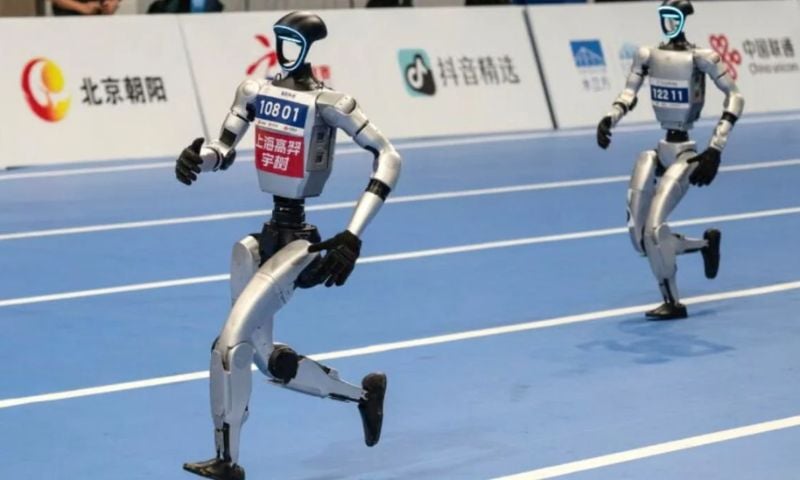
ISLAMABAD: Beijing has carried out a full-scale test run of the 2026 humanoid robot half-marathon in the E-Town Economic and Technological Development Area, as preparations intensify for the official race scheduled for April 19.
The overnight rehearsal was conducted from the evening of April 11 to the early hours of April 12.
The event simulated complete race conditions, including track navigation, event scheduling, equipment coordination, and emergency response systems designed to ensure a smooth and safe competition.
北京亦庄,正在进行机器人马拉松训练,所有的机器人都没有自主的大脑,都需要有人用遥控器跟随。 pic.twitter.com/ByyfhkDk9c
— 作家崔成浩 (@cuichenghao) April 11, 2026
Organisers said the exercise replicated the full 21.0975-kilometre route under official timing rules, testing robot performance across urban roads and ecological park terrain.
The trial also evaluated support systems, operational procedures, and coordination between technical and safety teams.
More than 70 teams took part in the large-scale rehearsal, including four international teams, marking a significant expansion in participation compared to previous editions.
This year’s competition has attracted over 100 teams, nearly five times as many as last year’s inaugural event, representing rapidly growing global interest in humanoid robotics.
The event features two main categories—autonomous navigation and remote-controlled robots. The autonomous navigation teams account for nearly 40 per cent of participants.
Both categories were included in the nighttime test run to evaluate endurance, stability, and real-world adaptability under low-visibility conditions.
A major highlight of the competition is the expanded deployment of autonomous navigation systems, where robots must interpret and respond to complex, dynamic environments in real time.
The systems require high computational capacity, especially as machines are expected to manage long-distance movement, battery efficiency, and continuous balance adjustments with millisecond-level precision to prevent falls.
Organisers also introduced upgraded competition regulations this year. The rules include stricter limits on human intervention, more structured starting and running procedures, clearer scoring and penalty mechanisms, and improved standards for equipment resupply.
Safety protocols and emergency response frameworks have also been strengthened to support the expanded scale of participation.
Short-distance running performance of humanoid robots has improved significantly, officials said, as CGTN reported. Some teams approached speeds comparable to elite human athletes over shorter segments, they added.
However, endurance, energy management, and terrain adaptability remain key technical challenges over the full half-marathon distance.
The upcoming race is being seen as a major milestone in the development of robotics, reflecting a broader push to transition humanoid machines from controlled laboratory environments into practical, real-world applications.
With final preparations underway, Beijing is positioning the event as a global demonstration of advances in artificial intelligence, robotics engineering, and autonomous integration of systems.