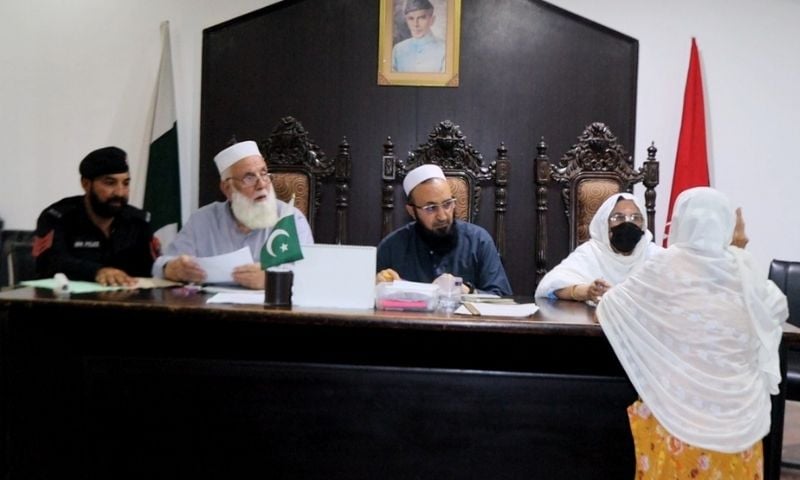
MARDAN, Pakistan: When elderly Riffaqat Bibi first walked into a Dispute Resolution Council (DRC) in Mardan, she was looking for a way out of a personal problem that had already taken her through the doors of courts and lawyers.
The experience changed her view of how ordinary people can seek justice. After her dispute was resolved through the DRC within a week, Bibi, a social worker in her mid-60s, began encouraging other women in her neighbourhood and surrounding villages to consider the community-based forum for certain family and property disputes rather than immediately entering a lengthy court process.
Easing the burden on courts
On a recent visit, she brought a woman seeking her share of an inheritance from her brothers.
“After my own case was resolved here, I started telling women in my area about the DRC. Now women often come to my home and ask me to help them submit their applications.” – Riffaqat Bibi, a social worker
“After my own case was resolved here, I started telling women in my area about the DRC. Now women often come to my home and ask me to help them submit their applications,” Bibi says.
The DRCs in Khyber Pakhtunkhwa have a specific statutory basis under Section 73 of the Khyber Pakhtunkhwa Police Act, 2017. The provision empowers the provincial police head to constitute DRCs at the district, sub-division or police-station level for the amicable, out-of-court settlement of cases of a petty or minor nature.
The legal framework was originally introduced through the Khyber Pakhtunkhwa Police Order (Amendment) Act, 2015, giving statutory cover to DRCs that had already been operating since 2014.
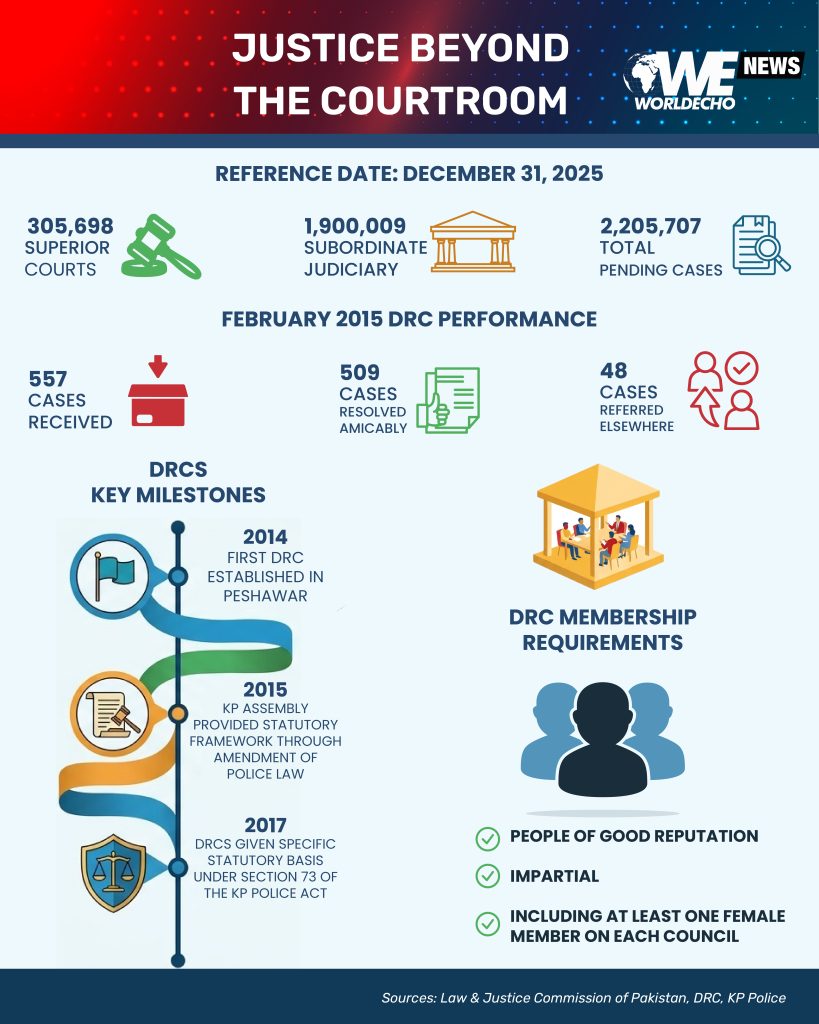
The first DRC was established in Peshawar in 2014. In 2015, the Khyber Pakhtunkhwa Assembly amended the police law to provide a legal framework for DRCs. The law required members to be people of good reputation and impartiality and provided for at least one female member on each council.
In February 2015 alone, Khyber Pakhtunkhwa police say that DRCs received 557 cases, of which 509 were resolved amicably and 48 were referred to other forums for legal action.
For women like Bibi, however, the attraction is not simply the speed. It is also the possibility of resolving a dispute closer to home, without immediately entering a formal legal process that can involve repeated hearings and legal expenses.
Pakistan’s formal justice system continues to face a substantial caseload.
The latest figures from the Law and Justice Commission of Pakistan show that 305,698 cases were pending before the country’s superior courts and 1,900,009 before the subordinate judiciary as of December 31, 2025, bringing the total backlog to 2,205,707.
Family disputes find forum
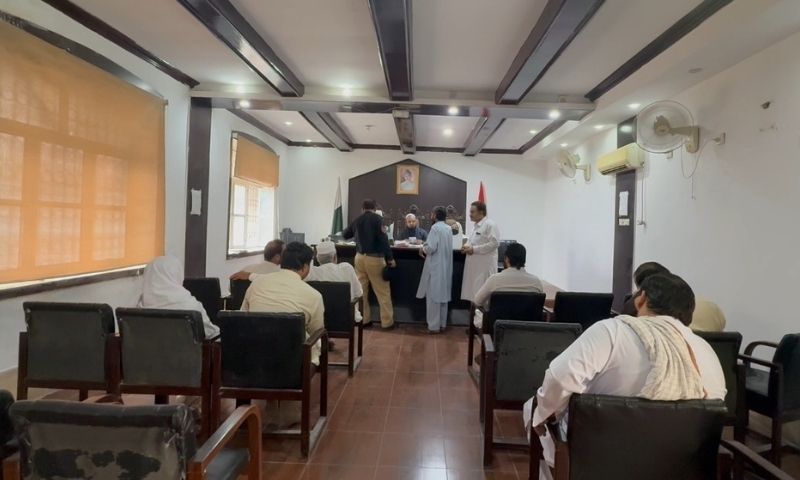
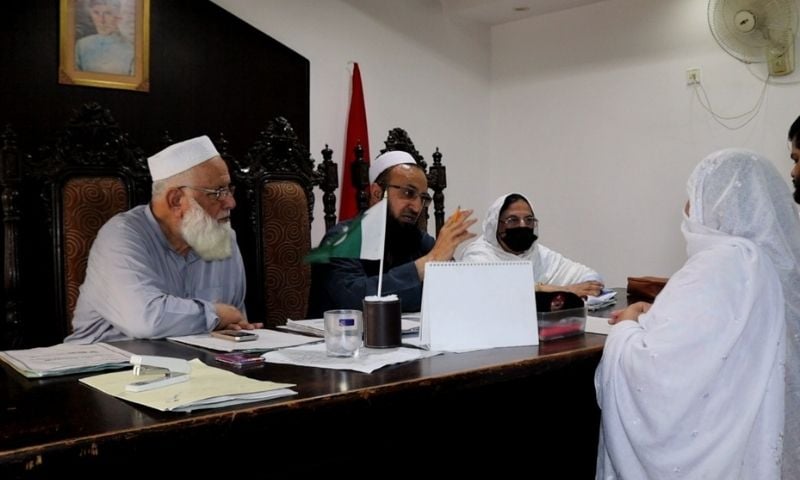
Nusrat Ara, a member of the DRC in Mardan, says women approaching the council often come with disputes involving husbands and wives, mothers-in-law and daughters-in-law, and claims to inheritance.
“Decisions here are not based on anyone’s personal opinion or likes and dislikes. We listen to both sides and try to resolve the dispute according to the facts and the applicable framework.”
“Decisions here are not based on anyone’s personal opinion or likes and dislikes. We listen to both sides and try to resolve the dispute according to the facts and the applicable framework.” – Nusrat Ara, member of the DRC
She says inheritance disputes are among the cases brought by women who say they have been denied their lawful share. However, the DRC does not deal with every family-law matter.
According to Ara, cases involving khula and divorce are referred to the courts, because formal legal procedures and documentation are required. The council can, however, assist parties in matters involving financial rights such as dower and conditions recorded in a marriage contract, where the relevant evidence supports the claim.
“In practice, the councils handle a range of minor disputes, including family and domestic conflicts, land and property disputes, financial transactions and other matters that can be resolved through mutual agreement. Serious criminal cases are dealt with through the formal justice system.”
This distinction is important: a DRC is not a substitute for Pakistan’s courts in every legal matter. Its role is primarily to facilitate amicable resolution of disputes that fall within its legal mandate.
When homes become unsafe
Bibi recalls one case that particularly influenced her decision to help other women.
A young woman from her neighbourhood had married a man in Haripur who already had another wife and a daughter. The woman told Bibi that she was being physically abused by her husband and members of the household. One day, the woman came to Bibi’s home with injuries to her head and hands.
“She told me that her husband was beating her, would not take her to a separate home and was not providing her with financial support,” Bibi says.
The woman initially asked Bibi to accompany her to court. When they approached a lawyer, they were told that the legal expenses could reach around Rs50,000.
She then suggested that they approach the DRC instead.
Both sides were called before the council for a discussion. After hearing them, the council reached an agreement under which the husband accepted responsibility for his wife’s expenses and other needs. The woman was given a written settlement, and her husband promised to treat her better.
“She is happy now,” Bibi says.
Her account is a personal testimony rather than independently verified case data, but it illustrates why some women view DRCs as an accessible first step when facing family disputes.
A regulated form of jirga
The DRC model has roots in local traditions of community-based dispute settlement, but it operates within a formal legal and police framework.
When the system was launched in 2014, its stated objective was to modernise the traditional jirga concept and use community elders to settle minor disputes while reducing pressure on police stations and courts.
The legal status of DRCs was questioned by the Peshawar High Court in 2015. The provincial government subsequently amended the law, providing statutory backing to the councils, and the High Court withdrew its stay on their functioning.
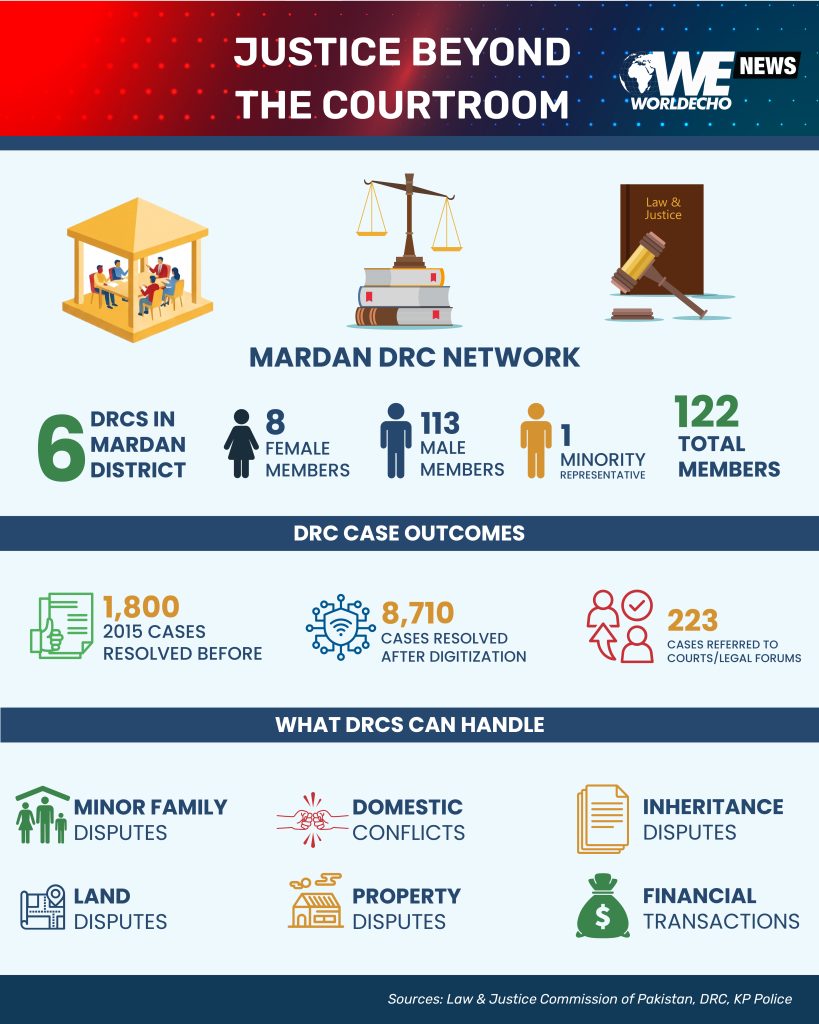
Mardan District Police Officer Masood Khan tells WE News English that there are six DRCs in the district, with 113 male and eight female members, as well as a minority representative. He says members are selected after clearance by the relevant intelligence and police authorities.
“The objective was to regulate the jirga system and bring it within a legal framework.” – Masood Khan, Mardan District Police Officer
“The objective was to regulate the jirga system and bring it within a legal framework,” Khan explains.
He says the councils first try to persuade disputing parties to accept an amicable settlement. If a matter cannot be resolved through that process, police mechanisms remain available.
Around 90 per cent of the cases handled by the councils are resolved, according to the district police’s assessment. Cases involving serious offences, Khan adds, are dealt with through the formal criminal justice system, including registration of an FIR and further proceedings under the law.
DRC member Nusrat Ara says that the councils had resolved around 1,800 cases before 2015, when their records were not yet maintained digitally. Since the DRC system was digitised, she adds, a total of 8,710 cases have been resolved, while approximately 223 cases have been referred to other courts or relevant legal forums.
Making settlements work
Imran Takkar, a Peshawar-based social campaigner, says it is natural for a party to a dispute to reject a decision that goes against its interests.
“When two parties are involved in a dispute and a decision is made in favour of one and against the other, it is natural that the losing party may refuse to accept it. But this does not happen only in DRCs,” he says.
Because DRCs play an important role in resolving disputes outside the regular courts, the system needs a more organised and effective mechanism to ensure that settlements reached through the councils are properly implemented.” – Imran Takkar, Peshawar-based social activist
“Because DRCs play an important role in resolving disputes outside the regular courts, the system needs a more organised and effective mechanism to ensure that settlements reached through the councils are properly implemented,” Takkar adds.
If parties, Takkar elaborates, ultimately have to go back to the police or the courts to enforce a decision, then the same burden returns to police stations and the judicial system. The role of the DRC is, therefore, extremely important because it can help reduce pressure on both the courts and the police.”
Although DRCs draw on the tradition of community-based dispute resolution, their statutory framework places the process within a formal institutional structure rather than leaving disputes solely to individual elders. Cases that cannot be amicably resolved or fall outside the council’s mandate can be taken to the appropriate legal forum.
For women such as Riffaqat Bibi, that combination of community access and statutory backing offers something the conventional system can struggle to provide: a place to seek help before a dispute grows into a prolonged legal battle.
Her role has now extended beyond resolving her own dispute. By accompanying other women to the DRC, she has become part of an informal network helping them navigate an alternative route to justice.