Key Points
- Russian Foreign Minister Sergey Lavrov identifies ISKP as the principal regional terrorist threat.
- Moscow alleges terrorist strongholds remain near three Central Asian borders.
- Russia says terrorists attempt to enter neighbouring countries covertly.
- Moscow warns of threats extending into Russia and Central Asia.
- ISKP claimed responsibility for the deadly 2024 Moscow concert hall attack.
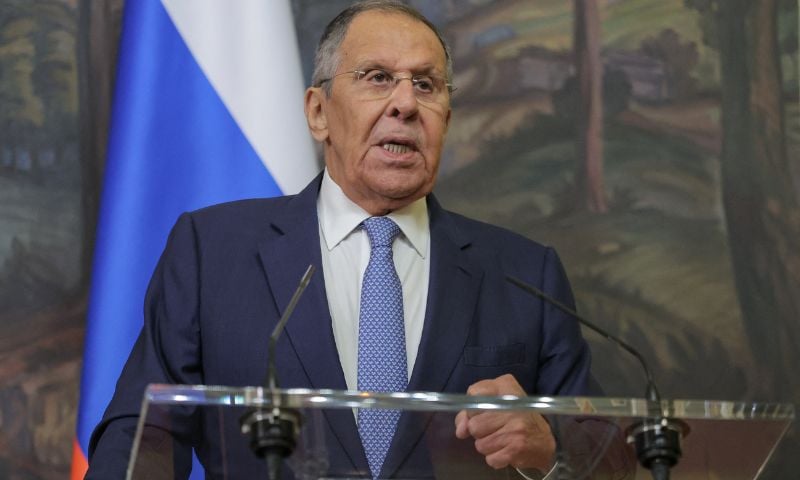
ISLAMABAD: Russian Foreign Minister Sergey Lavrov has expressed serious concern over the continued presence of terrorist and extremist groups in Afghanistan, warning that Islamic State Khorasan Province (ISKP) seeks to undermine the Taliban administration and use Afghan territory as a launching pad for terrorist activities across Central Asia and Russia.
Speaking at a conference on security in Central Asia and Afghanistan on Friday, Lavrov said terrorist groups maintained a significant presence in Afghan regions bordering Tajikistan, Turkmenistan and Uzbekistan, including training camps and strongholds.
He said members of these organisations attempted to enter Central Asian countries, sometimes disguising themselves as refugees or tourists.
According to Lavrov, the principal threat came from Wilayat Khorasan, also known as Islamic State Khorasan Province (ISKP), a regional affiliate of the Islamic State group.
“The main threat comes from the fighters of Wilayat Khorasan,” Lavrov said, describing the group as an organisation openly seeking to undermine the Kabul government’s ability to maintain stability in Afghanistan.
He added that the terrorists wanted to use Afghanistan as a “springboard” to extend terrorist activity into Central Asia and the Russian Federation.
ISKP’s regional ambitions
Lavrov said the terrorist network operating across the Afghan border had brought together fighters of Central Asian, North Caucasian and Uyghur origin who had gained combat experience in armed operations in the Middle East and Africa.
He also pointed to the presence of preachers promoting radical ideology, underground madrasas and propaganda networks operating in the information space, particularly on social media.
The Russian foreign minister further said that attempts were being made to smuggle weapons and drugs from Afghanistan into Central Asian countries and subsequently into Russia.
The remarks underline Moscow’s concern that the security threat extends beyond Afghanistan’s domestic conflict and could affect neighbouring states through cross-border terrorist movement, ideological recruitment and illicit trafficking.
A persistent international threat
ISKP emerged in Afghanistan in 2015 as an affiliate of the Islamic State group and has since become one of its most active branches. It has carried out attacks against civilians, religious minorities and government targets, while seeking to challenge the Taliban authorities and project its influence beyond Afghanistan.
The group’s international reach was highlighted in March 2024, when Islamic State-linked terrorists attacked the Crocus City Hall concert venue near Moscow, killing scores of people. ISKP claimed responsibility for the attack, which demonstrated the potential consequences of terrorist networks operating beyond Afghanistan.
The United Nations has continued to assess the threat posed by Islamic State and its affiliates through periodic reports to the Security Council. Its reporting on Afghanistan and regional security provides an important international context for concerns about the group’s ability to sustain operations and threaten countries beyond its principal areas of activity.
Regional security concerns
Lavrov’s warning also reflects the strategic importance of Afghanistan’s northern borders, which connect the country with Tajikistan, Turkmenistan and Uzbekistan.
The three countries face different geographical and security challenges along their borders with Afghanistan, while their proximity to Russian strategic interests makes instability in the region a wider concern for Moscow.
Russia has repeatedly emphasised the need for regional cooperation against terrorism and has sought to strengthen its engagement with Afghanistan’s de facto Taliban authorities on security matters.