
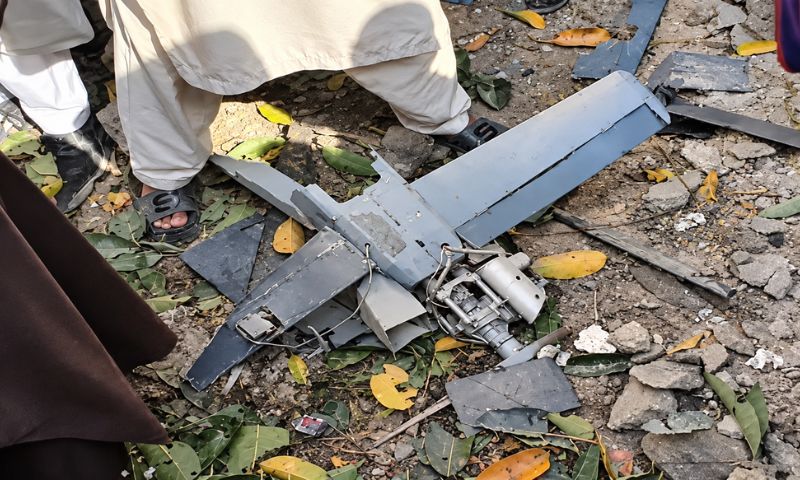
ISLAMABAD: Pakistan is facing an evolving security challenge as authorities report an increase in drone incursions and attacks originating from Afghanistan, adding a new dimension to tensions with the Afghan Taliban’s interim government.
Pakistan’s Foreign Ministry said on September 28 that it had lodged a protest with the Taliban authorities over provocative drone incursions, reporting that 23 drones had entered Pakistani airspace from Afghanistan since the beginning of the month.
The Pakistani military had earlier reported intercepting at least eight fixed-wing drones in Khyber Pakhtunkhwa on September 23, including one near the Torkham border crossing.
The reported incidents have raised concerns in Islamabad about the use of relatively inexpensive unmanned aerial vehicles (UAVs) in cross-border attacks and the challenges they pose to Pakistan’s security forces.
Pakistan has repeatedly called on the Afghan Taliban administration to prevent terrorist groups, particularly Tehreek-e-Taliban Pakistan (TTP), from using Afghan territory to plan or launch attacks against Pakistan.
Rising Drone Threat
According to the reports cited by FRANCE 24, the drones used in the reported attacks include small first-person-view (FPV) quadcopters carrying explosives and larger fixed-wing aircraft designed for one-way missions.
The emergence of such systems presents a new challenge for security forces across the region. Although relatively inexpensive drones may have limited destructive capacity compared with conventional military aircraft, their use can complicate border surveillance and increase pressure on security infrastructure.
Pakistan has reported intercepting drones near sensitive locations, including areas close to the Afghan border and the outskirts of Islamabad.
In March 2026, Pakistani sources reported that two drones had been intercepted near the capital. The attacks have intensified calls for stronger border monitoring and effective action against terrorist networks operating across the Pakistan-Afghanistan frontier.
Terrorist groups operating from Afghanistan
Pakistan and the Afghan Taliban’s relations have deteriorated sharply amid persistent security concerns and disagreements over terrorist groups operating from Afghanistan.
Pakistan’s Defence Minister Khawaja Muhammad Asif previously described the relationship as an “open war” after tensions escalated.
A central issue is the presence of the Tehreek-e-Taliban Pakistan and other terrorist groups inside Afghanistan, which have waged a prolonged campaign of violence against Pakistani security forces and civilians.
The TTP and Afghan Taliban have longstanding ideological and organisational alignments. The TTP is designated as a terrorist organisation by Pakistan and has been associated with numerous attacks inside the country.
Islamabad accuses the Afghan Taliban authorities of allowing TTP terrorist militants to use Afghan territory as a base for operations against Pakistan.
Pakistan has carried out strikes against militant positions inside Afghanistan, saying such operations are intended to prevent attacks on its territory.
Low-Cost Weapons
Security analysts say the growing availability of relatively inexpensive drone technology has made it easier for non-state armed groups to acquire aerial capabilities that were previously beyond their reach.
Mark Grozel, a specialist in unmanned aerial vehicles quoted by FRANCE 24, said fixed-wing drones of the type examined by the publication could carry small explosive payloads and were generally vulnerable to interception once detected.
However, he noted that detecting such aircraft could be difficult, particularly when they fly at low altitudes.
The availability of commercial components and widely accessible navigation technology has also lowered barriers to acquiring or assembling basic unmanned aircraft.
Pakistan attempted negotiations with the TTP between late 2021 and mid-2022 in an effort to reduce violence and reach an agreement.
Regional Security
The growing use of drones highlights the changing nature of the security challenge confronting Pakistan and other countries dealing with armed groups operating across borders.
For Islamabad, the priority remains preventing militant attacks, protecting civilians and ensuring that neighbouring territory is not used to launch violence against Pakistan.
Sustainable progress will require effective action against militant networks, credible mechanisms for cross-border cooperation and diplomatic efforts to prevent further escalation.
Pakistan’s security concerns over the TTP and reported drone incursions remain central to its relationship with the Afghan Taliban administration. Addressing those concerns will be important for reducing violence and improving stability along the shared border.