










Key Points
- Pakistan needs coordinated policies to turn population growth into economic gains.
- Women’s education and workforce participation are key priorities.
- Digital skills can help young people earn more and expand exports.
ISLAMABAD: Pakistan Finance Minister Muhammad Aurangzeb has called for an integrated approach to population management, human capital development and job creation.
He stressed that Pakistan must equip its growing workforce with skills and employment opportunities to reap the benefits of demographic change.
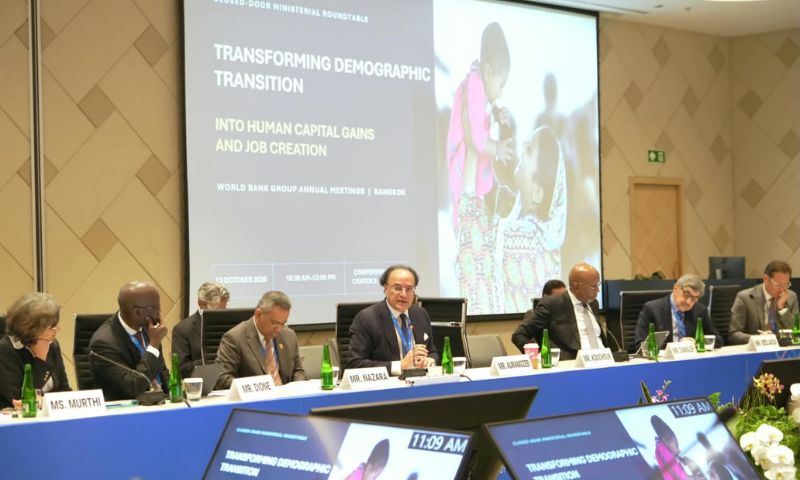
Aurangzeb highlighted women’s education, workforce participation and private-sector-led growth as key priorities, while speaking at the World Bank’s roundtable on “Transforming Demographic Transition into Human Capital Gains and Job Creation” on the sidelines of the World Bank Group–International Monetary Fund (IMF) Annual Meetings 2026 in Bangkok, Thailand, on Tuesday.
Drawing on experiences from Indonesia, Bangladesh and Iran, the finance minister emphasised the importance of women’s education and economic participation.
He also underlined the need for engagement with religious leaders on birth spacing, as part of efforts to address Pakistan’s rapid population growth and its implications for health, education and employment.
He stressed that translating demographic change into economic gains required coordinated federal and provincial policies, sustained political commitment and measurable outcomes, bringing fragmented initiatives under a comprehensive framework.
Pakistan’s National Population Council
Aurangzeb also discussed the recent establishment of the National Population Council, led by the Prime Minister, and the need to make it an effective mechanism for coordinating efforts on population-related challenges.
The minister said Pakistan’s ability to realise its demographic dividend depended on developing a skilled workforce and generating jobs through private-sector-led growth.
READ ALSO: Pakistan Set to Lead G-24 Call for Global Reform
A growing working-age population can contribute to economic expansion only when people have the education, skills and opportunities needed to participate productively in the economy.
He identified freelancing, information technology-enabled services and digital skills as opportunities for young Pakistanis to increase their earnings while contributing to export growth.
Aurangzeb called for population, health, education, and employment policies pursued in an integrated manner, with greater coordination among government institutions and a focus on tangible results.
The World Bank roundtable discussion centred on how countries can turn demographic transitions into gains in human capital and employment, rather than allowing rapid population growth to intensify pressure on public services and labour markets.
For Pakistan, the challenge is to align investment in education and healthcare with productive job creation, while enabling more women to enter the workforce and equipping young people with skills demanded by employers and international markets.













