Key Points
- Pakistan to assume G-24 chairmanship
- Minister urges development-focused global financial system
- Bangkok meeting reviews challenges facing developing economies
ISLAMABAD: Pakistan has called for reforms to the international financial system to make it more representative and responsive to developing economies, said Finance Minister Muhammad Aurangzeb on Tuesday.
The Finance Minister reaffirmed Pakistan’s commitment to advancing developing countries’ interests as the incoming chair of the Group of 24 (G-24).
The Group of 24 (G-24) is a coalition of developing countries that coordinates positions on international monetary, financial and development issues, particularly in dealings with the IMF and World Bank.
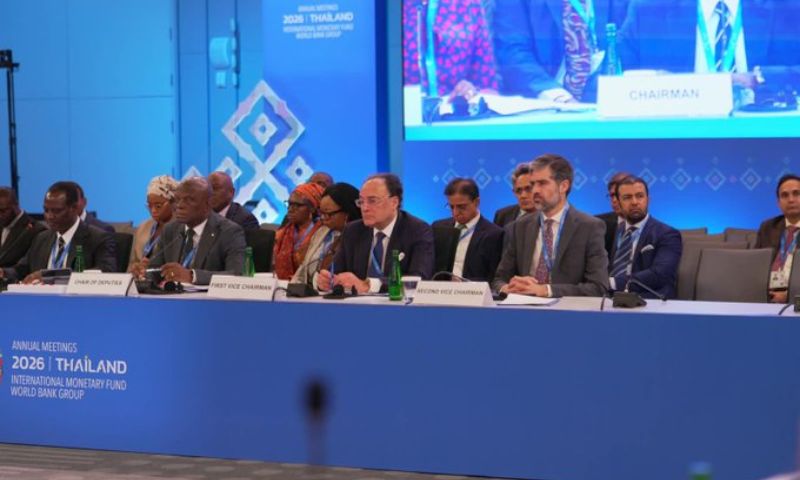
Speaking as the group’s First Vice-Chair at a meeting of finance ministers and central bank governors in Bangkok, Thailand, on the sidelines of the World Bank Group–International Monetary Fund (IMF) Annual Meetings 2026, Aurangzeb highlighted mounting pressures on developing countries.
The challenges include trade and investment disruptions, climate shocks, restrictive financial conditions and widening financing gaps, he added.
He stressed that the international financial architecture must evolve to address these challenges and provide timely support to countries undertaking difficult economic reforms while facing external shocks beyond their control.
Aurangzeb outlined three priorities for the G-24: restoring development as the international financial system’s central objective, making the Bretton Woods institutions more representative and responsive, and building a development-oriented global financial architecture.
The Bretton Woods institutions, established after World War II, include the World Bank and the IMF. Their governance structures, lending policies and representation of member countries have remained central to international debates over reforms to global economic institutions.
Pakistan next chair of G-24
Pakistan is expected to assume the G-24 chairmanship at the conclusion of the World Bank–IMF Annual Meetings in October 2026, succeeding Nigeria.
The G-24’s official governance rules provide for the chair-country’s one-year term to begin at the end of the Annual Meeting of Ministers, according to the Intergovernmental Group of Twenty Four G-24 organisational structures and governance.
The finance minister said Pakistan, as the incoming G-24 chair, would work to strengthen the group’s collective influence and promote the interests of developing economies.
He also emphasised cooperation among member countries and institutional partners, aiming at a more representative, resilient and development-centred international economic order.
He appreciated Nigeria’s leadership of the group, underscoring the importance of continuity and collective efforts in pursuing its objectives.
The G-24 brings together developing countries to coordinate positions on international monetary, financial and development issues, particularly in their engagement with the IMF and World Bank.
READ ALSO: Pakistan Eyes Japanese Market, More Yuan Bonds
Its meetings provided a platform for members to raise concerns regarding access to finance, debt pressures, economic stability and the impact of global developments on their economies.
Developing countries have faced persistent financing challenges as tighter financial conditions, climate-related disasters and external economic disruptions have increased pressure on public finances and investment needs.
The G-24 has advocated reforms to international financial institutions to improve developing countries’ representation in decision-making and expand support for sustainable development.
Aurangzeb’s remarks placed Pakistan’s incoming chairmanship within these efforts. Pakistan would focus on strengthening developing economies’ collective voice and ensuring that international financial arrangements better reflect their development needs.
Bangkok is hosting the 2026 annual meetings of the World Bank Group and IMF, bringing together finance ministers, central bank governors and other policymakers to discuss global economic conditions, financial stability and development priorities.
Pakistan’s forthcoming G-24 chairmanship will offer an opportunity to coordinate member countries’ positions on international financial reforms and advocate measures to address the financing needs and economic vulnerabilities of developing economies.
According to IMF eLibrary, climate-vulnerable G-24 members, including Pakistan, face mounting losses from floods, droughts, heatwaves and rising sea levels.
Pakistan’s devastating floods and recurring extreme weather highlight the risks for countries with scarce resources to rebuild and adapt.
These climate hotspots need greater access to affordable finance for disaster recovery, resilient infrastructure and long-term adaptation.
The World Bank identifies Pakistan as highly exposed to recurrent floods, intensifying heatwaves and accelerated glacial melt, underscoring the need for international support to protect livelihoods and economic stability.