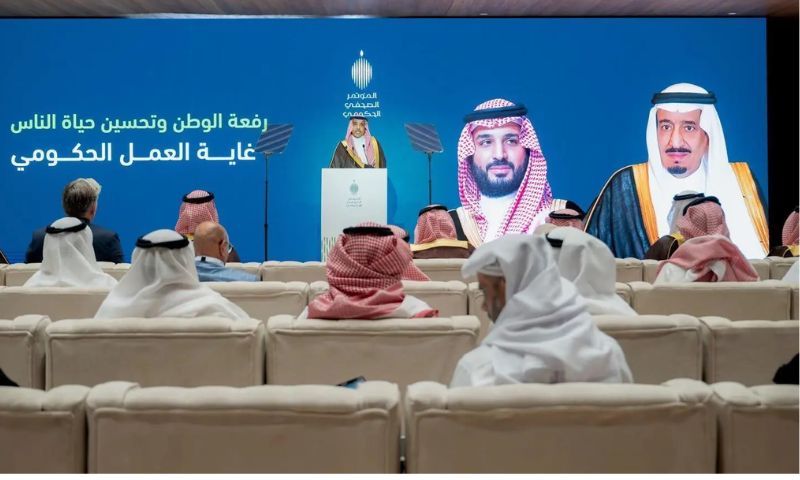
RIYADH: Saudi Arabia’s Minister of Media Salman bin Yousef Al-Dossary has affirmed that the Kingdom will remain strong through national unity and resolute in protecting its security, resources and holy sites, while placing people at the heart of its development priorities.
Speaking at the opening of the 37th government press conference in Riyadh on Monday, Al-Dossary condemned Houthi terrorist attacks targeting civilians and civilian objects in the Kingdom and expressed condolences to the victims’ families.
He said all Saudis stood united behind the country’s leadership and were proud of the security personnel and armed forces, adding that the Kingdom was prepared to confront any threat.
The minister stressed that the safety and security of citizens and residents remained the Kingdom’s top priority. Military, security, health and service agencies were coordinating to ensure an integrated response to emergencies, while the country had advanced capabilities to counter aerial, missile and drone threats.
He said life in the Kingdom continued as normal and that heightened readiness reflected preparedness for all scenarios rather than a cause for alarm.
He also urged the public to obtain information from official sources and refrain from circulating images, videos or information about security and military operations from unknown or unreliable sources.
Al-Dossary said the leadership’s development priorities included improving education and healthcare, investing in citizens’ capabilities, expanding employment opportunities and competitiveness, and continuing real estate reforms to broaden housing options and facilitate homeownership.
More than 63,000 Saudi families became first-time homeowners in the first half of 2026, he said, adding that the Human Resources Development Fund helped 329,000 Saudi men and women find jobs during the same period, a 23 per cent increase compared with the corresponding period last year.
He also highlighted progress in digital government services, noting that Saudi Arabia retained first place regionally for the fourth consecutive time in the digital government services maturity index, with an overall score of 99 per cent.
In transport, Saudi Arabia Railways signed an agreement to finance the purchase of 10 new passenger trains to expand intercity services and increase passenger capacity.
The Kingdom’s trains carried more than 38 million passengers in the second quarter of 2026, alongside nearly 3.7 million tonnes of minerals and goods.
The minister also highlighted investments in energy storage, water industries and strategic minerals, as well as the expansion of healthcare services and the development of internationally recognised Healthy Cities. He said 21 Saudi cities had received World Health Organisation accreditation after meeting 80 international standards.
Turning to Riyadh’s development, Minister of State and CEO of the Royal Commission for Riyadh City Ibrahim bin Mohammed Al-Sultan outlined major projects aimed at improving transport, infrastructure, housing and environmental sustainability.
He said the programme to develop Riyadh’s ring roads and main corridors aimed to upgrade about 700 kilometres of key corridors and more than 330 major intersections, including the construction of over 300 bridges and 80 tunnels.
Riyadh’s public transport network is approaching 500 million passengers since operations began, including more than 300 million on the Riyadh Metro, Al-Sultan said. The commission has signed contracts to purchase 94 additional trains, increasing the metro fleet from 183 to 277.
He also highlighted progress on major green initiatives, including King Salman Park, the Green Riyadh Programme and the rehabilitation of natural areas. More than 4.5 million trees have been planted under the Green Riyadh Programme, with afforestation extended along 235 kilometres of roads and corridors.
On housing, Al-Sultan said measures to increase real estate supply and expand options for citizens included providing 10,000 to 40,000 residential plots annually over five years at no more than SAR1,500 per square metre.
Regarding Expo 2030 Riyadh, he said the project had moved from planning to implementation, with the detailed master plan completed, participation contracts being signed and construction and operational preparations under way.
The exhibition will feature more than 230 pavilions, with 197 countries and other organisations participating, across a site covering approximately six million square metres.
Al-Sultan said the ongoing projects formed an integrated development system covering planning, transport, the economy, housing and the environment to meet Riyadh’s growing needs and prepare the capital for the future.