
Key Points
- 71 mobile phones and 155 laptops seized during the raid
- Digital devices sent for forensic examination by investigators
- Case registered as authorities probe the wider network
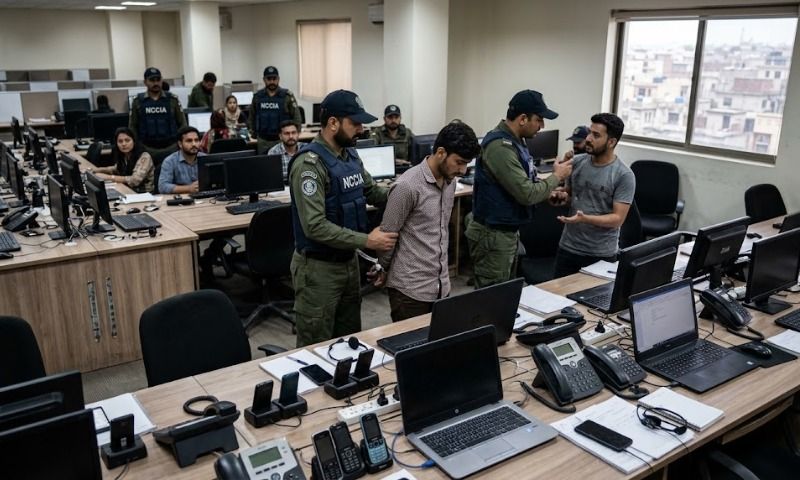
ISLAMABAD: Pakistan’s National Cyber Crime Investigation Agency, the country’s cybercrime prevention and investigation agency, has arrested 61 people after raiding an alleged illegal call centre in Rawalpindi.
Suspects allegedly targeted foreign nationals in a loan recovery and extortion scheme, according to statement issued by the agency.
The raid was conducted at a call centre in the Commercial Market area of Rawalpindi’s Satellite Town after the agency received information about an alleged operation targeting victims abroad. Rawalpindi is the adjacent city of Pakistan’s federal capital Islamabad.
Investigators said the suspects allegedly posed as loan recovery agents and used threats and intimidation to force foreign nationals to make payments.
The authorities are examining the operation to determine how the alleged scheme was organised and the extent of its activities.
During the raid, officials seized 71 mobile phones and 155 laptops.
The devices and data have been taken for forensic analysis, which could help investigators trace communications, identify potential victims and establish links with other people or organisations.
A case has been registered and further investigation is underway.
The operation is part of a crackdown by Pakistan’s cybercrime authorities against illegal call centres and cyber-enabled financial fraud.
Authorities have targeted operations that use digital communications, social media and other online platforms to defraud or intimidate victims in Pakistan and abroad.
Ealier on Tuesday the National Cyber Crime Investigation Agency (NCCIA) arrested 39 people during a crackdown on an alleged illegal call centre operating in Lahore under the cover of a fake medical billing service.
The operation was conducted under the supervision of Additional Director NCCIA Lahore Zone Atif Ameer as part of an ongoing campaign against organised cyber fraud.
According to an NCCIA spokesperson, the action was initiated following an inquiry based on confidential information.
The investigation revealed that the suspects were allegedly operating the call centre under the name “MediConvox” while presenting it as a medical billing service provider.
The spokesperson said the call centre contacted foreign citizens under the pretext of a Canada-related mobility campaign and attracted them through promotional and marketing offers.
The suspects allegedly posed as representatives of a legitimate service provider and obtained personal and financial information from individuals.
They also sought credit and debit card details, which were allegedly used in attempts to obtain money from victims.
During the operation, the agency seized 24 computers, seven laptops and 42 mobile phones. Three vehicles were also taken into custody.
The NCCIA said such activities not only caused financial losses to individuals but also damaged Pakistan’s reputation abroad.
Further investigations are under way to trace the wider network, identify other individuals involved and determine the methods allegedly used to carry out the financial fraud.
In September, the agency reported another operation in Rawalpindi in which 28 people were arrested over an alleged online financial fraud network.
Investigators said suspects in that case used Telegram channels and fake social-media profiles to attract victims through purported investment and e-commerce schemes.
These operations highlight the growing use of call centres and online platforms in cross-border financial crime, allowing criminal networks to communicate with victims overseas while operating from Pakistan.
In the latest case, Pakistan investigators are examining the seized computers and phones for evidence of communications, financial transactions and other digital activity.
The forensic examination is expected to help authorities establish whether the suspects were acting independently or as part of a larger network.
Pakistan authorities are also seeking to determine the number of foreign nationals allegedly targeted and the amount of money involved in the suspected scheme.
The National Cyber Crime Investigation Agency was established to investigate cybercrime and related offences, including online financial fraud, identity-related crimes and other technology-enabled criminal activity.
The Rawalpindi investigation remains ongoing, with authorities expected to determine whether additional suspects were involved and whether further arrests or charges will follow.