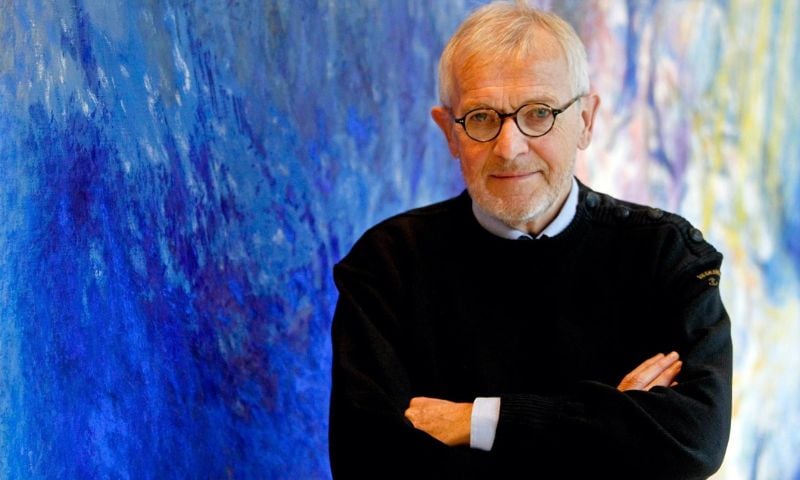
WASHINGTON: Belgian-American physicist Francis Halzen has won the 2026 Nobel Prize in Physics for his pioneering work in developing an observatory in Antarctica to detect high-energy neutrinos, among the universe’s most elusive subatomic particles.
Halzen, 82, recognised that the exceptionally clear ice beneath the South Pole could be used to detect traces of neutrinos, sometimes called “ghost particles” because they can pass through the Earth and human bodies with little or no interaction with matter.
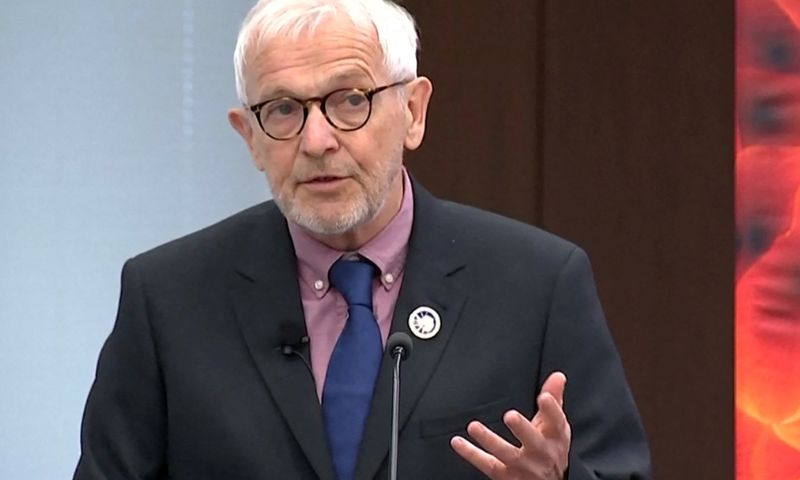
“The messengers bring information from the cosmos,” Eva Olsson of the Royal Swedish Academy of Sciences said at a press conference. “They open the door to distant galaxies and tell us about the processes of exploding stars.”
IceCube observatory
The IceCube observatory in Antarctica has more than 5,000 sensors embedded in a cubic kilometre of ice, extending to a depth of about 2,500 metres near the Amundsen-Scott South Pole Station.
The facility detects rare interactions involving high-energy neutrinos, allowing scientists to investigate where the particles originate and how they are produced. Such observations could also help uncover previously unknown phenomena, the Nobel committee said.
Neutrinos are electrically neutral and are not deflected by magnetic fields. Unlike electromagnetic radiation such as visible light, they therefore travel in a relatively straight path from their source, allowing scientists to trace them back to violent cosmic events.
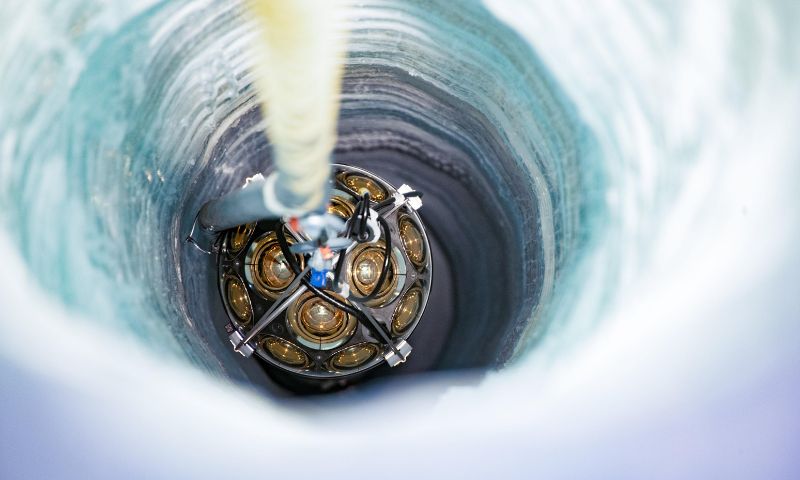
The observatory has detected high-energy neutrinos originating both within and beyond the Milky Way, opening a new field of astronomy focused on identifying the cosmic objects and processes responsible for producing them.
Halzen first proposed using the South Pole to detect neutrino traces in 1988, but the project was not completed until 2011. “I have to emphasise how lucky I was because, when we started this project, everybody realised this was maybe a good idea, but very few thought it would work, including myself,” Halzen told reporters by telephone.
‘Neutrino Man’
Halzen, a professor at the University of Wisconsin-Madison, was dubbed “Neutrino Man” by Smithsonian magazine in 2014 when he received one of its Ingenuity Awards for his work on the experiment.
The IceCube facility must operate throughout the harsh Antarctic winter, when temperatures can fall below -50°C and aircraft cannot land for months. A small team of researchers, known as “winterovers”, remains at the station to maintain the observatory.

The South Pole station can accommodate up to about 150 people and includes facilities such as a kitchen, dining room, gym and greenhouse. Despite the observatory’s achievements, Halzen said the most significant discoveries from his work may still lie ahead. “The real excitement is that I cannot answer that question yet,” he said. “This is just an introduction to the science, the astronomy is still to come.”
Nobel recognition
Belgian Prime Minister Bart De Wever congratulated Halzen, describing the award as recognition of “a life dedicated to unraveling the greatest secrets of the cosmos through its most minuscule manifestations”. The Nobel laureate receives a prize of 12 million Swedish crowns, equivalent to about $1.2 million.
The Nobel Prizes were established through the will of Swedish inventor and entrepreneur Alfred Nobel. The Physics Prize has honoured discoveries that have fundamentally changed humanity’s understanding of the universe and the laws governing it.
READ ALSO: Nobel Prizes 2026: What They Are and When the Winners Will Be Announced
Previous laureates include Albert Einstein, Marie and Pierre Curie, Max Planck and Niels Bohr. The Nobel medals will be presented by Sweden’s King Carl XVI Gustaf at a ceremony in Stockholm on December 10, the anniversary of Nobel’s death. A banquet traditionally follows the ceremony. The Nobel Peace Prize is awarded separately in Oslo, Norway.
Famous Nobel laureates
The Nobel Prize has been awarded to some of the world’s most influential scientists, writers and political figures. Notable laureates include physicists Albert Einstein and Niels Bohr, writers Ernest Hemingway and Albert Camus, and figures such as Nelson Mandela and Mother Teresa.
The Curie family is among the most distinguished Nobel-winning families. Marie Curie received two Nobel Prizes, while her husband Pierre Curie, daughter Irène Joliot-Curie and son-in-law Frédéric Joliot-Curie also became laureates.
Only five people have won Nobel Prizes more than once. American chemist and peace activist Linus Pauling remains the only person to have received two unshared Nobel Prizes.
The awards have also attracted criticism over the years. For example, the 1949 Nobel Prize in Physiology or Medicine awarded to Egas Moniz for work associated with lobotomy has since been heavily criticised as the procedure fell out of favour.
Several Peace Prize decisions have also generated debate, including awards involving Henry Kissinger, Yasser Arafat, Yitzhak Rabin and Shimon Peres. Gandhi’s failure to receive the prize before his death in 1948 has also been widely discussed.
Pakistan’s Nobel legacy
Pakistan has produced two Nobel laureates – physicist Dr Abdus Salam and education activist Malala Yousafzai. Dr Abdus Salam shared the 1979 Nobel Prize in Physics with Sheldon Glashow and Steven Weinberg for their contributions to the theory of the unified weak and electromagnetic interaction between elementary particles, including the prediction of the weak neutral current. He was the first Pakistani to receive a Nobel Prize.
Malala Yousafzai shared the 2014 Nobel Peace Prize with Indian child-rights activist Kailash Satyarthi. They were awarded the prize for their struggle against the suppression of children and young people and for the right of all children to education.