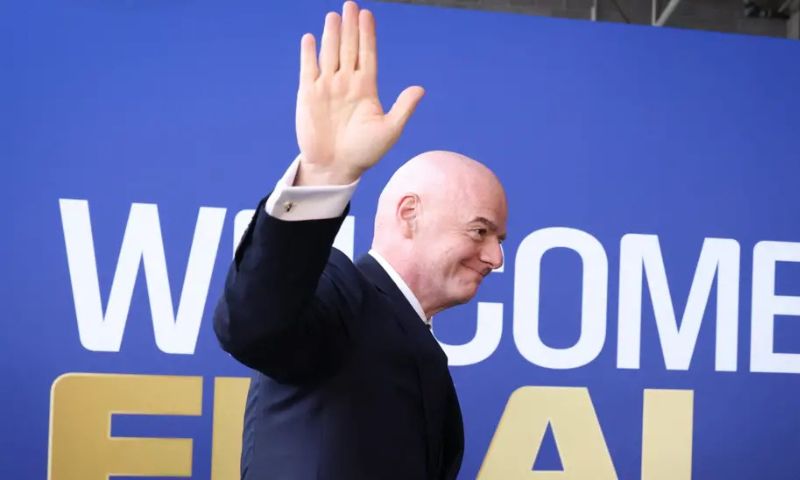
ISLAMABAD: Gianni Infantino’s grip on the FIFA presidency is hanging by a thread as the embattled Swiss chief fights for his political survival following a catastrophic miscalculation that has united football’s most powerful confederations against him.
WE News English can exclusively reveal the seven big names preparing to enter the race to succeed Infantino, with the November 18 nomination deadline fast approaching and the FIFA president’s departure now considered “certain” by insiders.
Moves to force Gianni Infantino out of the FIFA presidency are officially under way and accelerating.
There is now a determined effort at the top of European football in particular to ensure Infantino does not survive at FIFA
Details herehttps://t.co/azA26OqjLK
— Rob Harris (@RobHarris) August 1, 2026
What began as a secretive scheme to sell stakes in FIFA tournaments to private investors has spiralled into the most serious leadership crisis world football has witnessed in years. UEFA, CONCACAF and the Asian Football Confederation have all voiced their displeasure, forcing Infantino to execute a humiliating U-turn that many insiders believe has fatally wounded his authority.
Yet his opponents are not content with merely killing the plot, they want the man himself gone. UEFA are said to be ‘accelerating’ plans to remove the 10-year incumbent, and FIFA insiders now consider his departure ‘certain’.
“If Infantino doesn’t resign voluntarily, his opponents will have no choice but to force a vote of no confidence or back a rival candidate in the upcoming FIFA presidential election,” a senior football told media.
The English Football Association is sending a letter withdrawing its support for Gianni Infantino’s re-election as pressure mounts on the FIFA president to stand down, per multiple reports.
This comes shortly after the Football Association of Wales (FAW) became the first of the… pic.twitter.com/CgDsaTAKUC
— Yahoo Sports (@YahooSports) August 3, 2026
With the clock ticking towards the November 18 deadline, the battle to succeed Infantino is already raging behind closed doors. Here are the seven leading contenders WE News English has identified as potential candidates.
Arsène Wenger: The footballing legend turned administrator
“I miss Arsenal because I left my heart in there…I gave my life to this club for 22 years. Every minute of my life was dedicated to this club…I support Arsenal. It will be forever my club.”
3 years ago today, Arsène Wenger went to see his statue.pic.twitter.com/V2qlkbofBB
— Gunners (@Gunnersc0m) August 3, 2026
Former Arsenal boss and FIFA’s Chief of Global Football Development emerges as a genuine outsider
Since bringing his legendary managerial career to an end, the iconic Frenchman has become an increasingly influential figure within FIFA as its Chief of Global Football Development, helping shape the future direction of the game.
Wenger has never been afraid to champion bold ideas. Earlier this year, his proposed “daylight offside rule” was even put on trial in Canada, highlighting his willingness to challenge soccer’s traditional thinking.
He has been complimentary of Infantino in the past, although notably has remained silent throughout the latest controversy surrounding the failed World Cup investment plans.
Wenger’s standing within the sport is beyond question. Few people command as much respect, and his appointment would undoubtedly help refresh FIFA’s public image. However, his previous backing of Infantino and limited experience in soccer politics compared to the other candidates make him a genuine long shot.
Victor Montagliani: The former ally turned rival
Victor Montagliani, le président de la CONCACAF, s’imagine bien président de la FIFA à la place de son (ancien) ami Gianni…
Et croyez-moi : si c’est pour ramener Montagliani à la tête du football mondial, il n’y a clairement aucune utilité à sortir Infantino.
Homme du… pic.twitter.com/VU0U1UvgTV
— Romain Molina (@Romain_Molina) August 1, 2026
CONCACAF president and long-time Infantino ally who has sensed his moment
The Canadian football chief has emerged as one of the most credible challengers in a chaotic few days. Montagliani, 60, had previously intended to wait until 2031 to make his move, with Infantino expected to run unopposed. But the sudden collapse of the FIFA president’s standing has created an opportunity too tempting to ignore.
CONCACAF, which represents North and Central America and the Caribbean—rejected FIFA’s investment proposal outright, though Montagliani’s words were notably less incendiary than UEFA’s blistering condemnation. This diplomatic approach could prove shrewd, positioning him as a unifying figure rather than a divisive one.
Since becoming the first non-Caribbean CONCACAF president in 1969, Montagliani has built significant credibility. His involvement in World Cup organising has boosted his global profile, and he is understood to have support beyond his own federation’s borders.
Nasser Al-Khelaifi: The reluctant power broker
European football leaders have been trying to line up Qatari powerbroker Nasser Al-Khelaifi as a challenger to Fifa president Gianni Infantino.
Telegraph Sport has confirmed that the chairman of Qatar Sports Investments and president of Paris St-Germain is seen by supporters as… pic.twitter.com/O6ezv0ZeMA
— Telegraph Football (@TeleFootball) July 30, 2026
PSG chief and European club football’s most influential figure, but does he want the job?
The Paris Saint-Germain president commands extraordinary influence in European football as head of the European Football Clubs umbrella group. His network of allies spans continents, making him an obvious candidate to succeed Infantino.
However, sources close to the Qatari suggest he has “absolutely no ambition, no intention, nor any interest in this role at FIFA.” His reluctance appeared to harden further when the Qatar Football Association issued a statement on Sunday backing Infantino, seemingly closing the door on any potential candidacy.
Nevertheless, in the volatile world of football politics, situations can change rapidly. If European football unites behind a single candidate, pressure on Al-Khelaifi to reconsider could become irresistible.
Mattias Granstrom: The insider’s choice
According to @Romain_Molina, FIFA General Secretary Mattias Grafström is allegedly attempting to oust Gianni Infantino, with claims that the FIFA president could soon lose his position. pic.twitter.com/GFOLK3vzCJ
— DSI_Football (@DSI_Football) July 31, 2026
FIFA general secretary and the most likely internal successor
Granstrom represents continuity without the baggage that now encumbers Infantino. The FIFA general secretary has reportedly remained untarnished by the disastrous investment plot, making him an appealing compromise candidate for those who want change without wholesale disruption.
His lack of public profile is both advantage and disadvantage. While he lacks the name recognition of other contenders, his intimate knowledge of FIFA’s internal machinery could prove invaluable during a turbulent transition period. If insiders decide they want a steady hand rather than a revolutionary, Granstrom’s prospects would improve significantly.
Dariusz Mioduski: The European Unity candidate
Coraz częściej czytamy w mediach, że Gianni Infantino traci poparcie różnych federacji. Czy Dariusz Mioduski stoi w takim razem przed wielką szansą na zostanie kolejnym prezydentem FIFA? Wybory już za rok. 🧐👀
Sprawdźcie naszą pełną ofertę ➡️ https://t.co/kHHWMqnTPt pic.twitter.com/bg1zWQpN6g
— LV BET (@LVBETpl) August 1, 2026
Polish lawyer and Legia Warsaw owner backed by five European associations
Mioduski’s name has emerged from the rumour mill with surprising force. The vice-president of the European Football Clubs body has reportedly secured endorsements from the Belgian, Spanish, Norwegian, German and Swedish football associations, according to talkSPORT.
With UEFA president Aleksander Ceferin seemingly unwilling to enter the race himself, Mioduski could become the consensus European candidate, provided he can broaden his appeal beyond continental boundaries.
His background as a lawyer and club owner gives him a different perspective from traditional football administrators. However, questions remain about whether he possesses sufficient international recognition to mount a credible global campaign.
Sheikh Salman bin Ebrahim Al Khalifa: The experienced dark horse
🔴 FIFA scraps $4.2bn World Cup stake sale after regional confederation backlash
FIFA President Gianni Infantino withdrew plans to sell a 20 percent stake in a new unit overseeing World Cup events to private investors. The proposal would have raised up to $4.2 billion.
Asian… pic.twitter.com/jgUX0XMGy8— NewsTongue (@NewsTongueX) August 1, 2026
AFC president since 2013 who could emerge as a compromise figure
The Bahraini football chief has led the Asian Football Confederation since 2013, making him one of the most experienced administrators in world football. The AFC issued a statement expressing solidarity with UEFA and CONCACAF, though their language was notably milder than the European confederation’s blistering condemnation.
Sheikh Salman has reportedly been reluctant to challenge Infantino directly, and it remains unclear whether he will ultimately decide to stand. The 60-year-old’s substantial experience and status within the AFC could make him an appealing compromise candidate if the various power blocs cannot agree on a single alternative.
Lise Klaveness: The reformist outsider
There is an irony in two women, Laura McAllister and Lise Klaveness, leading the resistance to the great World Cup sell-off, given how football has historically and systemically kept females at arm’s length – on the pitch, on the touchlines, in the boardrooms, in its executive… pic.twitter.com/pV2Kvi3G8u
— The Athletic | Football (@TheAthleticFC) August 3, 2026
Norwegian FA president and outspoken critic of FIFA’s leadership
Lise Klaveness, the president of the Norwegian Football Federation, has emerged as a surprise contender to replace Gianni Infantino.
Following the collapse of Infantino’s World Cup investment plans, Klaveness appeared on Norwegian broadcaster Dagsrevyen and was highly critical of the FIFA president’s leadership.
“We board members don’t lead alone, and that’s what he’s missed in this matter,” she said, in what many viewed as a direct criticism of Infantino.
It is far from the first time Klaveness has challenged FIFA. She has consistently spoken out against what she sees as the governing body’s failures, criticizing everything from the controversial FIFA Peace Prize to the handling of the 2022 World Cup in Qatar, while repeatedly calling for greater transparency, accountability and stronger human rights protections.
With a strong moral compass and a vision that appears to be the complete opposite of Infantino’s, Klaveness has many of the qualities FIFA arguably needs.
The challenge, however, is obvious. As unfair as it may be, she would face the enormous hurdle of becoming the first woman ever elected FIFA president, a barrier no candidate has yet been able to break.
Read Also: European Football Countries Threaten World Cup Boycott Over FIFA’s $20 Billion Private Equity Plan
What happens next?
The coming weeks will be critical. If Infantino chooses not to resign, his opponents must decide between forcing a vote of no confidence or backing a rival candidate before the November 18 nomination deadline.
🚨 Gianni Infantino is set to hold a meeting with senior figures in the Trump administration as he seeks support to continue at FIFA.
Infantino has already been calling federations for public support as pressure grows for him to resign. pic.twitter.com/mtCXKMGcEi
— Ben Jacobs (@JacobsBen) August 3, 2026
European football’s role will be decisive. With UEFA president Ceferin apparently unwilling to run, European associations must coalesce around a single alternative to avoid splitting the opposition vote.
Read Also: FIFA Insists ‘Nobody Is Selling Football’ After Global Backlash from Member Associations
Meanwhile, Infantino appears determined to fight. A defiant statement issued over the weekend attempted to draw a line under the controversy, but his opponents have made clear they consider the matter far from closed.
Read Also: FIFA in Crisis as Top Advisor Resigns in Protest Over World Cup Stake Sale Plan
For a man who once seemed unassailable, the FIFA president now faces the most perilous period of his decade-long reign. The battle for control of world football’s most powerful institution has only just begun.