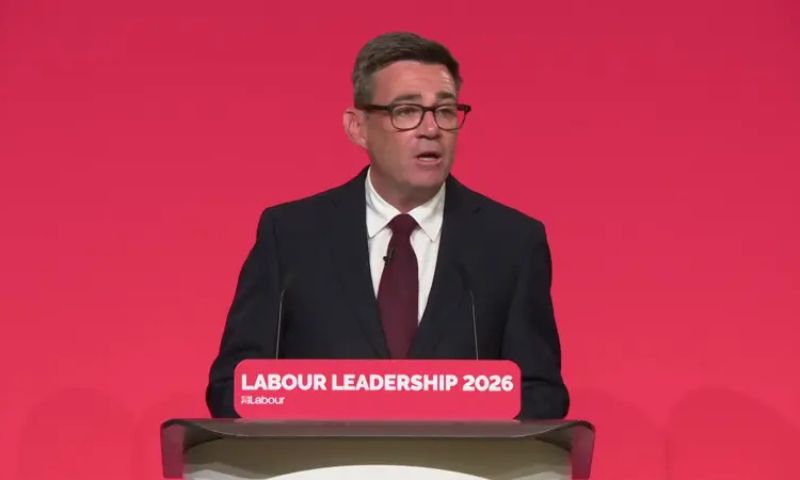
LONDON: Andy Burnham was officially declared leader of Britain’s governing Labour Party on Friday, clearing the way for him to become the country’s next prime minister on Monday.
Labour announced the outcome of its leadership contest to replace outgoing Prime Minister Keir Starmer, with Burnham running unopposed.
His victory had been widely expected after he secured the backing of 379 of Labour’s 403 Members of Parliament in the House of Commons ahead of the vote.
Congratulations to @andyburnham, the new Leader of the Labour Party! pic.twitter.com/uTsrssEJCD
— The Labour Party (@UKLabour) July 17, 2026
Addressing party members after the result was announced, Burnham pledged to restore optimism and confidence.
“We’re going to give them hope back,” he said. “This is a proud and emotional moment for my family and me, and one for which I am ready.”
Outlining his fourth pledge, Burnham said he would lead “for the north, the south, the east and the west; for Scotland, Wales and Northern Ireland.”
He said the north of England had “given me so much” and that he had worked to be its strongest voice. As prime minister, however, he pledged to champion every part of the United Kingdom equally.
It’s the honour of my life to be Leader of the Labour Party.
I will be a leader for every region and nation in this great country, and this Party will be unashamedly Labour in our priorities and in the decisions we take.
Together, we will set Britain on a new path. https://t.co/7SYlOp9qO6
— Andy Burnham (@andyburnham) July 17, 2026
Burnham said he loved every region of the country but believed they all had greater potential. He added that his government would empower communities by giving them the tools and authority to shape their own future.
He said Britain took a series of wrong turns in the 1980s, arguing that political power became increasingly centralised while economic power was privatised.
He added successive governments surrendered control of essential services, including housing, water, energy, and transport, leaving people exposed to rising living costs. According to Burnham, the shift also concentrated wealth and influence in the hands of a small number of people and regions.
Burnham says he will work with other parties where he can, but will set a direction that is “distinctively Labour” and the party will win by being “boldly, confidently, authentically us”.
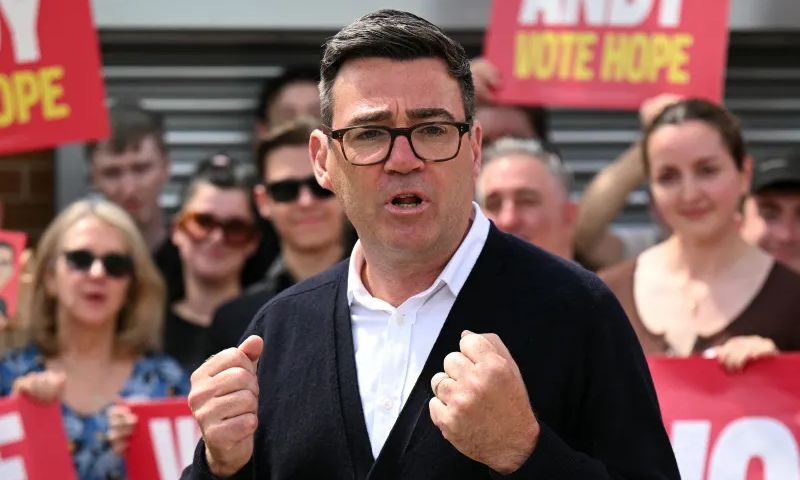
Andy Burnham has served as the Mayor of Greater Manchester since 2017. Born on January 7, 1970, in Liverpool, he previously served as a Member of Parliament for Leigh and held several senior roles in government under former Labour prime ministers.
Burnham served as Secretary of State for Health (2009–2010), Secretary of State for Culture, Media and Sport (2007–2009), and held other cabinet positions during the Labour governments of the 2000s. He was a candidate for Labour Party leader in 2010 and 2015 before becoming one of the party’s prominent figures outside Westminster.
As mayor of Greater Manchester, Burnham has focused on regional investment, public services, transport, and greater decision-making powers for local communities. Known for his emphasis on giving regions outside London a stronger voice, he has often positioned himself as an advocate for devolving power across the UK.
Starmer announces to step down
Prime Minister Keir Starmer announced last month that he would step down after two years in office, following a series of political setbacks and controversies that weakened his support within the Labour Party and among the public.
Also Read: UK’s Keir Starmer Resigns as Prime Minister and Labour Party Leader
Labour has consistently trailed the anti-immigration Reform UK party in opinion polls, while its heavy losses in May’s local elections intensified pressure on Starmer to resign.
Starmer will remain prime minister until Monday, when he is expected to formally submit his resignation to King Charles III. The King will then invite Andy Burnham to form a new government.
Under Britain’s parliamentary system, a governing party can replace its leader—and, by extension, the prime minister—without calling a general election. The next nationwide vote is not due until 2029.
Burnham will become Britain’s seventh prime minister since 2016, reflecting the rapid turnover of political leadership in recent years.