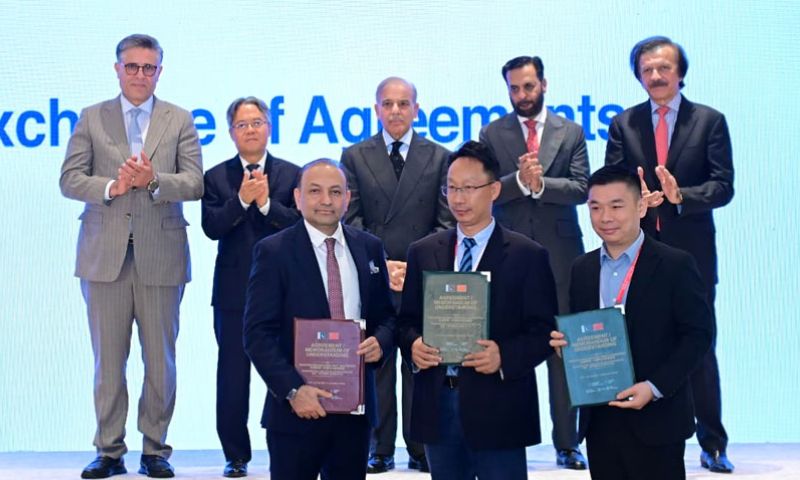



ISLAMABAD: Pakistan and China have signed pharmaceutical sector agreements worth $440 million to expand cooperation in pharmaceutical manufacturing, research and development, and healthcare exports.
The agreements were signed between Pakistani and Chinese pharmaceutical companies during a Pakistan-China Business-to-Business (B2B) investment conference held in Islamabad on Friday.
Addressing the conference, Prime Minister Shehbaz Sharif expressed confidence that the agreements would soon translate into practical projects, describing the development as another significant step toward advancing the second phase of the China-Pakistan Economic Corridor (CPEC) project.
Prime Minister Muhammad Shehbaz Sharif addresses the Pak China Pharmaceutical B2B Conference. Islamabad, 17 July 2026. pic.twitter.com/vtWzUtjvMA
— Prime Minister’s Office (@PakPMO) July 17, 2026
He said the participation of around 300 Chinese delegates reflected the strong commitment of both countries to strengthening economic and commercial ties.
Highlighting the importance of the pharmaceutical partnership, the prime minister said collaboration between companies from both countries would help boost the production of life-saving medicines and vaccines, enhance research capabilities, and enable Pakistan to become a regional centre for pharmaceutical exports.
Prime Minister Muhammad Shehbaz Sharif witnesses the signing and exchange of agreements between Chinese and Pakistani Pharmaceutical Companies at the Pak China Pharmaceutical B2B Conference. Islamabad, 17 July 2026. pic.twitter.com/hXxmEVReXR
— Prime Minister’s Office (@PakPMO) July 17, 2026
Pakistan promoting US-Iran dialogue
Referring to the ongoing regional situation, Shehbaz Sharif said the current crises had caused major disruptions across the region and beyond. He added that Pakistan had played a constructive role in promoting dialogue and mediation between the United States and Iran.
وزیرِ اعظم محمد شہباز شریف نے اسلام آباد میں منعقدہ پاکستان اورچین کی فارما سیوٹیکلز کمپنیوں کی بزنس ٹو بزنس کانفرنس میں شرکت کی اور خطاب کیا۔ وزیراعظم نے پاکستان اور چینی کمپنیوں کے مابین فارما سیوٹیکلز کے شعبے میں 44کروڑ ڈالرسے زائد مالیت کے 9معاہدوں کا خیرمقد م کرتے ہوئے… pic.twitter.com/Q9y2xm5Hlp
— Prime Minister’s Office (@PakPMO) July 17, 2026
Earlier on Thursday, he Sharif warned that the renewed escalation in the Middle East could have adverse implications for Pakistan’s economy, stressing the need for vigilance and preparedness across all relevant institutions.
Also Read: Pakistan, China Urge US and Iran to Resume Talks
Meanwhile, mediator Pakistan urged all parties to avoid actions that could further undermine regional peace and stability.
Speaking at the Foreign Office’s weekly media briefing in Islamabad, spokesperson Tahir Andrabi said Pakistan continued to support diplomacy and the implementation of the Islamabad Memorandum of Understanding as an enduring framework for promoting peace, mutual respect and shared prosperity.
“The Islamabad MoU remains an enduring framework for promoting peace, mutual respect and shared prosperity,” Andrabi said.
PM vows to ensure security of Chinese citizens
The prime minister also reaffirmed Pakistan’s commitment to ensuring the security of Chinese citizens working in the country, saying their safety remained a top priority for the government.
Later, addressing a news conference, Minister for National Health Services Mustafa Kamal said the agreements would create employment opportunities, facilitate technology transfer, and help Pakistan access new international markets.
Special Assistant to the Prime Minister on Industries and Production Haroon Akhtar Khan said Pakistan had achieved macroeconomic stability and was now moving toward becoming a manufacturing hub.