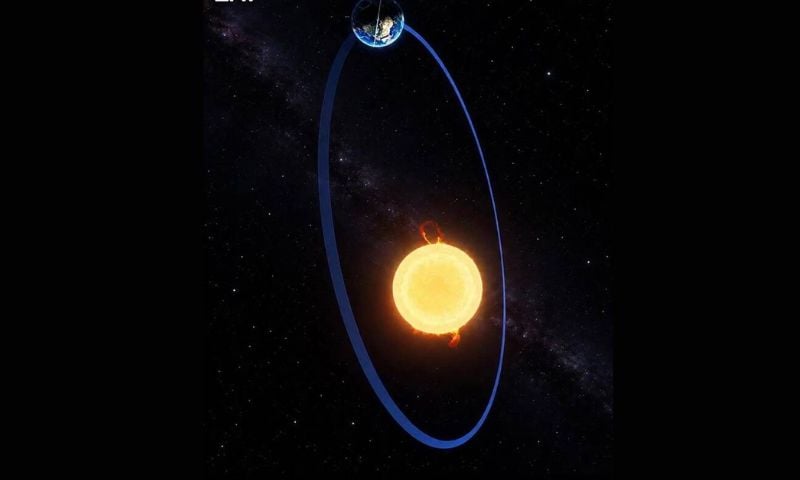
JEDDAH: Earth reached aphelion on Monday, the point in its annual orbit when it is at its greatest distance from the Sun, travelling about 152 million kilometres away from the star, according to astronomers.
The rare celestial milestone, which occurs every year as part of Earth’s regular orbital cycle, was observed at 8:30 p.m. Makkah time and highlighted by the Saudi Astronomy Society and the Noor Astronomy Society.
Astronomers said the event serves as a reminder that Earth’s seasons are not determined by its distance from the Sun, but by the planet’s 23.4-degree axial tilt.
During the Northern Hemisphere’s summer, this tilt causes sunlight to reach the region more directly, resulting in warmer temperatures despite Earth being farther from the Sun.
According to Arab News, Majed Abu Zahra, director of the Jeddah Astronomy Society, explained that Earth’s orbit is elliptical rather than perfectly circular, causing its distance from the Sun to change by nearly five million kilometres throughout the year.
He said that during aphelion, the Sun appears slightly smaller in the sky compared with when Earth reaches perihelion — its closest point to the Sun. However, the difference is too subtle to be noticed without specialised equipment.
Abu Zahra added that Earth also moves slightly slower in its orbit when it is farther from the Sun. This orbital variation contributes to the Northern Hemisphere experiencing a slightly longer summer compared with winter.
The Noor Astronomy Society described aphelion as a natural phenomenon caused by the elliptical shape of Earth’s path around the Sun. Its president, Issa Al-Ghafili, said the event has no direct impact on seasonal changes or the amount of solar radiation reaching Earth.
Al-Ghafili emphasised that the changing seasons are controlled by Earth’s axial tilt as the planet revolves around the Sun, rather than fluctuations in its distance from the star.
He noted that Earth reaches aphelion during the Northern Hemisphere’s summer, while perihelion occurs during the winter months.
Astronomy groups said such events provide valuable opportunities for the public to learn more about Earth’s movement, planetary science and the mechanisms that govern the solar system, while correcting common misunderstandings about the causes of seasonal changes.