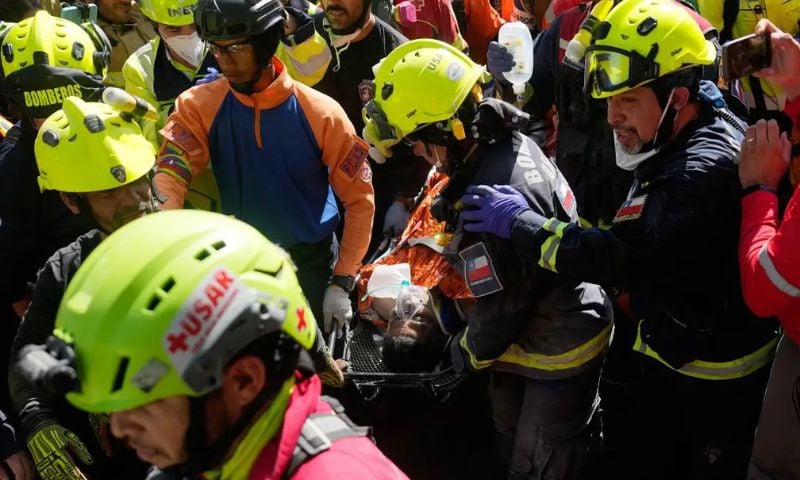
LA GUAIRA, Venezuela: Rescue teams pulled a man alive from the rubble of a collapsed building in Venezuela on Thursday, eight days after twin earthquakes devastated the country, in what emergency workers described as a “miraculous” rescue.
Hernán Alberto Gil Flores, a security guard in his 40s, was rescued after spending more than a week trapped beneath around 29 feet of concrete and debris following the collapse of the Galerías Playa Grande shopping centre in the coastal city of La Guaira.
The rescue, carried out by local and international teams, came as the death toll from the June 24 earthquakes approached 2,300 and hopes of finding more survivors continued to fade.
🇻🇪🙏🏻 A MIRACLE in Venezuela!!!
44-year-old security guard Hernán Gil Flores was rescued alive after 8 days buried under 29 feet of rubble from a collapsed mall in La Guaira.
Devastating earthquakes killed more than 2,300. International teams (Chile, Costa Rica & more) dug…
— Mario Nawfal (@MarioNawfal) July 2, 2026
According to Chile’s Fire Department, Gil was rescued after an operation lasting around 70 hours and was transferred to a medical facility in good condition.
“Fortunately, once we received Mr Hernán in the ambulance, he was stable,” Venezuelan Red Cross paramedic Luis Rodríguez, who assisted in the operation, told Reuters at the scene.
“During the whole ride he was conscious, focused and collaborating, and all of his vital signs were within normal,” he said.
The Associated Press reported that rescuers had worked for more than 100 hours after first detecting signs of life over the weekend, navigating an unstable structure, persistent aftershocks and heavy rain to reach the trapped survivor.
Gil, who worked the night shift as a security guard at the shopping complex, survived because his small security cabin remained largely intact, creating a pocket of air beneath the collapsed building, according to AP.
The operation involved specialist teams from Venezuela, Chile, Costa Rica, the United States, Portugal, Mexico and El Salvador.
Emergency crews maintained contact with Gil throughout the rescue by inserting a telescopic camera into the collapsed basement. They supplied him with water, liquid nutrients, oxygen and medication through a narrow hose while excavating a tunnel to reach him.
Video released by Chilean firefighters showed Gil waving his fingers through a narrow gap in the rubble after rescuers first established visual contact on Wednesday. Later footage showed him emerging from the debris wearing an oxygen mask and protective goggles.
Cristian Vera, who led the Chilean rescue team, told AFP that reaching the survivor had been extremely difficult.
“It wasn’t easy to reach the exact spot where the victim was located,” he said.
During the final stage of the operation, around 30 rescuers cleared debris while two specialists dug a three-metre tunnel to reach him, AFP reported.
Gil’s wife, Gusbimar González, described the rescue as extraordinary.
“This is truly a miracle,” she told AFP while rescue workers were still working to free her husband.
Speaking to CNN shortly before the successful rescue, she said she had endured “days of great sorrow” believing her husband had died.
“But once I found out that he was alive I saw a ray of sunshine,” she said. “He was holding up like a hero.”
She added that the couple’s two children were waiting for him at home.
Costa Rican Red Cross rescuer Minyar Collado told AP that Gil had initially asked rescuers not to tell his wife he was alive in case the operation failed.
“When we found him, he asked us not to tell his wife that he was alive, just in case he wouldn’t make it,” Collado said.
“But we were never going to leave him here.”
Sebastián Mocorquer of the United Nations Disaster Assessment and Coordination team told CNN that rescues so many days after an earthquake were exceptionally rare.
“Only miraculous rescues have been achieved” after seven days, he said, noting that the normal “golden window” for locating survivors is generally between 48 and 72 hours.
The rescue came as authorities reported a further rise in casualties from the twin earthquakes, which struck northern Venezuela on June 24 with magnitudes of 7.2 and 7.5.
National Assembly President Jorge Rodríguez said the death toll had risen to at least 2,295, while more than 11,200 people had been injured.
Rodríguez also said thousands remained missing and that many casualty figures were expected to increase as search operations continued.
According to NASA estimates, nearly 60,000 buildings were destroyed or damaged by the earthquakes.
Authorities said more than 15,000 people had been left homeless, while an unofficial grassroots platform estimated that over 43,000 people remained unaccounted for.
The United Nations Resident Coordinator in Venezuela, Gianluca Rampolla del Tindaro, said the organisation had procured 10,000 body bags amid expectations that more victims would be recovered.
The World Food Programme has appealed for $50 million to provide emergency food assistance to around 500,000 people over the next three months as shortages of food and clean water worsen.
In the hardest-hit city of La Guaira, many collapsed buildings have been marked after searches found no further signs of life, with rescue operations increasingly shifting from searching for survivors to recovering bodies.
Mexican firefighter César González, who was working with search-and-rescue dogs, said hopes of finding additional survivors had diminished significantly.
“One is for detecting the living, the other for cadavers,” he said of his dogs.
“Just two days ago, there was much more hope. Now, it would take a miracle.”