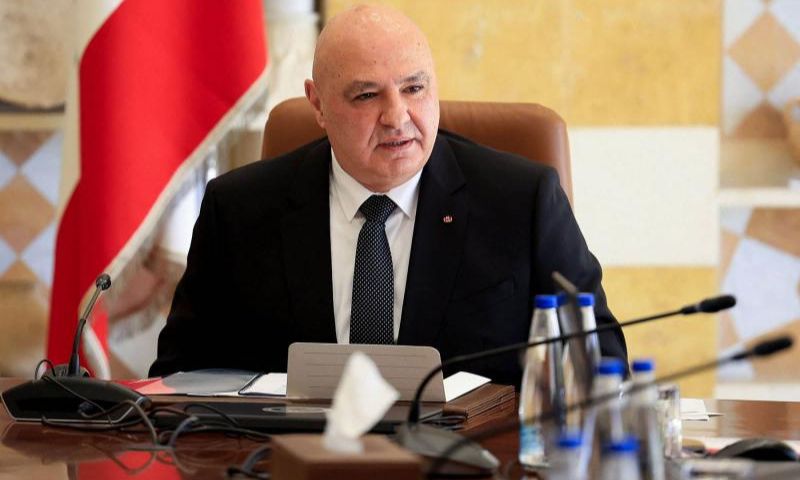
BEIRUT, Lebanon: Lebanese President Joseph Aoun on Thursday defended his government’s decision to negotiate with Israel, saying the talks were a diplomatic effort to ensure Israel’s withdrawal from Lebanese territory.
In a statement issued by the Lebanese presidency, Aoun said Lebanon would not cede “a single inch” of its territory under the US-backed framework agreement signed with Israel last week.
“Negotiations are not treason but a diplomatic war without unnecessary bloodshed,” Aoun said.
He added that Beirut had chosen to engage in talks “to guarantee Israel’s withdrawal from its territory”.
“We will not yield a single inch of Lebanese territory,” he said.
Aoun’s remarks came amid domestic criticism of the framework agreement, particularly from Hezbollah, which has opposed negotiations with Israel.
According to the presidency, Aoun said the framework did not undermine Lebanon’s rights or national principles but instead sought to safeguard them.
“The concept of sovereignty includes the state’s sovereignty in its decision-making,” he said, adding that respecting sovereignty also meant respecting the state’s decision to pursue negotiations aimed at reclaiming Lebanon’s rights.
“We will not relinquish a single inch of Lebanese land, and let judgment be passed on us through implementation, for the goals we have set before our eyes do not differ from the goals of all Lebanese without exception,” the presidency quoted him as saying.
President Aoun’s comments followed a statement by Israeli Defence Minister Israel Katz on Wednesday that Israeli forces would remain “until further notice” in “security zones” in Lebanon, Syria and the Gaza Strip.
Israeli Prime Minister Benjamin Netanyahu also reaffirmed the policy during a visit to the security zone in southern Lebanon on Tuesday, saying Israeli troops would remain there as long as Hezbollah continued to pose a threat.
The framework agreement envisages the gradual deployment of the Lebanese army across southern Lebanon as Hezbollah disarms and Israeli forces withdraw.
The latest conflict began on March 2 after Hezbollah launched missiles into Israel.
Israel responded with extensive air strikes and a ground offensive.
Lebanese authorities say the conflict has killed more than 4,200 people in Lebanon.
Lebanon-Syria agreement
Meanwhile on Thursday, Lebanon and Syria signed an agreement committing both countries to mutual respect and non-interference in each other’s internal affairs, Lebanon’s National News Agency reported.
The agreement was signed in Beirut during talks between Lebanese Prime Minister Nawaf Salam and Syrian Foreign Minister Asaad al-Shaibani, attended by delegations from both countries.
According to the agency, the agreement affirms respect for the sovereignty, independence, unity and territorial integrity of both states, as well as equality between the two sides and non-interference in domestic affairs.
During his visit to Beirut, Syrian Foreign Minister Asaad al-Shaibani met President Aoun, Prime Minister Salam and Parliament Speaker Nabih Berri, Lebanon’s National News Agency reported.
Al-Shaibani said Damascus was prepared to meet representatives of Hezbollah “if interests require it”, according to the agency.
Such a meeting would mark the first direct contact between Syria’s new leadership and Hezbollah after years of conflict.
The Syrian foreign minister also said Damascus had no intention of intervening militarily in Lebanon despite pressure from the United States.
Prime Minister Nawaf Salam also defended the US-backed framework agreement, saying it was intended to guide negotiations rather than serve as a final peace treaty.
“The phrase ‘framework agreement’ causes confusion,” local media quoted Salam as saying in an interview with Lebanon’s private broadcaster LBCI.
“We are talking about a guiding framework for negotiations to define their path with the aim of reaching an agreement, not an agreement or treaty,” he said.
Salam said Lebanon had entered negotiations after enduring two wars that had inflicted heavy human and economic losses.
“We are not enthusiasts for negotiations with Israel, but we reached this stage after two wars that left thousands of victims,” he said.
He added that the first Israeli offensive caused direct damage exceeding $7 billion, excluding wider economic losses estimated at around $13 billion.