CARACAS, Venezuela: The death toll from Venezuela’s devastating twin earthquakes has risen to 2,295, the country’s National Assembly President Jorge Rodriguez said on Wednesday, a week after the disaster struck.
Speaking to reporters, Rodriguez said more than 11,000 people had been injured and nearly 13,000 left homeless by the twin earthquakes, which measured 7.2 and 7.5 in magnitude and struck less than a minute apart last week.
The United Nations has warned that the death toll could eventually rise to 10,000. UN estimates also indicate that around 50,000 people remain missing.
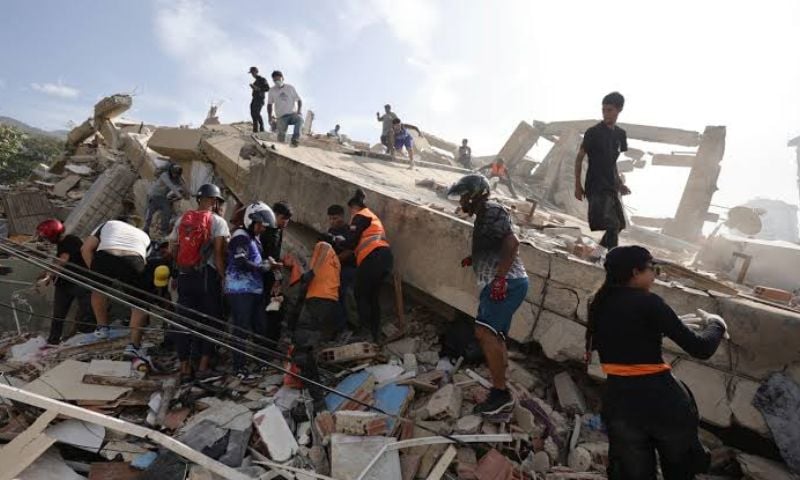
Hope of finding additional survivors has faded as rescue teams continue searching collapsed buildings across the worst-hit areas.
“There is no expectation of recovering people alive” from sites already thoroughly searched, Javier Rodes, coordinator of a Spanish rescue team, said after his team’s search dog failed to detect signs of life beneath the rubble.
Experts say victims trapped beneath collapsed buildings are unlikely to survive beyond 72 hours after a major earthquake.
Rescue and humanitarian operations
More than 3,600 rescue and relief workers, supported by 118 search-and-rescue dogs from several countries, are continuing operations using specialised equipment.
Authorities have marked many collapsed buildings in the hardest-hit city of La Guaira with the letter “D” to indicate they have been searched and that no signs of life were found.
There have, however, been isolated rescues. A three-year-old boy was pulled alive from the rubble on Tuesday, six days after the earthquakes.
According to government figures, list of missing persons now stands at 40,567.
A United Nations envoy said this week that the organisation was procuring 10,000 body bags for Venezuela.
Residents in several affected areas have criticised authorities for a slow and inadequate emergency response.
The International Rescue Committee said on Tuesday that “the scale of the response does not meet the scale of humanitarian need.”
Interim President Delcy Rodriguez acknowledged public frustration in a post on X, saying authorities were continuing relief operations and supervising recovery efforts.
“I know that many Venezuelans feel pain and frustration. I deeply share those feelings,” she wrote.
Rodriguez has also declared seven days of national mourning following the disaster.
Health system under pressure
The World Health Organization (WHO) said Venezuela’s healthcare system was under significant strain following the earthquakes.
According to the UN agency, 21 healthcare facilities are located in the worst-affected areas. At least three have suffered critical damage, while six others have sustained structural damage or are only partially operational.
WHO spokesman Christian Lindmeier warned that health services were under “extreme pressure” and said there was an increased risk of outbreaks of vaccine-preventable diseases, including measles and diphtheria, because of low vaccination coverage before the disaster.
The agency has also warned of increased risks of dengue fever and yellow fever among displaced communities.
Eduardo Rivas, a physician at the La Florida Clinical Institute in Caracas and a lecturer at Vargas Hospital, said medical teams were treating patients with fractures, severe trauma and psychological distress.
Food shortages
As emergency operations continue, humanitarian agencies have warned of worsening shortages of food and clean water.
The World Food Programme has appealed for US$50 million to provide food assistance to around 500,000 people over the next three months.
Many survivors are relying on volunteer groups and charitable donations.
Authorities also reported widespread looting in some disaster-hit areas. The justice ministry said four police officers had been arrested after residents allegedly caught them stealing valuables from collapsed buildings.
The United States has committed US$300 million to emergency relief operations, with President Donald Trump saying Washington “will be there for our new and great friends.”
The European Union has pledged €5 million in assistance and is dispatching around 50 tonnes of shelter materials, water and sanitation equipment and education supplies from Copenhagen.
The UN refugee agency has appealed for US$14.9 million to expand temporary shelter and humanitarian assistance for 30,000 people over the next six months.
NASA’s preliminary satellite assessment estimates that nearly 58,870 buildings were damaged or destroyed by the earthquakes.