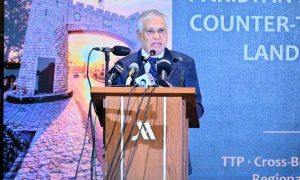

ISLAMABAD: Pakistan’s political leadership, legal experts, water officials and international speakers have warned that India’s attempt to place the Indus Waters Treaty in abeyance has no legal standing and poses a grave threat to regional peace, food security and international law.
Addressing an international seminar on the Indus Waters Treaty in Islamabad, speakers said the World Bank-brokered agreement, signed in 1960, remained one of the world’s most durable transboundary water-sharing arrangements and could not be amended, suspended or revoked unilaterally by India.
Deputy Prime Minister and Foreign Minister Senator Mohammad Ishaq Dar warned that India must not jeopardise peace and security in South Asia through violations of the treaty. Former foreign minister Hina Rabbani Khar also described India as a violator of international law and a threat to international peace and security over its unilateral water-related actions.
Ambassador Jauhar Saleem said preserving the Indus Waters Treaty was Pakistan’s existential national interest, while Pakistan People’s Party Chairman Bilawal Bhutto Zardari said depriving Pakistan of water posed a strategic threat to the country.
Pakistan’s lifeline
Information Minister Attaullah Tarar said Pakistan would protect the sanctity of the treaty by all available means, describing the Indus River System as the lifeline of 240 million Pakistanis.
“The country’s food security, agriculture and economic well-being are intrinsically linked to the uninterrupted flow of its waters,” he said, adding that the treaty could not be amended, revoked, suspended or held in abeyance by one party alone.
Federal Minister for Climate Change Dr Musadik Masood Malik said India’s actions posed a grave threat to the lives and livelihoods of the Pakistani nation.
“Hundred per cent food security depends on this water,” Dr Malik said, adding that nearly 120 million people were directly connected to the river system through farming, food production, employment and daily life.
“This is a crisis of justice,” he said. “Pakistan will not compromise on its rightful share of water.”
Chenab concerns
Pakistan’s Commissioner for Indus Waters said India had no legal basis to hold the treaty in abeyance and warned that repeated fluctuations in Chenab River flows had created operational uncertainty for downstream water management.
He said Pakistan had formally sought explanations from India, but the absence of a response had deepened concerns. He also raised alarm over Indian infrastructure plans, including the Chenab-Beas link, which Pakistan believes could divert water outside the treaty domain.
Data shared during the seminar showed that Indian hydropower projects were concentrated on the Chenab River. Four existing projects have a combined storage capacity of 0.376 million acre-feet, while five projects under construction are expected to be completed by 2029, adding 1.1017 million acre-feet of storage capacity.
The Chenab-Beas Link Tunnel alone could divert one million acre-feet of water to the River Beas, while India has also planned 13 additional projects on the Chenab, some with larger storage capacity than run-of-river projects.
Legal and global warning
International law expert Ahmer Bilal Soofi said any Indian violation of the treaty could become a threat to international peace and security. He said Article 12(4) of the treaty clearly provides that it can only be modified by mutual consent.
He said water resources were a “global commons” and any unilateral suspension of treaty obligations would amount to a breach of international treaty law.
Russian strategic affairs expert Dr Roxolana Zigón said India was weaponising water and warned that the issue was not limited to Pakistan and India.
“This is not just about Pakistan and India, it has to do with every state,” she said, adding that the world was witnessing a “serious deterioration of the international legal system.”
She accused the Modi government of using water as a tool of pressure. “Modi is causing water terrorism,” she said. “The Indian government is actively working to ensure not a single drop of water goes to Pakistan.”
Dr Zigón said more than 90 per cent of Pakistan’s agriculture depended on the Indus river system, making any interference a direct threat to Pakistan’s food security, agriculture and economy.
Existential national interest
Speakers said the treaty had survived wars and decades of hostility between two nuclear-armed neighbours because it was built on legal obligation, mutual consent and dispute-resolution mechanisms.
They urged India to restore routine engagement between Indus Commissioners, resume data-sharing and resolve all disputes through the treaty’s legal framework instead of coercive unilateralism.
Chinese scholar says Indus Waters Treaty disruption amount to war crimes
Dr Victor Gao, Vice President of the Center for China and Globalization (CCG), warned that Indian threats to cut water supplies to downstream populations could amount to crimes against humanity and war crimes, urging New Delhi to respect international agreements governing shared rivers and pursue cooperative water management.
Speaking at the international seminar in Islamabad, Dr Victor Gao urged strict adherence to the Indus Waters Treaty and rejected unilateral disruption of river flows. He said unilateral attempts to disrupt transboundary river flows would undermine regional stability and violate established international norms.
Dr Gao argued that India was not the only upstream actor and called for a broader regional framing of shared river systems. He proposed a China–India–Pakistan trilateral mechanism to manage transboundary water flows cooperatively.
The Chinese scholar noted that around 18 countries depend on rivers originating from the Qinghai–Tibet Plateau. He called for a global code of conduct for transboundary water governance under the guidance of the United Nations, saying common international principles were needed to address disputes over shared rivers.
Dr Gao stressed peaceful resolution of shared water resources through international law, diplomacy, and multilateral cooperation instead of escalation. He said threatening to cut water to downstream populations could constitute crimes against humanity or war crimes because of the humanitarian consequences such actions could have for millions of people dependent on shared river systems.
He argued stability in the Indus basin had implications beyond South Asia, linking water security to wider regional and global peace and stability.
Dr Gao reaffirmed China’s support for Pakistan’s position on sovereignty and the protection of its water rights while expressing hope that continued diplomatic engagement and mediation efforts would lead to a peaceful settlement of disputes.
He stressed that dialogue and international cooperation remained the most effective means of addressing disagreements over shared water resources.
The seminar was attended by Pakistan’s political leaders, legal experts, water officials and international speakers to discuss the future of the Indus Waters Treaty, which has come under renewed focus following India’s move to unilaterally place the agreement in abeyance, according to Pakistani officials.
The treaty, brokered by the World Bank and signed in 1960, is regarded as one of the world’s longest-standing transboundary water-sharing agreements. Speakers at the seminar said the treaty could not be amended, suspended or revoked unilaterally.