BEIRUT, Lebanon: An Israeli drone strike hit southern Lebanon on Saturday, Lebanese state media and the Israeli military said, a day after Israel and Lebanon signed a United States-brokered security framework to lay the groundwork for a future peace deal between the two regional rivals.
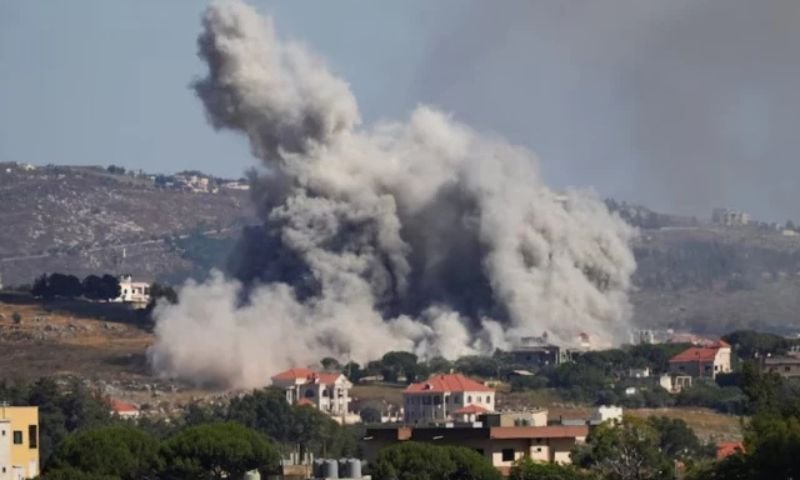
Lebanon’s National News Agency (NNA) said the drone struck the Farah amusement park intersection in Nabatieh al-Fawqa, in the Nabatieh district of southern Lebanon. The area lies outside a security zone shown on a map published by Israel marking an expanded area under its military control.
The Israeli military confirmed the strike, saying it had targeted an individual who posed a threat to Israeli forces.
The Israeli military said a drone was used because no Israeli troops were operating in the immediate area. The military did not provide further details or evidence regarding the target.
The attack came less than 24 hours after Israel and Lebanon signed a trilateral framework agreement with the United States in Washington aimed at reducing tensions after months of cross-border fighting between Israel and Hezbollah.
The agreement was signed on Friday at the US State Department by Lebanese Ambassador Nada Moawad and Israeli Ambassador Yechiel Leiter in the presence of US Secretary of State Marco Rubio.
SECRETARY RUBIO: "We're happy to announce a framework agreement between the sovereign government of Lebanon and the government of Israel, with the mediation and support of the United States of America." pic.twitter.com/0Zbd9HRKmh
— Department of State (@StateDept) June 26, 2026
“Today we’ve taken the first step in what will be a difficult journey, without a doubt, but an important and an essential and a necessary one,” Rubio said before the agreement was signed.
The text of the framework agreement has not been made public, and officials did not explain how it differs from the ceasefire agreement reached on April 16, which was followed by several rounds of US-mediated negotiations.
According to Reuters, discussions in Washington included proposals for Israeli forces to withdraw from parts of the territory they occupy in southern Lebanon. A US State Department official had earlier said Israel agreed to pull back from some areas.
A senior Lebanese official, speaking anonymously to Anadolu, said the framework includes a gradual withdrawal of Israeli forces from southern Lebanon. The official said negotiations had made progress on the remaining issues.
Leaders welcome agreement
Speaking after the signing ceremony, Lebanese Ambassador Moawad described the framework as “a first step” towards restoring Lebanon’s sovereignty and territorial integrity, achieving a permanent cessation of hostilities and enabling displaced residents to return home.
Israeli Ambassador Leiter praised Moawad for negotiating like a “lioness” and said: “In this performance-based trilateral framework agreement, Iran is out, Hezbollah is out, and the road to peace between Israel and Lebanon is in.”
Separately, Lebanese President Joseph Aoun discussed the agreement by telephone with United Arab Emirates President Sheikh Mohammed bin Zayed Al Nahyan, according to the Lebanese presidency.
The presidency said Sheikh Mohammed reaffirmed the UAE’s support for Lebanon and expressed readiness to assist the country politically, economically and socially. Aoun thanked the UAE for its continued support.
Ceasefire remains fragile
The latest strike underscored the fragility of the ceasefire despite renewed diplomatic efforts.
Before negotiations resumed this week, Israel and Hezbollah had agreed to halt fire, although Israeli troops remained deployed in what Israel describes as a security buffer zone inside southern Lebanon.
Violence has continued since the ceasefire. Israel said on Friday that its forces killed seven Hezbollah members operating near territory under Israeli control.
Israeli Prime Minister Benjamin Netanyahu said Israel would maintain its military presence in southern Lebanon until Hezbollah is disarmed.
“The most important thing is, first of all, that Israel remains in the security zone in southern Lebanon. This is a major achievement, and we will maintain it as long as Hezbollah has not disarmed,” Netanyahu said in a recorded video released to Israeli media.
He added that the Israeli military would permit the Lebanese army to assume control of two pilot areas, one south of the Litani River and another north of it.
Earlier on Friday, Israeli forces also dropped evacuation leaflets over a town in southern Lebanon, according to Lebanese state media.
Hezbollah leader Naim Qassem said Israel had “no option” but to withdraw completely from all Lebanese territory it occupies. “Israel must leave unconditionally,” he said.
International response
The current fighting began after Hezbollah launched attacks on Israel on March 2. Israel responded with extensive air strikes and a ground offensive in Lebanon.
Lebanese authorities say Israeli attacks have killed more than 4,000 people and displaced more than one million.
Israel says at least 32 soldiers and four civilians have been killed during the fighting. Hezbollah has not released figures for its losses.
Italian Foreign Minister Antonio Tajani welcomed the framework agreement, describing it as “certainly a step forward”.
Speaking in Croatia, he said Italy was ready to provide diplomatic support and could contribute to a future international mission following the mandate of the UN peacekeeping force, if agreed multilaterally.
He said Italy, together with France, could play an important role in rebuilding Lebanon and strengthening its state institutions.