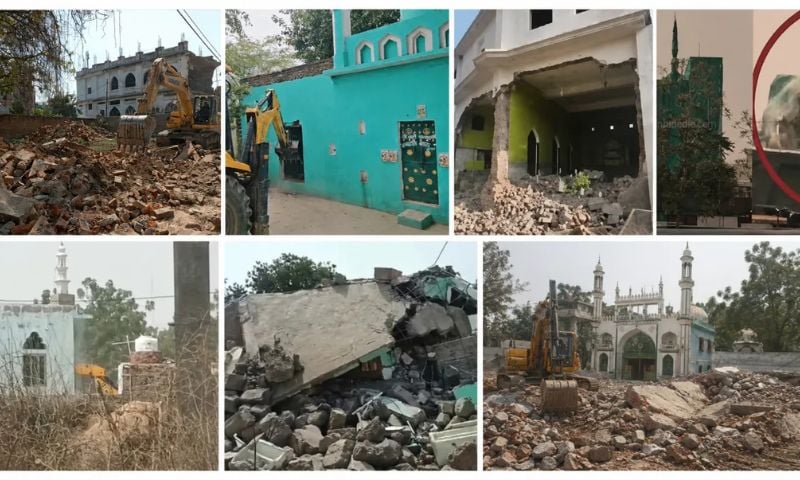
NEW DELHI, India: The demolition of over 23 Muslim religious structures, including mosques, dargahs, Eidgahs, and madrasas across six BJP-ruled states in just 45 days has drawn sharp international condemnation, with critics characterising the actions as a deliberate assault on India’s secular fabric and interfaith harmony.
From a 1,000-year-old mosque in Varanasi to a 200-year-old Dargah in Delhi, the wave of demolitions has prompted global human rights organizations, foreign governments, and interfaith groups to question whether India’s constitutional guarantee of religious freedom is being systematically undermined.
Modi is demolishing this 1000 year old mosque in Varanasi India! The world was in uproar when Taliban had destroyed a Buddha statue, the same world doesn’t notice while Modi is destroying one historical monument after another for the last 12 years. pic.twitter.com/pIexIxP7qu
— Ashok Swain (@ashoswai) June 20, 2026
The incidents, reported from Uttar Pradesh, Rajasthan, Maharashtra, Gujarat, Haryana, and Delhi, have been described by international observers as part of a troubling pattern rather than isolated administrative actions.
The U.S.-based advocacy group Justice For All expressed alarm on June 17 over what it termed an “acceleration” in mosque demolitions, citing recent actions in Sambhal, Varanasi, and Jaipur where three mosques were razed within five days. The organisation alleged that authorities are applying different standards when dealing with religious structures, with Hindu temples on public land often left untouched while Muslim sites face immediate demolition.
‘Hate politics’ and double standards: International criticism intensifies
‘Justice For All’ urged India’s intellectuals and civil society to collectively oppose what it called “hate politics,” warning that the growing number of demolitions could deepen insecurity among minority communities and irreparably damage communal coexistence.
The group argued that India’s constitutional guarantee of freedom of religion must be upheld and that the selective application of encroachment laws represents a dangerous erosion of equal treatment under the law.
International human rights watchdogs have echoed these concerns, pointing to the lack of due process in many cases. In several instances, no prior notice was served before demolition drives were carried out, and legal objections filed by caretakers were allegedly ignored.
The demolition of the Ajgaib Shaheed Mosque in Varanasi, carried out overnight on June 2 under heavy police deployment, was described by global observers as a violation of the rights of religious minorities to practice their faith without fear of state-sanctioned destruction.
The destruction of a 200-year-old Dargah in Pune on June 3–4, which local leaders had long described as a symbol of Hindu-Muslim harmony and communal coexistence, has become a flashpoint in the global debate. International commentators noted that the shrine had served for generations as a testament to India’s syncretic traditions, and its demolition sent a chilling message about the future of interfaith relationships in the country.
BJP ruled states face serious criticism after reports that 23 Muslim religious sites were demolished across India within 44 days. Mosques, madrasas, eidgahs and dargahs in Delhi, Maharashtra, Uttar Pradesh, Gujarat, Rajasthan and Haryana were targeted, raising alarm over pic.twitter.com/pc3rbbOVbD
— ABDUL KADER SHAIKH (@akhs66) June 21, 2026
Waqf Board violations and heritage erasure
The demolition of registered Waqf properties has further inflamed international criticism. In Jaipur, the Noorani Mosque, built in 1981 through donations from local residents and registered as a Waqf property, was demolished on June 8 despite allegedly pending legal proceedings. The Rajasthan Waqf Board and community leaders argued that the demolition was carried out in violation of legal protections afforded to Waqf properties, raising questions about the sanctity of religious endowments in India.
Global heritage organisations have also expressed alarm over the destruction of centuries-old structures. The Masjid Ganj Shaheeda in Varanasi, claimed by the mosque committee to be nearly 1,000 years old and mentioned in settlement maps from 1883–84, now faces imminent demolition after railway authorities posted a notice to vacate the premises.
Scholars and historians have warned that the erasure of such historic sites represents not only a religious affront but also a cultural loss that diminishes India’s pluralistic heritage.
In Sambhal, the demolition of Masjid Mustafa Qadri on June 6 became even more controversial after police registered a case against eight individuals, including the mosque’s caretaker, over the alleged recovery of posters bearing the slogan “I Love Muhammad” from inside the mosque premises.
International civil liberties groups condemned the action, arguing that criminalising expressions of religious devotion inside a place of worship sets a dangerous precedent and raises serious concerns about freedom of religion and expression in India.
Over 23 Mosques, Madrasas, Eidgahs and Dargahs Demolished in 45 Days — All in BJP-Ruled States
Wave of Mosque , Eidgaah, Mazar demolitions under BJP government in India. Where India is drifting to….?https://t.co/uUlvY41H4Z— Zafarul-Islam Khan (@khan_zafarul) June 20, 2026
‘A threat to India’s secular fabric’: Opposition and global voices unite
The demolition drive has also sparked fierce political backlash within India, with opposition leaders accusing the Modi government of using the issue for electoral polarisation and undermining the country’s secular foundations.
Former Rajasthan Chief Minister Ashok Gehlot questioned the timing and intent behind the demolitions, particularly in border areas near Pakistan, alleging that the actions were motivated by a desire to create “political polarisation and disrupt the social fabric.”
Authorities demolish 50-year-old shrine and adjoining graves in Uttar Pradesh’s Sambhal district.
Authorities in Ikona village of Sambhal district, Uttar Pradesh, demolished the 50-year-old mausoleum of Baba Salahuddin Dhaka Wale Pir Baba and six nearby graves. Officials said… pic.twitter.com/IRn9ADNkCA
— TAM (@Awakeningmedia1) June 22, 2026
International diplomatic sources have reportedly expressed concern over the developments, with some foreign governments quietly urging New Delhi to ensure that anti-encroachment drives are conducted transparently and without discrimination. The United Nations human rights mechanisms have been urged by advocacy groups to take note of the pattern of demolitions and to call for safeguards to protect minority religious sites.
Nearly 1000-Year-Old Varanasi Mosque Served with Demolition Notice, Asked to Vacate by 20 June
Yes they are doing exactly what they came for, targeting Muslims and Masjids.
Sad that those who support them that this is not governance and without governance your life is going to… pic.twitter.com/kdd7G3wmP7— Pragnya Gupta (@GuptaPragnya) June 18, 2026
Justice For All’s statement specifically referenced the demolition of Masjid Mustafa Qadri in Sambhal, the Shaheed Azgaib Mosque in Varanasi, and the Noorani Mosque in Jaipur as evidence of a coordinated campaign. The organisation argued that the country’s constitutional guarantee of freedom of religion must be upheld and warned that the growing number of demolitions could deepen insecurity among minority communities.
The future of interfaith coexistence in question
As bulldozers continue to reshape religious landscapes across India, the debate has grown beyond questions of encroachment. It now touches on the preservation of centuries-old heritage, constitutional guarantees of religious freedom, and the future of communal coexistence in the country.
Global observers have noted that while authorities maintain that the demolitions are conducted strictly according to legal and administrative requirements, the lack of transparency, the absence of prior notice in many cases, and the selective targeting of Muslim sites have eroded public confidence in the fairness of the process. The destruction of graveyards in Gujarat and the demolition of madrasas in Delhi have further intensified concerns that religious minorities are being systematically marginalised.
BJP ruled states face serious criticism after reports that 23 Muslim religious sites were demolished across India within 44 days. Mosques, madrasas, eidgahs and dargahs in Delhi, Maharashtra, Uttar Pradesh,
.
.
.#BTS_WORLDTOUR_BANGKOK #SAMURAIBLUE📷— MISHAL KHAN (@MishalKhanNDU12) June 21, 2026
Rights advocates argue that ensuring transparency, due process, and equal application of the law is essential for maintaining public confidence and protecting the constitutional rights of all communities.
President Asif Ali Zardari expressed deep concern over the demolitions and threats to historic Muslim religious sites in India, including the 1,000-year-old Masjid Ganj Shaheeda in Varanasi. He asked India to immediately stop such actions, warning that they risk leading to the…
— The President of Pakistan (@PresOfPakistan) June 20, 2026
The international community continues to watch closely, with many hoping that India’s democratic institutions and civil society will uphold the country’s long-standing traditions of religious pluralism and interfaith harmony.
The growing chorus of global criticism serves as a stark reminder that actions taken against religious minorities in India are being scrutinised on the world stage, and that the Modi government’s handling of these demolitions could have lasting implications for India’s reputation as a secular, pluralistic democracy.