PESHAWAR, Pakistan: Recalling the pre-dawn assault, Ahmed Hussain remembers a battlefield where the state forces were starkly outmatched.
“We could hardly see the attackers, but they could clearly see us,” he says.
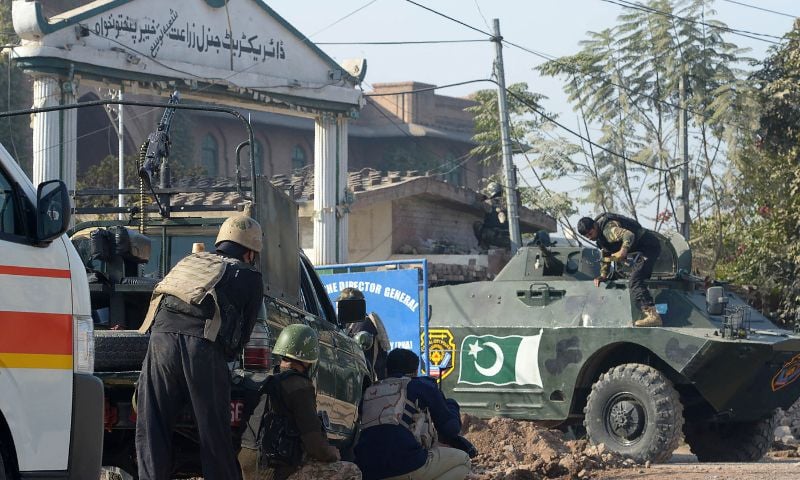
Hussain, a 35-year-old Elite Force commando from Swabi — approximately 90 kilometres northeast of Peshawar — is still recovering from severe injuries sustained during that deadly terrorist assault on the Chodwan Police Station in the Draban area of Dera Ismail Khan — some 350 kilometres to the south of Peshawar.
On the night of February 4, 2024, nearly 30 heavily armed terrorists launched a coordinated assault, attacking the station from multiple directions with grenades and automatic weapons. Elite Force personnel had been deployed to the area specifically to support local police ahead of the general elections amid growing terrorist threats. During the brutal two-hour gun battle, some attackers positioned themselves atop a water tank, raining down fire with advanced M-4 and M-16 rifles.
Hussain’s account underscores a chilling reality: the terrorists were equipped with advanced night-vision and thermal imaging devices, giving them a devastating tactical advantage.
A deafening wake-up call
The terrifying asymmetry experienced by frontline officers like Ahmed Hussain is no longer confined to isolated outposts — it is actively fracturing civilian spaces across Khyber Pakhtunkhwa (KP).
When 34-year-old Furqan Sajid returned to Pakistan on May 7, 2026 after nearly 28 months of working as a labourer in Dubai, he hoped to spend peaceful days with his family in Fateh Khel — a suburban village on the outskirts of Bannu.
“The sound was deafening. For a few moments, my ears completely stopped working.” – Furqan Sajid, resident of Fateh Khel, Bannu
Two days later, sitting with his mother after dinner, Sajid was discussing life and conditions in Dubai when a massive blast struck the area. The blast was so powerful that he was thrown off the bed while a pedestal fan placed nearby crashed violently onto the floor.
“The sound was deafening. For a few moments, my ears completely stopped working,” he recalls.
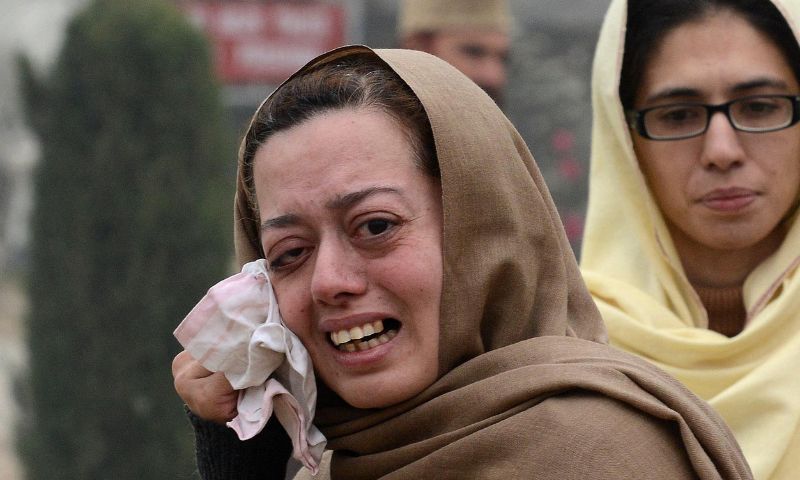
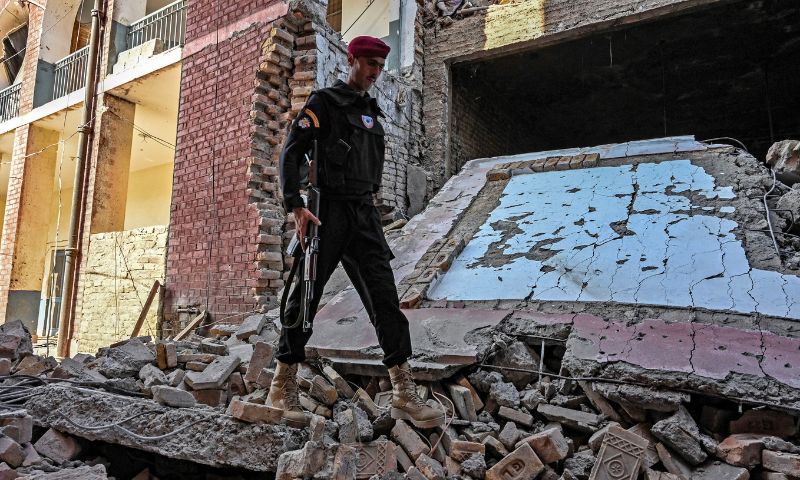
By dawn, the Fateh Khel police post, located roughly 150 metres from his house, had been reduced to rubble. Rescue operations were already underway, and by around 10 am, bodies of police personnel were being pulled from the debris. Police later confirmed that it was a suicide attack in which 15 police officers were killed.
The resurgence of violence
The experiences of Ahmed Hussain and Furqan Sajid highlight a rapidly deteriorating security situation across the province, particularly in southern and merged tribal districts, where terrorist violence has resurged at an alarming scale.
Data from the Centre for Research and Security Studies (CRSS) — an Islamabad-based independent non-profit think tank — reveals the stark mathematical trajectory of this escalation, proving that these individual tragedies are part of a massive regional surge:
2022: Pakistan saw 512 total attacks leading to 980 fatalities and 750 injuries. In Khyber Pakhtunkhwa alone, there were 313 attacks, resulting in 633 fatalities and 420 injuries.
2023: Violence escalated further to 789 national incidents, causing 1,533 fatalities and 1,462 injuries. Khyber Pakhtunkhwa accounted for 458 of these attacks.
2024: The security situation worsened significantly, making it one of the most violent years on record with 1,166 national incidents (2,546 fatalities; 2,267 injuries). In Khyber Pakhtunkhwa, attacks surged to 693, claiming 1,616 lives and injuring 1,037 people.
2025: The upward trend continued with 1,272 national incidents leading to 3,417 fatalities and 2,134 injuries. Khyber Pakhtunkhwa witnessed 795 attacks, leaving 2,331 dead and 1,206 injured.
Compounding this timeline, specialised data from the Khyber Pakhtunkhwa Counter-Terrorism Department (CTD) underscores the changing, high-tech tactics of modern militancy that Hussain witnessed firsthand.
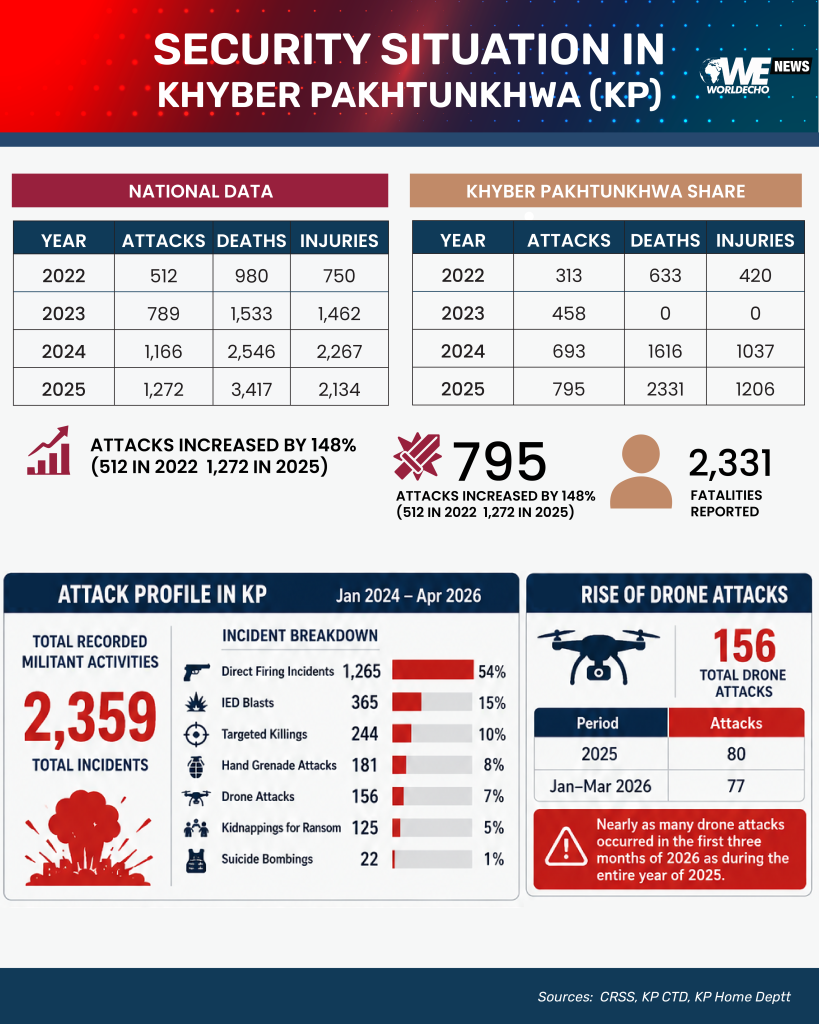
From January 2024 to April 6, 2026, the province recorded a staggering grand total of 2,359 terrorist activities. This includes 1,265 instances of direct firing, 365 Improvised Explosive Device (IED) blasts, 244 targeted killings, 181 hand grenade attacks, 125 kidnappings for ransom, and 22 suicide bombings. Most notably, terrorists have increasingly turned to technology, launching 156 drone attacks — 80 in 2025 and 77 in the first three months of 2026 alone.
Inside the Provincial Action Plan
Against this backdrop, the Khyber Pakhtunkhwa government has finalised a comprehensive Provincial Action Plan (PAP), describing it as a multi-agency strategy aimed at countering militancy through coordinated institutional action. The plan covers five major areas: counter-terrorism operations, governance reforms, legal restructuring, information management, and socio-economic interventions.
“I treated him like a son rather than a younger brother. We were always together, and his loss has left a void that can never be filled.” – Kashif Khan, brother of a slain policeman
Officials say the plan will soon be presented before the provincial cabinet before being shared with members of the Khyber Pakhtunkhwa Assembly — the provincial legislature — through in-camera briefings in an effort to ensure political ownership and institutional coordination.
Profiling the militant networks
At the centre of the implementation framework is the Home and Tribal Affairs Department, which will supervise coordination among departments and security institutions.
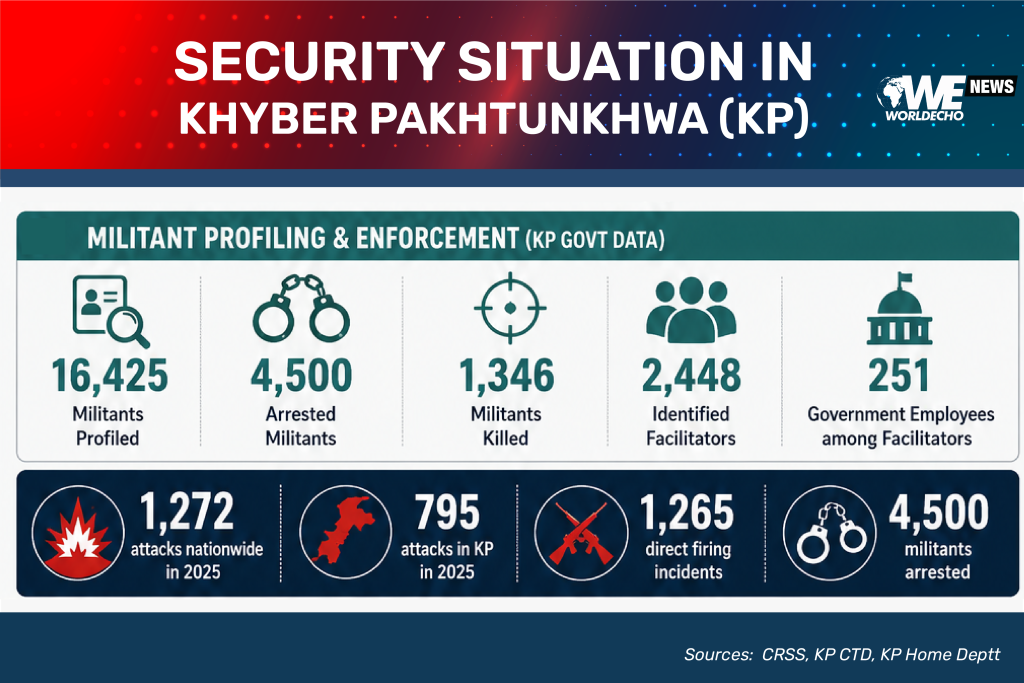
The official documents seen by this scribe reveal that authorities have already profiled 16,425 militants across the province, with detailed records including identity documents and family data available with the government.
The data shows that 4,500 militants have been arrested so far, while 1,346 have been killed in different security operations up to May 2026. The government has also identified 2,448 facilitators allegedly linked to militant networks, including 251 government employees.
Intelligence sources reveal that a significant hurdle to immediate arrest is that many of these facilitators are relatives of the militants, maintaining indirect local or personal links.
Among them, the highest number belongs to the Elementary and Secondary Education Department, with 92 employees under scrutiny, followed by 12 employees from the Health Department. So far, proceedings have reportedly been initiated against 158 government servants, while separate security operations have netted 95 civilian facilitators.
Strangely enough, rather than facing a harsh crackdown, these ‘facilitators’ are merely being required to fill out a special proforma and submit a binding affidavit pledging they will not provide any support to banned outfits.
Legal and financial cords
Authorities have additionally placed 337 individuals on the Fourth Schedule, including 233 militants and 104 facilitators.
For everyday citizens, placement on the Fourth Schedule means their liberties are severely curtailed under the Anti-Terrorism Act. Recommendations originate from the District Intelligence Committee — headed by the Deputy Commissioner — and are approved by the Home Department if a person is a suspected member of a banned outfit. Once listed, the individual’s assets, communication, and movements are monitored closely for a minimum of three years.
The government has also intensified measures targeting militant financing and logistical networks.
According to official records, action has been initiated against the immovable properties of 255 militants, while properties belonging to nine facilitators have also been blocked or confiscated. In addition, 739 movable assets have been seized and arms licences of 528 militants have been cancelled or blocked.
A localised action plan
The Provincial Action Plan introduces a layered oversight mechanism intended to prevent bureaucratic delays and weak implementation — a criticism that has surrounded previous security frameworks.
Under the proposed structure, the Apex Committee, chaired by the Chief Minister and the Chief Secretary, will review progress every three months. The committee may also nominate senior officials, such as a special or additional secretary, to oversee the implementation.
The government has assigned clearly defined roles to key departments under a “whole-of-government approach,” ensuring coordination across governance, legal, security, and development sectors.
The Additional Chief Secretary (General) will be tasked with improving governance and ensuring service delivery at the local level, including reforms in Patwar offices, Deputy Commissioner offices, and other public-facing institutions.
“Because the CTD is a wing of the police department, it is standard practice for personnel to be assigned from the regular police force after completing specialised training.” – Muhammad Ali, CTD Spokesperson
Political engagement also forms part of the strategy. Officials say the provincial government intends to formally brief political leadership, including the Speaker of the Khyber Pakhtunkhwa Assembly and cabinet members, while lawmakers will receive in-camera security briefings.
The plan also includes visits to merged tribal districts and inspections of development projects in conflict-affected regions. Authorities believe governance gaps, delayed development, and weak state presence have contributed to insecurity in several districts.
Meanwhile, the Law Department will review legal loopholes that may allow militants to obtain relief through courts and recommend amendments where necessary. The Information Department will be responsible for strategic communication, including promoting awareness campaigns and highlighting sacrifices made by security forces.
Similarly, the Planning and Development Department will be tasked with identifying and monitoring projects aimed at improving socio-economic conditions in vulnerable areas.
According to sources, the Excise Department has also been empowered to cancel vehicle registrations linked to militants under existing laws.
National vs Provincial Action Plan
When questioned on why a provincial plan is necessary when a National Action Plan (NAP) already exists, provincial officials explain that the Provincial Action Plan is not a replacement, but a hyper-localised, detailed expansion of the NAP.
“It focuses heavily on five granular provincial pillars: counter-terrorism enforcement, socio-economic governance, political engagement, strategic information, and legal restructuring.”
However, sources close to the matter admit that in reality, the Provincial Action Plan does not possess independent constitutional powers to enforce its decisions. Instead, it is an administrative effort by the Khyber Pakhtunkhwa government to streamline its own departments.
An ill-equipped frontline
The skepticism of grieving families is vindicated by official documents detailing the severe operational limitations of the Counter-Terrorism Department (CTD) — the very agency tasked with executing this crackdown.
Despite an ambitious roadmap, the CTD faces crippling shortages in manpower, infrastructure, and modern technology. Although the department has a total strength of 3,844 personnel across the province, a mere 25 of them are permanent, dedicated CTD employees. The remaining staff are deputed from the regular police force.
Furthermore, the CTD does not possess its own permanent headquarters or district office buildings, forcing it to operate out of 21 makeshift district offices. For field operations across the entire province, the department has only 17 double-cabin bulletproof vehicles.
Crucially, the CTD completely lacks a modern forensic laboratory, cell locators, signal jammers, and heavy armoured vehicles, severely undercutting its capacity to preempt or investigate high-tech militant operations.
However, CTD Spokesperson Muhammad Ali minimises the structural issues, stating that “because the CTD is a wing of the police department, it is standard practice for personnel to be assigned from the regular police force after completing specialised training.” He adds that a recruitment process for permanent CTD staff is currently underway.
The weight borne by the bereaved
For the families left behind by this statistical surge, bureaucratic policies offer little solace, and their patience with political rhetoric has entirely run out.
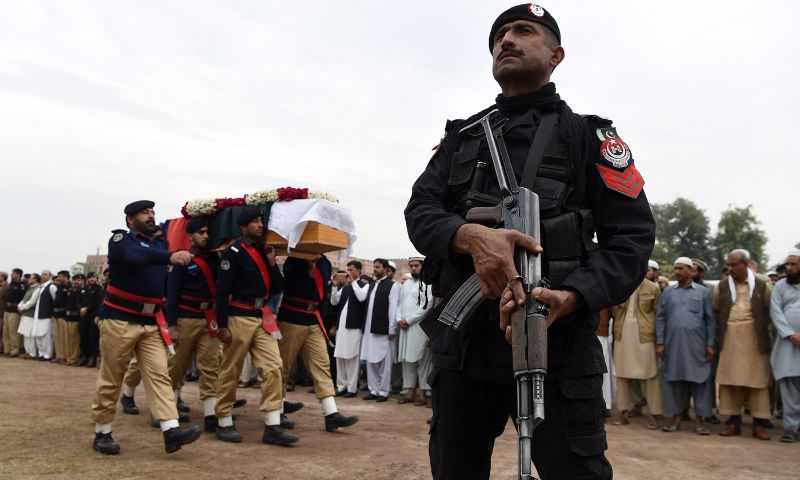
Kashif Khan, 40, lost his 32-year-old brother, Muhammad Sulaiman, in the devastating January 30, 2023 suicide bombing at the mosque in Peshawar Police Lines, which killed more than 80 people.
Sulaiman had served in the police force for 14 years and left behind a widow and a six-month-old daughter.
“I treated him like a son rather than a younger brother. We were always together, and his loss has left a void that can never be filled,” Kashif says.
More than three years later, the pain remains fresh. While Kashif admits he is completely in the dark regarding the specifics of the government’s new security plan, his demands are simple: the total elimination of militants and strict action by security forces.